
The Western Balkans
Serbian president Aleksandar Vučić has accused Croatia, Albania, and Kosovo of planning to attack Serbia. Serbia has acquired Chinese CM-400 air-to-surface missiles. This has worsened relations between Croatia and Serbia and triggered a security dilemma. At the same time, Vučić and the Albanian Prime Minister Edi Rama have put forward a joint proposal for the admission of Western Balkan countries into the Schengen Area and for access to the EU single market. In regards to the conflicts in the Middle East, the countries of the Western Balkans have sought to position themselves in a way that does not directly oppose the position of the United States but also maintains some commonality with the position of the EU members. Marta Kos, the European Commissioner for Enlargement, visited Montenegro. She confirmed that Montenegro is the most advanced candidate for membership, but that it has still not met the rule of law requirements. Disagreements and a lack of understanding among parliamentary parties in Montenegro remain highly pronounced.
1. Serbia and Croatia: Deteriorating Relations
The President of Serbia, Aleksandar Vučić, stated that Croatia, Albania, and Kosovo had formed a military alliance against Serbia and were merely waiting for favourable circumstances to launch an attack.[1] During the same period, information came to the forefront that Serbia had purchased Chinese CM-400 hypersonic air-to-surface missiles.[2] This triggered debates in Croatia about the readiness of the Croatian Armed Forces and its air defence capabilities. Zoran Milanović, the President of Croatia, and Ivan Anušić, Deputy Prime Minister and Minister of Defence, found themselves at odds over the procurement of an air defence system. Milanović opposed the acquisition of the Israeli David’s Sling system, which, in any case, will not be implemented. The reason cited is a ban on cooperation between the Croatian and Israeli armed forces, while Milanović also highlighted the fact that Israel is supplying arms to Serbia, which is currently perceived in Croatia as a security concern.[3] Serbia is purchasing advanced artillery systems, unmanned systems, long-range missiles, and electronic warfare systems from the Israeli company Elbit Systems.[4]
A session of the Croatian National Security Council was also convened, for the first time since 2021, as well as a meeting of the Defence Council of the Republic of Croatia, although Serbia’s armament purchases was not explicitly listed among the agenda items or reasons for convening the sessions.[5] Officially, the sessions were convened due to the need to discuss the consequences of the war in the Middle East, its impact on energy prices, and other issues of importance for national security, as well as to address the strengthening of the defence capabilities of the Republic of Croatia, particularly the equipping and modernisation of the Croatian Armed Forces.[6]
The Brdo-Brijuni Summit, a process initiated in 2010 by the Slovenian Prime Minister Borut Pahor and the Croatian Prime Minister Jadranka Kosor, was scheduled to take place in May of this year. At the core of this initiative lies regional cooperation among the countries of the Western Balkans, the peaceful resolution of disputes, and support for these nations in their process of European Union integration.[7] However, at the end of March 2026, Milanović cancelled the meeting of the Brdo-Brijuni Process, which was supposed to take place in Croatia, explaining that the statements and actions of the Serbian President violate good neighbourly relations and contradict the purpose of the initiative. [8]
An indicator of the deteriorating relations that preceded all the above was an advice issued in the first week of March on the website of the Ministry of Foreign Affairs of the Republic of Serbia. Namely, citizens are advised to travel to Croatia only in emergencies and to avoid organized trips to sporting and cultural events.[9]
However, tensions and actions detrimental to good neighbourly relations remained mainly between Serbia and Croatia. In other countries of the region, reactions were less publicly pronounced, including reactions to the purchase of CM-400 missiles.
1.1 Contours of the Security Dilemma
A regional arms race has not yet occurred, but the contours of a security dilemma are emerging. From Serbia’s perspective, the question is why Croatia, Kosovo, and Albania signed the Declaration on Cooperation. For Serbia, support for Kosovo is, of course, problematic. From the perspective of neighbouring countries, the question is why Serbia is acquiring missiles with a range of up to 400 kilometres — sufficient to reach their territory.
It is important to note that Croatia, Kosovo, and Albania have not formed a military alliance. The three-page Declaration expresses these countries’ commitment to cooperation in developing defence capabilities, conducting joint exercises, exchanging intelligence, and countering hybrid threats and foreign malign influence. The Declaration does not establish any mutual obligations, nor does it create a mechanism of collective defence.[10] For Croatia, it is important to support Kosovo on its Euro-Atlantic path, thereby reducing the likelihood that Serbia might at some point pursue territorial ambitions toward its former province.
Within a security dilemma, cooperation and support are difficult to achieve, while maintaining correct relations is equally challenging. At present, neither of these exists between Serbia and Croatia.
Although Aleksandar Vučić’s accusations that Serbia will be attacked also refer to Albania, this statement has not escalated tensions between the two countries. Quite the opposite, in fact.
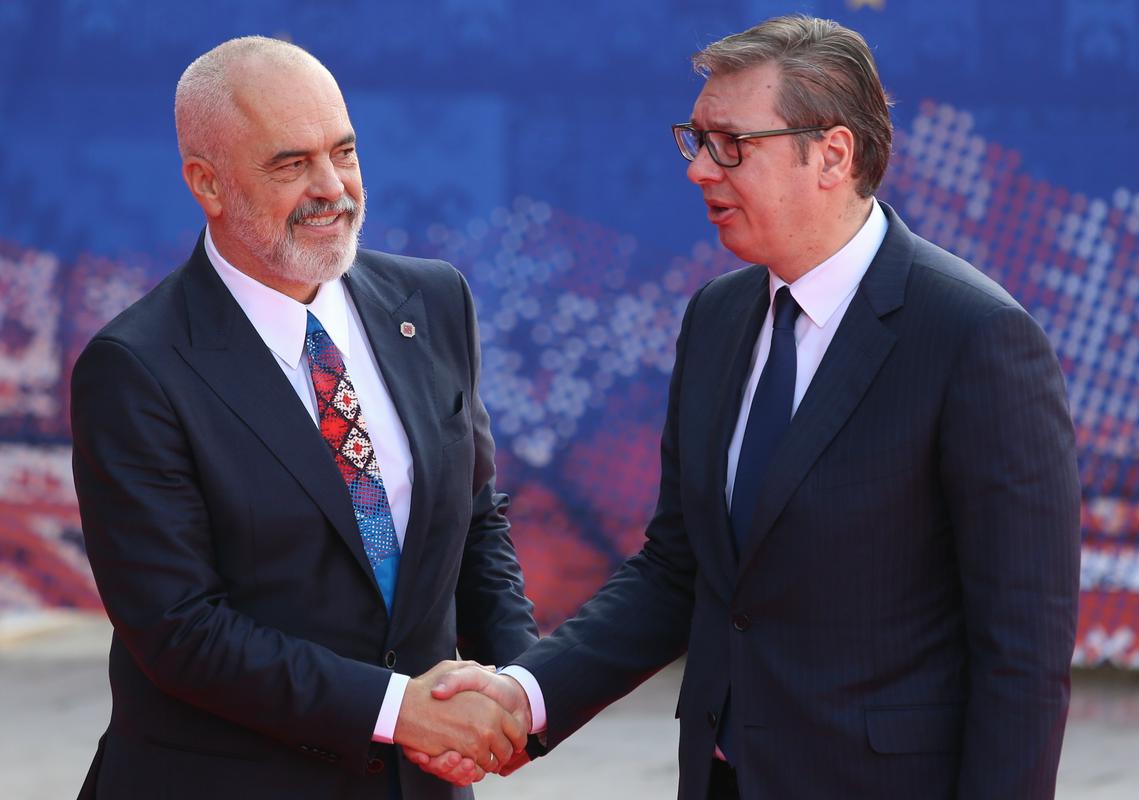
Aleksandar Vučić and Edi Rama, the Prime Minister of Albania, even addressed a letter to the European Union via the Frankfurter Allgemeine Zeitung , proposing the inclusion of Western Balkan countries in the Schengen Area and access to the single market without full membership.[11] Serbia offered this proposal although it is amongst those that have not made significant progress under Cluster 1 (fundamentals) of the reforms required for EU membership.
Because it is an EU member, Croatia could block this initiative, as it would not want open borders with Serbia due to strained relations. However, accession to the Schengen Area and the single market without full membership is not an option under formal negotiation, meaning Croatia will not have the opportunity to block it. Therefore, it is likely that the deterioration of relations between Croatia and Serbia primarily serves domestic political purposes.
As a side note, even if such an option were accepted, it would not be suitable for Montenegro, which is projected to potentially become a full member by 2028 and is regarded by the EU as the most advanced candidate.
2. War in the Middle East and the Positioning of the Countries of the Western Balkans
Regarding the attacks by Israel and the United States on Iran, as well as Iranian counterstrikes in the region, the reactions of Western Balkan countries varied in wording and intensity. However, in practice, no country remained truly neutral or expressed support for Iran and its regime. Albania[12], North Macedonia[13], and Kosovo[14] explicitly supported the US and Israel. Reactions from Serbia, Montenegro, and Bosnia and Herzegovina (BiH) largely stressed the importance of peace without clear or unequivocal alignment.
Ultimately, all Western Balkan countries endorsed the draft United Nations Security Council Resolution 2817 (2026), condemning attacks by the Islamic Republic of Iran on Bahrain, Kuwait, Oman, Qatar, Saudi Arabia, the United Arab Emirates, and Jordan, as well as the closure of the Strait of Hormuz.[15] However, the media most frequently highlighted BiH as a co-sponsor because its Presidency failed to reach a consensus on supporting the resolution. Željko Komšić, the member of the BiH Presidency from the Croatian constituency, argued that it was unnecessary for BiH to support a resolution condemning only one side, disregarding the fact that Iran is the attacked country.[16]
In March, media reports indicated that the EU High Representative for Foreign Policy, Kaja Kallas, stated that Albania, BiH, Montenegro, North Macedonia, and Serbia had aligned with the decision of the European Council to list the Iranian Islamic Revolutionary Guard as a terrorist organisation.[17]
Ultimately, the Western Balkan countries adopted positions ensuring that they would not oppose the US or diverge from common EU positions. The US is regarded in BiH and Kosovo as a guarantor of stability and a key driver of institutional development and state-building. In this context, the positions of the Western Balkan countries were predictable, despite the diverse, and sometimes entirely opposing, sentiments of their populations. The reasons for such sentiments should not be sought solely in the shared religious affiliation of part of the population, but rather in specific historical events and circumstances. In the case of population in BiH, mainly Bosniaks (Muslims), solidarity with Iran stems from the fact that Iran supplied weapons to the Army of Bosnia and Herzegovina during the war in BiH (the official armed forces of the internationally recognized Republic of BiH)[18]. These deliveries were significant because an arms embargo on Yugoslavia had been in place since 1991 (UN Security Council Resolution 713), which left the Army of BiH short of weapons[19]. In the case of the Serb population, solidarity arises from the experience of NATO’s Operation Allied Force (1999), during which the Federal Republic of Yugoslavia (Serbia with Kosovo and Montenegro) was bombed.[20]
3. Marta Kos Visits Montenegro
The European Commissioner for Enlargement, Marta Kos, visited Montenegro from 26 to 27 March 2026. She identified Montenegro as the most advanced candidate country but emphasised that the rule of law has still not been fully achieved and must remain Montenegro’s absolute priority. The importance of cooperation among the government, opposition, and civil society was underlined.[21]
Contrary to the emphasised need for cooperation, opposition parties did not accept an invitation from Prime Minister Milojko Spajić to a joint meeting to discuss the adoption of laws from the European agenda, which was scheduled prior to Marta Kos’s visit. Opposition parties cited various reasons for their absence and set conditions for possible attendance, but the underlying message was that such a meeting merely creates an appearance of harmony among Montenegro’s parliamentary parties and an impression of normality.[22] Representatives of the opposition Democratic Party of Socialists (DPS) met separately with the commissioner.[23] Although Marta Kos made statements that were encouraging and complimentary towards Montenegro, she did not promise timelines for the conclusion of negotiations or Montenegro’s accession.
The opposition in Montenegro, which is ideologically and ethnically diverse, does not openly hold anti-European positions. Nevertheless, it believes that the ruling coalition is creating the appearance of progress and that the optimism expressed regarding Montenegro’s advancement does not reflect the country’s actual situation.
On 6 March 2026, the Parliament of Montenegro adopted two laws, the provisions of which are not seen as being aligned with EU legal standards: the Law on the National Security Agency and the Law on Internal Affairs. Specifically, the laws are not aligned with the General Data Protection Regulation (GDPR) and the Directive on Criminal Enforcement (LED).[24] The Law on the National Security Agency has been contested, among other reasons, because it allows access to the databases of all state authorities, local self-government units, and legal entities without the need for a judicial warrant. Unlike EU rules, this Law does not define specific purpose of such data collection, nor are sensitive categories of data specified, such as health data.[25] The Law on Internal Affairs, for example, introduces a security risk as a direct ground for dismissal, without the conduct of disciplinary proceedings. This restricts the right to defence and circumvents the presumption of innocence.[26] As a result, President Jakov Milatović returned them for reconsideration, but the Parliament re-adopted them on 19 March 2026, without removing the disputed provisions. According to the EU Delegation in Montenegro, the provisions of these laws can still be aligned later, but certainly before the closure of Chapters 23 (Justice and Fundamental Rights) and 24 (Justice, Freedom, and Security), which belong to Cluster 1 (Fundamentals) and form the foundation of the rule of law. The opposition opposed the adoption of the laws, labelling them repressive, and they received significant criticisms also from the civil society.
* Views and opinions of the authors of this paper do not necessarily correspond to the views of the Euro-Atlantic Council of Slovenia.
Sources
[1] Vučić, A. (12.3.2026). Četvrtkom u 9. [Video]. YouTube. https://youtu.be/d5DBOFwRVIk?t=1224
[2]Reuters. (13.3.2026). NATO-partner Serbia admits buying Chinese missiles after photos leaked. https://www.reuters.com/business/aerospace-defense/nato-partner-serbia-admits-buying-chinese-missiles-after-photos-leaked-2026-03-13/
[3] RTL. (25.3.2026). RTL Danas. [Video]. YouTube. https://www.youtube.com/watch?v=2H7tWesMzJg
[4] BalkanInsight (7.4.2026). Serbia Poised to Produce Drones with Israeli Arms Giant Involved in Gaza. https://balkaninsight.com/2026/04/07/serbia-poised-to-produce-drones-with-israeli-arms-giant-involved-in-gaza/bi/
[5]HRT. (1.4.2026). Održane sjednice Vijeća za nacionalnu sigurnost i Vijeća za obranu. https://vijesti.hrt.hr/hrvatska/vijece-za-nacionalnu-sigurnost-sastaje-se-nakon-vise-od-cetiri-godine-12649037
[6] Ured Vijeća za nacionalnu sigurnost (1.4.2026). Održane sjednica vijeća za nacionalnu sigurnost i odbranu. https://www.uvns.hr/hr/aktualnosti-i-obavijesti/odrzane-sjednice-vijeca-za-nacionalnu-sigurnost-i-vijeca-za-obranu
[7] Friends of Western Balkans (n.d.). Brdo-Brijuni Proces / Brdo-Brijuni Process. https://www.fowb.si/doseki-/-achievements/project-three-ef48g
[8]HRT. (30.3.2026). Milanović: Nema uvjeta za dolazak Vučića, otkazan Proces Brdo-Brijuni. https://vijesti.hrt.hr/hrvatska/milanovic-otkazan-proces-brdo-brijuni-vucicev-dolazak-neprikladan-12645977
[9]Ministarstvo spoljnih poslova Republike Srbije. Vize i saveti za putovanja. https://www.mfa.gov.rs/gradjani/putovanje-u-inostranstvo/vize-i-informacije-o-drzavama/hrvatska
[10] Ministry of Defence of the Republic of Albania, Ministry of Defence of the Repulic of Croatia and Ministry of Defence of the Republic of Kosova. (18.3.2025). Joint Declaration.
[11]Euronews. (11.32026). Serbia and Albania issue joint text on EU accession without veto. https://www.euronews.com/2026/03/11/serbia-and-albania-issue-joint-text-on-eu-accession-without-veto
[12] Tirana Times. (28.2.2026). Albania Backs U.S. Strikes on Iran. https://www.tiranatimes.com/albania-backs-u-s-strikes-on-iran/
[13]MNA. (28.2.2026). Mucunski: We stand with our American allies in confronting Middle East threats. https://mia.mk/en/story/mucunski-we-stand-with-our-american-allies-in-confronting-middle-east-threats?utm_source=chatgpt.com
[14] Kossev. (28.2.2026). The Kosovo MFA supported the US in the attack on Iran, and “with the Iranian people in the fight for freedom and democracy”. https://kossev.info/en/kosovski-mip-podrzao-sad-u-napadu-na-iran-a-uz-iranski-narod-u-borbi-za-slobodu-i-demokratiju/?utm_source=chatgpt.com
[15] United Nations Security Council. (11.3.2026). Draft resolution [on condemning attacks by the Islamic Republic of Iran against Bahrain, Kuwait, Oman, Qatar, Saudi Arabia, the United Arab Emirates and Jordan]. https://digitallibrary.un.org/record/4105561?ln=en&utm_source=chatgpt.com&v=pdf#files
[16]Euronews. (12.3.2026). Komšić: Bespotreban čin, Lagumdžiji sam više puta rekao da BiH ne treba kosponzorisati rezoluciju o osudi Irana. https://euronews.ba/bosna-i-hercegovina/aktuelno/53027/komsic-bespotreban-cin-lagumdziji-sam-vise-puta-rekao-da-bih-ne-treba-kosponzorisati-rezoluciju-o-osudi-irana
[17] European Western Balkans. (17.3.2026). Western Balkan countries split between neutrality and the support to USA. https://europeanwesternbalkans.com/2026/03/17/western-balkan-countries-split-between-neutrality-and-the-support-to-usa/?utm_source=chatgpt.com
[18] Deutsche Welle. (9.12.2022). Iranski uticaj u BiH. https://www.dw.com/bs/iranski-uticaj-u-bih/a-64033394
[19] United Nations Security Council (25.9.1991). Security Council resolution 713 (1991) [imposing a general and complete embargo on all deliveries of weapons and military equipment to Yugoslavia]. https://digitallibrary.un.org/record/126827?v=pdf
[20] Human Rights Watch (n.d.). The Crisis in Kosovo. https://www.hrw.org/reports/2000/nato/Natbm200-01.htm
[21]Vijesti Online. (26.3.2026). VIJESTI U POLA 7 – SPAJIĆ I MARTA KOS EU | Vijesti online. [Video]. YouTube. https://www.youtube.com/watch?v=y2-H4_ZFviI
[22]Vijesti Online. (25.3.2026). Spajić: Predstavnike opozicije će sačekati kafa i kolač. https://www.vijesti.me/vijesti/politika/801772/spajic-predstavnike-opozicije-ce-sacekati-kafa-i-kolac
[23] CDM. (27.3.2026). Živković i Vuković Kuč sa Martom Kos: Saradnja sa opozicijom presudna za uspjeh evropske integracije. https://www.cdm.me/politika/zivkovic-i-vukovic-kuc-sa-martom-kos-saradnja-sa-opozicijom-presudna-za-uspjeh-evropske-integracije/
[24]Radio Slobodna Evropa. (19.3.2026). Skupština Crne Gore ponovo usvojila Zakone koje je predsednik države vratio. https://www.slobodnaevropa.org/a/skupstina-crna-gora-zakoni-anb-unutrasnji-poslovi/33710716.html
[25] Radio Slobodna Evropa (11.3.2026). Usklađivanje ili raskorak? Brisel kritikuje Podgoricu zbog odredbi novog zakona o ličnim podacima. https://www.slobodnaevropa.org/a/licni-podaci-crna-gora-zakoni-kritike-eu/33701993.html
[26] President of Montenegro (9.3.2000). Predsjednik države vratio Zakon o unutrašnjim poslovima: Za reformu policije, ali kroz ustavan i evropski usklađen zakon. https://predsjednik.me/en/press/article/predsjednik-drzave-vratio-zakon-o-unutrasnjim-poslovima-za-reformu-policije-ali-kroz-ustavan-i-evropski-uskladen-zakon