

The Iran Conflict
In March 2026, the escalating war between Israel and the United States on one side and Iran and Axis of Resistance, pro-Iranian network of paramilitary groups, on the other drew the most attention in the Middle East. After a month of airstrikes on Iranian targets, several key regime figures were killed, and a large number of Iranian ballistic missiles, drones were destroyed, along with military and industrial infrastructure, critical to Iran’s weapons programs. Iran and its allies responded to US-Israeli strikes with drone and missile strikes against military and civilian targets primarily in Israel and the Gulf states. This report will specifically focus on US-Israeli airstrike campaign on Iranian territory and Iranian / Axis of Resistance response to the attacks.
1. US-Israeli Airstrike Campaign
On 28 February 2026, acting upon orders of the President of the United States Donald Trump, the US Central Command (CENTCOM) commenced ”Operation Epic Fury” to dismantle the Iranian regime’s security apparatus, prioritizing locations that pose imminent threat, according to CENTCOM.[1] In strategic coordination with CENTCOM, the Israeli Defence Forces (IDF) launched ”Operation Roaring Lion” to prevent the development of nuclear weapons, eliminate key offensive assets, and senior security leadership of Iranian regime, according to the IDF.[2] The beginning of the joint US-Israeli airstrike campaign followed weeks of military build-up in the Middle East that turned into one of the largest regional concentration of US military firepower.[3]
CENTCOM deployed a sizeable amount of US air, ground and naval assets for the operation, including B-1 and B-52 bombers, B-2 stealth bombers, F-15, F-16 and F-18 fighter jets, F-22 and F-35 stealth fighter jets, A-10 attack jets, EA-18G and EC-130H electronic warfare aircraft, U-2 and RC-135 reconnaissance aircraft, E-2D airborne early warning & control aircraft, E-11A communications aircraft, C-130J cargo aircraft, C17 Globemaster cargo aircraft, KC-46 and KC-135 refuelling aircraft, KC-130 Hercules tankers, AH-64 Apache helicopters, MH-60 Sea Hawk helicopters, V-22 Osprey tilt-rotor aircraft, MQ-9 surveillance and attack drones, LUCAS one-way attack drones, multiple nuclear-powered aircraft carriers and submarines, guided-missile destroyers, refuelling and supply ships, an amphibious assault ship and transport dock ship, M-142 high mobility artillery rocket systems, Patriot interceptor missile systems, THAAD anti-ballistic missile systems, and various counter-drone systems.[4]
Since the beginning of the airstrike campaign there has been multiple speculations if the U.S. is planning limited ground operations in Iran, particularly to seize crucial oil facilities on Kharg Island, since Pentagon announced it would sent 1.000 troops from the 82nd Airborne division and two U.S. Marine Corps (USMC) units consisting of 5.000 troops and thousands of sailors to the region, where more than 50.000 U.S. troops were actively participating in the operation.[5] By the end of the month, these speculations appeared to be more plausible, as President Trump issued a series of threats to Iran with deployment of ground troops to capture Kharg Island. Security experts warned that such operation would risk large numbers of American lives and most likely still fail to end the war, since the island’s location is unfavourable for amphibious operations.[6]
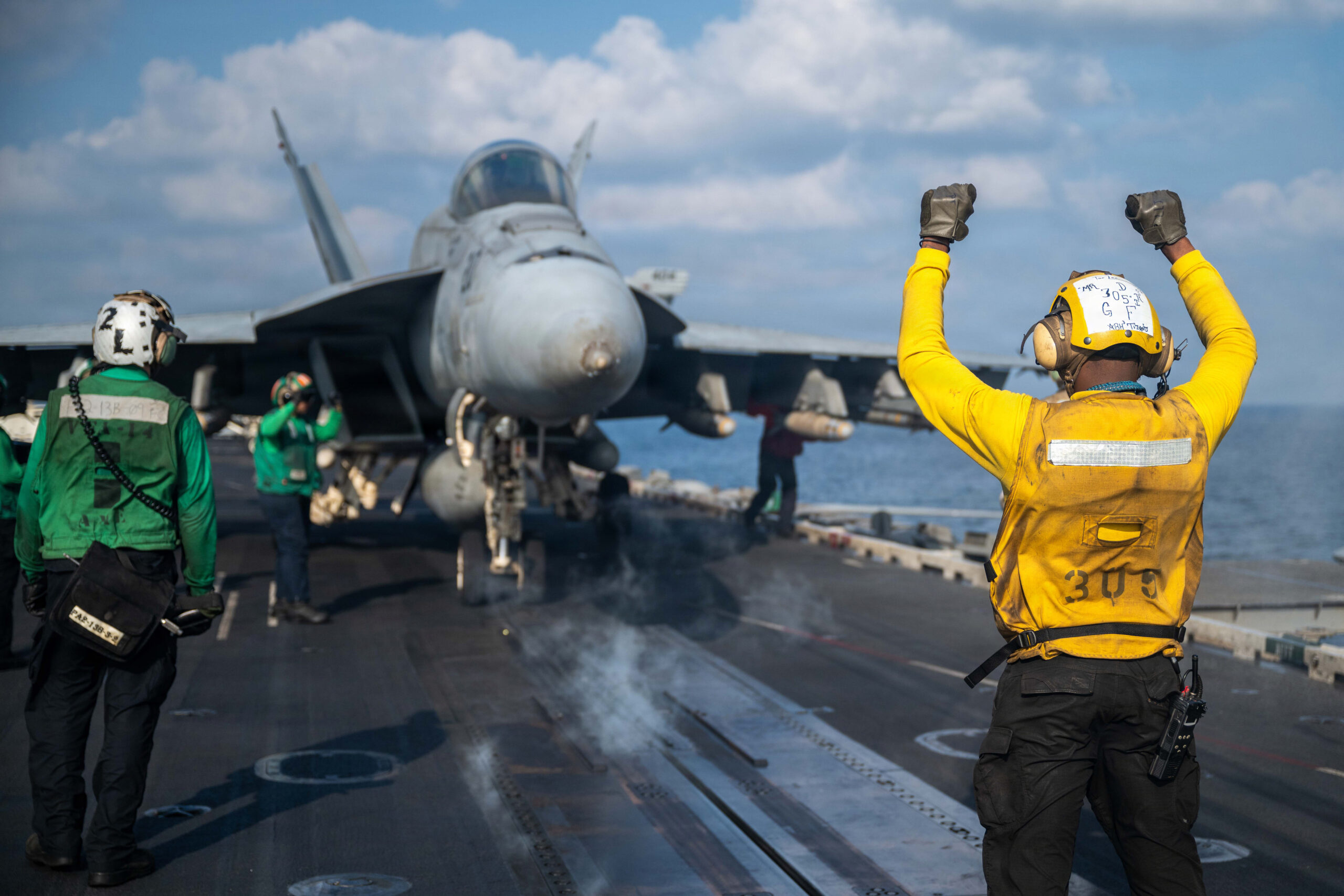
”Operation Epic Fury” proved to be a very expensive military endeavour. In the first six days, the operation cost around $11.3 billion, while predictions made by the Center for Strategic and International Studies suggest that by day 12 of the operation the cost would increase to $16.5 billion.[7] One of the most significant indicators of rising costs was the amount of Tomahawk long-range cruise missiles used against Iran. U.S. fired more than 850 Tomahawks in the first four weeks of the operation, each missile costing $3.6 million per shot. Experts suggested that while the existing Tomahawk stockpile holds approximately 3.000 missiles, further expenditure could weaken U.S. military posture in the Western Pacific.[8]
13 U.S. service members were killed since the beginning of the ”Operation Epic Fury.”[9] The U.S. also lost several aircraft including three F-15 fighter jets that were mistakenly shot down by Kuwaiti air defences on 1 March 2026 and KC-135 refuelling aircraft that was lost neither to hostile nor friendly fire over airspace in western Iraq on 12 March 2026. While all three F-15 pilots survived, all six service members aboard KC-135 were killed.[10]
1.1 Primary targets of airstrike campaign
Multiple high-ranking officials of the Iranian government and security apparatus were killed during the first month of the operation, including Iran’s Supreme leader Ayatollah Ali Khamenei who died during an airstrike on 28 February 2026, and was reportedly replaced by his son, Mojtaba Khamenei. Other high-ranking Iranian officials that were killed throughout ”Operation Epic Fury” include Security Chief Ali Larijani, Islamic Revolutionaey Guard Corps (IRGC) Commander-in-Chief Mohammad Pakpour, IRGC Naval Chief Alireza Tangsiri, Adviser Ali Shamkhani, Intelligence Minister Esmail Khatib, Defence Minister Aziz Nasirzadeh, IRGC Basij militia Commander Gholamreza Soleimani, IRGC Spokesperson Ali Mohammad Naini, Head of the Military Office Mohammad Shirazi and Armed Forces Chief Abdolrahim Mousavi.[11]
U.S. and Israeli airstrikes targeted Iranian command and control centres, ballistic missile sites, integrated air defence systems, weapons production and storage bunkers, anti-ship missile sites, surface-to-air missile facilities, military support infrastructure, military communication capabilities, ballistic missile and drone manufacturing facilities, IRGC headquarters buildings, IRGC intelligence sites, Iranian Navy ships and submarines, key Iranian nuclear programme sites along with oil and gas production and refinement infrastructure.[12]
On 31 March 2026, CENTCOM Commander U.S. Navy Admiral Brad Cooper stated that after more than four weeks of ”Operation Epic Fury,” the U.S. forces managed to destroy most of the Iranian drone, missile and naval capabilities.[13] On the same day, the U.S. chairman of the Joint Chiefs of Staff, Air Force General Dan Caine reaffirmed that the primary targets of the ”Operation Epic Fury” would remain Iranian naval forces and their mine-laying capabilities as well as the Iranian defence industrial base – drone, missile and naval production facilities, factories, warehouses, nuclear weapons research and development labs and other important infrastructure for Iran to rebuild its combat capabilities, especially logistical and supply chains that enable these military efforts.[14]
CENTCOM reported that in March 2026, U.S. forces struck more than 12.300 targets in Iran, conducted more than 13.000 combat flights and damaged or destroyed more than 155 Iranian naval vessels.[15] By the end of the month, the airstrike campaign settled into a steady pace of bombing between 300 and 500 targets per day.[16]
OSINT analysts suggest that Iranian missile arsenal was degraded rather than exhausted, while Iranian ability to produce missile propellant and new missiles was temporary halted. Israeli sources claimed that more than 70% of missile launchers were destroyed. U.S. military assessed that it destroyed about one third of Iranian stockpile of ballistic missile and damaged or made inaccessible another third. The status of Iranian drone capabilities has been far more ambiguous, even after multiple confirmed destructions of drone storage sites and production facilities by U.S.-Israeli airstrikes. Iran’s nuclear programme was not amongst the primary targets at the start of the war, but targets related to it were progressively included as the strikes continued. Several locations connected to Iranian nuclear efforts were targeted, while more than 400 kilograms of weapons-grade uranium (enriched to 60% purity) remains somewhere in Iran.[17]
2. Iran & Axis of Resistance Response
Throughout March 2026, Iran managed to maintain a steady rate of missile and drone strikes against military, infrastructure and civilian targets in Israel and the Gulf states, where a fair number of Iranian ballistic missiles managed to penetrate local air defences. However, U.S. commanders stated that they managed to destroy up to 90% of the assessed pre-war Iranian drone and missile launchers since the start of the war.[18] As the war continued, Iran expanded its strikes against major energy infrastructure, mostly oil and gas fields, processing facilities and port terminals in Qatar, UAE and Saudi Arabia.[19]
Iran steadily increased the use of cluster munition warheads for maximizing damage in its attacks. Its attacks have also demonstrated that Iran possesses ballistic missiles with longer range than previously thought, as it was seen on 21 March 2026 with two ballistic missiles launched against UK military base on Diego Garcia in the Indian Ocean. Iran likely still possesses between a few hundred and a couple of thousand missiles from its pre-war stockpile.[20]
Long-range one-way attack drones like the Shahed-136 were deployed en masse by Iran during first month of the conflict and were responsible for the majority of the damage inflicted against the Gulf state’s infrastructure, as well as commercial vessels passing through the Strait of Hormuz. It was reported that Russia is providing Iran with drone warfare advice, drone components, and shipments of Geran-2 drones, an improved version of the Shahed-136 which Iran supplied to Russia early during the Russia-Ukraine war.[21]
Iran managed to very effectively close the Strait of Hormuz and consequentially caused a global energy shock, forcing the International Energy Agency (IEA) to release 400 million barrels of oil from its strategic reserve.[22] Reopening of the strait became one of the most important points of the conflict, since around 20% of global oil and gas moves through it. Iran’s blockade functions primarily by forcing ships to enter Iranian waters, be vetted by an IRGC inspection, and reportedly to pay a passage toll. Maritime traffic through the strait has dropped by 90% since the start of the war, while at least 18 commercial ships were hit by Iranian strikes.[23] On 27 March 2026, by request of the UN, Iran allowed humanitarian aid and agriculture shipments through the strait.[24]
Hezbollah has shown solidarity with its sponsor by joining the conflict with firing multiple rockets at Israeli territory. The attack resulted in renewed Israeli ground operations in Lebanon and significant fighting between IDF and Hezbollah fighters.[25]
Iranian-backed Yemeni Houthi rebels joined the conflict on 28 March 2026, by firing two ballistic missiles at supposedly military targets in southern Israel. Their involvement could further complicate global shipping routes if they renew their attacks on commercial ships in the Red Sea, specifically in the Bab el-Mandeb Strait, where 12% of global maritime trade normally passes through.[26]
3. March 2026 Operation Epic Fury Assessment
The joint US-Israeli airstrike campaign (”Operation Epic Fury” / ”Operation Roaring Lion”) managed to inflict high losses to the Iranian senior leadership, its missile and drone capabilities, air defence systems, internal security apparatus and naval forces. Nevertheless, it appears that the damage inflicted will not result in either a sudden Iranian surrender or regime collapse. Iran still possesses significant amounts of different types of munitions and drones that could be used to damage or destroy critical infrastructure in the Gulf States and Israel, while its network of proxy paramilitary forces is slowly entering the conflict and expanding the existing fronts. Ever growing instability accompanying the war will have negative impact not just on the Middle East but also on global scale, especially with the economic consequences of the closure, and slow re-opening of the Strait of Hormuz.
* Views and opinions of the authors of this paper do not necessarily correspond to the views of the Euro-Atlantic Council of Slovenia.
Sources
[1] US Central Command, ”U.S. Forces Launch Operation Epic Fury,” press release, (28.2.2026), https://www.centcom.mil/MEDIA/PRESS-RELEASES/Press-Release-View/Article/4418396/us-forces-launch-operation-epic-fury/
[2] ”Operation Roaring Lion: A Historic Stand for Regional Stability,” Friends of the Israel Defense Forces, (28.2.2026), https://www.fidf.org/operation-roaring-lion-idf-emergency-briefing/
[3] Center for Preventive Action, ”Iran’s War With Israel and the United States,” Global Conflict Tracker, (2.4.2026), https://www.cfr.org/global-conflict-tracker/conflict/confrontation-between-united-states-and-iran
[4] US Central Command (@CENTCOM), ”Operation Epic Fury: April 1st Update,” X, (2.4.2026, 2:08 am), https://x.com/CENTCOM/status/2039495178713522632
[5] Jon Gambrell, Aamer Madhani, Samy Magdy and David Rising, ”Trump administration offers 15-point ceasefire plan to Iran,” AP News, (25.3.2026), https://apnews.com/article/iran-us-israel-trump-lebanon-march-24-2026-8bb5e79a98ea72fccc5c50b4931ad778; US Central Command Public Affairs, ”CENTCOM Commander Provides Update on Operation Epic Fury,” US Central Command Video, (31.3.2026), https://www.centcom.mil/OPERATIONS-AND-EXERCISES/EPIC-FURY/
[6] Ben Finley and Sam Metz, ”Seizing Kharg Island would risk US troops’ lives and may not end Iran war, experts say,” AP News, (31.3.2026), https://apnews.com/article/kharg-island-seize-ground-troops-oil-iran-4244166c19dd33689f8a59e96e1d7d5b
[7] Mark F. Cancian and Chris H. Park, ”Iran War Cost Estimate Update: $11.3 Billion at Day 6, $16.5 Billion at Day 12,” Center for Strategic and International Studies, (13.3.2026), https://www.csis.org/analysis/iran-war-cost-estimate-update-113-billion-day-6-165-billion-day-12
[8] Mark F. Cancian and Chris H. Park, ”The 850 Tomahawks Launched in Operation Epic Fury Is the Most Fired in a Single Campaign,” Center for Strategic and International Studies, (27.3.2026), https://www.csis.org/analysis/850-tomahawks-launched-operation-epic-fury-most-fired-single-campaign
[9] BBC Persian, Emily Atkinson, Raffi Berg, Robert Greenall, Olivia Ireland, Hafsa Khalil, Jaroslav Lukiv, Mallory Moench and Gabriela Pomeroy, ”Why did US and Israel attack Iran and how long could the war last?” BBC, (1.4.2026), https://www.bbc.com/news/articles/cx2dyz6p3weo
[10] US Central Command, ”Three U.S. F-15s Involved in Friendly Fire Incident in Kuwait; Pilots Safe,” press release, (2.3.2026), https://www.centcom.mil/MEDIA/PRESS-RELEASES/Press-Release-View/Article/4418568/three-us-f-15s-involved-in-friendly-fire-incident-in-kuwait-pilots-safe/; US Central Command, ”All Crew Members of U.S. KC-135 Loss in Iraq Confirmed Deceased,” press release, (13.3.2026), https://www.centcom.mil/MEDIA/PRESS-RELEASES/Press-Release-View/Article/4434083/all-crew-members-of-us-kc-135-loss-in-iraq-confirmed-deceased/
[11] ”’Regime change’? The Iranian leaders killed in Israeli-US war,” France 24, (30.3.2026), https://www.france24.com/en/live-news/20260330-regime-change-the-iranian-leaders-killed-in-israeli-us-war
[12] ”Operation Epic Fury Fact Sheet, March 23, 2026,” US Central Command, (23.3.2026), https://www.centcom.mil/Portals/6/Documents/Publications/260323-Operation Epic Fury Fact Sheet.pdf?ver=ezk_KiJvld1N84sCwrTJEg%3d%3d; BBC Persian, Emily Atkinson, Raffi Berg, Robert Greenall, Olivia Ireland, Hafsa Khalil, Jaroslav Lukiv, Mallory Moench and Gabriela Pomeroy, ”Why did US and Israel attack Iran and how long could the war last?” BBC.
[13] US Central Command Public Affairs, ”CENTCOM Commander Provides Update on Operation Epic Fury,” US Central Command Video.
[14] C. Todd Lopez, ”Hegseth Impressed With Centcom Troops, ‘Wartime Speed’ During Epic Fury,” US Department of War, (31.3.2026), https://www.war.gov/News/News-Stories/Article/Article/4448202/hegseth-impressed-with-centcom-troops-wartime-speed-during-epic-fury/
[15] US Central Command (@CENTCOM), ”Operation Epic Fury: April 1st Update,” X.
[16] Mark F. Cancian and Chris H. Park, ”Assessing the Air Campaign After Three Weeks: Iran War By the Numbers,” Center for Strategic and International Studies, (25.3.2026), https://www.csis.org/analysis/assessing-air-campaign-after-three-weeks-iran-war-numbers
[17] Iran Watch, ”Iran War: Weapon Programs One-Month Update,” Wisconsin Project on Nuclear Arms Control, (31.3.2026), https://www.iranwatch.org/our-publications/articles-reports/iran-war-weapon-programs-one-month-update
[18] Iran Watch, ”Iran War: Weapon Programs One-Month Update,” Wisconsin Project on Nuclear Arms Control.
[19] Jon Gambrell, Sam Metz and Julie Watson, ”Strikes hit world’s largest natural gas field in Iran, and Tehran retaliates with more attacks,” AP News, (19.3.2026), https://apnews.com/article/iran-iraq-us-israel-trump-march-18-2026-d7ca062ba1bf99d1f8dc00c8073cf10f
[20] Iran Watch, ”Iran War: Weapon Programs One-Month Update,” Wisconsin Project on Nuclear Arms Control; BBC Persian, Emily Atkinson, Raffi Berg, Robert Greenall, Olivia Ireland, Hafsa Khalil, Jaroslav Lukiv, Mallory Moench and Gabriela Pomeroy, ”Why did US and Israel attack Iran and how long could the war last?” BBC.
[21] Iran Watch, ”Iran War: Weapon Programs One-Month Update,” Wisconsin Project on Nuclear Arms Control.
[22] Center for Preventive Action, ”Iran’s War With Israel and the United States,” Global Conflict Tracker.
[23] Jon Gambrell and David McHugh, ”Iran starts to formalize its chokehold on the Strait of Hormuz with a ‘toll booth’ regime,” AP News, (27.3.2026), https://apnews.com/article/iran-hormuz-shipping-tolls-china-de5159966cde7de7b964b3c2c67eec07
[24] Jon Gambrell, Aamer Madhani and Samy Magdy, ”Iran-backed Houthis enter the monthlong war and could further threaten global shipping,” AP News, (29.3.2026), https://apnews.com/article/iran-us-israel-trump-lebanon-march-28-2026-0f919596403d2f851196451f4532717e
[25] BBC Persian, Emily Atkinson, Raffi Berg, Robert Greenall, Olivia Ireland, Hafsa Khalil, Jaroslav Lukiv, Mallory Moench and Gabriela Pomeroy, ”Why did US and Israel attack Iran and how long could the war last?” BBC.
[26] Jon Gambrell, Aamer Madhani and Samy Magdy, ”Iran-backed Houthis enter the monthlong war and could further threaten global shipping,” AP News.