
The Western Balkans
In Bosnia and Herzegovina, the Law on the Southern Interconnection has been adopted, establishing a new gas pipeline that will connect the country to the liquefied natural gas terminal on the island of Krk, thereby reducing dependence on the TurkStream pipeline and Russian gas. In Serbia, discussions are underway regarding the construction of an alternative oil pipeline that would connect to the Russian Druzhba oil pipeline; however, for energy security, the most important current issue is the agreement on the sale of Russian stakes in Naftna Industrija Srbije, in order to lift US sanctions imposed on the company. In Kosovo, the Assembly has been dissolved, and snap parliamentary elections have been called for 7 June 2026. The reason for this is the inability of parliamentary parties to elect the President of the country. Montenegro, following encouraging assessments that it is the most advanced candidate country in the Western Balkans, has also received a concrete signal that the European Union’s intentions regarding its accession are serious, although still temporarily uncertain and largely dependent on Montenegro itself. The formation of an ad hoc group for drafting the accession treaty has been approved.
1. Gas and oil supply: new energy infrastructure and accompanying uncertainties
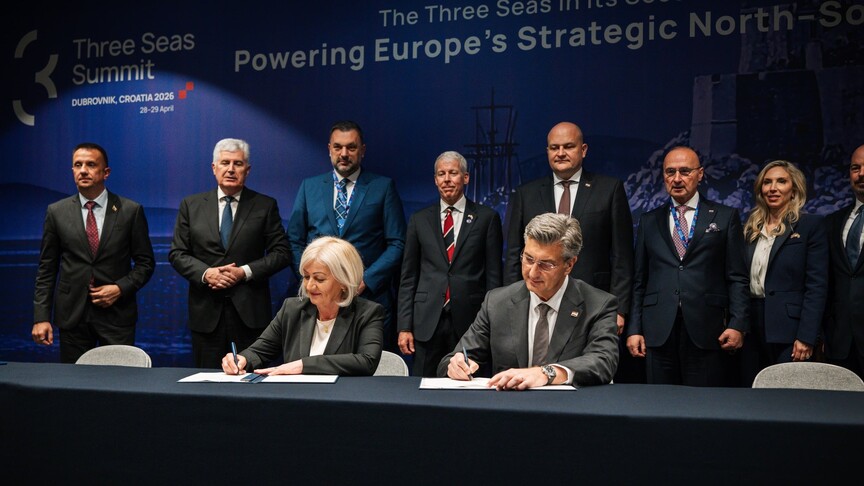
Bosnia and Herzegovina in attempting to finish legal proceedings related to the construction of the Southern interconnection gas pipeline. The Southern Interconnection is a project designed to ensure diversification of gas supply. Through the only existing pipeline, TurkStream, Bosnia and Herzegovina currently receives only Russian gas, via Bulgaria and Serbia.[1] The construction process of the Southern Interconnection is being accelerated by Regulation PE-CONS 63/25 of the European Parliament and of the Council of the European Union, according to which imports of Russian gas into the European Union (EU) are to be completely halted before the beginning of 2028.[2] Since the TurkStream pipeline runs through Bulgaria, the effect of this regulation also impacts Bosnia and Herzegovina. Through the Southern Interconnection, gas will be supplied to Bosnia and Herzegovina from the island of Krk in Croatia, where a liquefied natural gas terminal is located. The gas delivered there originates from the United States, Azerbaijan, Nigeria, Qatar, and others.[3] Bosnia and Herzegovina and Croatia signed an agreement regarding the construction on 28 April 2026.[4]
However, the successful and timely implementation of the project in Bosnia and Herzegovina is still not guaranteed. A temporary Law on the Prohibition of Disposal of State Property, introduced by the High Representative in 2005, is in force.[5] The Parliamentary Assembly of Bosnia and Herzegovina is required to adopt a law that will permanently regulate the issue of state property. The entity of Republika Srpska, however, maintains that assets such as agricultural and forested land, rivers, forests, and other resources belong to the entities. In the entity Federation of Bosnia and Herzegovina, there is broad consensus among most political parties that the state of Bosnia and Herzegovina can be the sole owner of such property, a position that is reflected in the temporary law. However, since this matter has not been permanently resolved, the concession required for the construction of the Southern Interconnection gas pipeline could fall into a legal trap, stalled between different interpretations of who gets to manage public land
Ironically, the project through which Bosnia and Herzegovina is aligning itself with EU regulations has already faced criticism from that very side. Luigi Soreca, Head of the EU Delegation to Bosnia and Herzegovina, sent a letter on 13 April 2026 to the authorities of the country, reminding them of their obligations under the Stabilization and Association Agreement (SAA). One of these obligations is that draft laws must be thoroughly coordinated among the relevant domestic institutions, as well as shared with the services of the European Commission. The purpose of this is to determine at an early stage whether the proposed legislation is in line with EU acquis.[6][7] The content of the letter, as reported in the media, mainly emphasizes the general need to comply with the SAA. However, what is likely truly controversial is the fact that, through a lex specialis, the American company AAFS was designated as the project’s lead developer without a public tender being conducted. Judging by the warning in Soreca’s letter, the services of the European Commission were not consulted regarding this law. Nevertheless, the EU does not oppose the construction of the Southern Interconnection. In order for the gas pipeline in the territory of Bosnia and Herzegovina to be connected to the Krk terminal, Croatia will construct its section on its own territory, from Split to Zagvozd. This construction will only begin after Croatia conducts a market analysis. In addition, the existing agreement between the two countries requires the signing of supplementary agreements, such as an agreement on the minimum booking of transport capacities and on the legal liability of the contracting parties.[8]
Meanwhile, in Serbia, reports have emerged regarding the project to build a second oil pipeline that would connect in Hungary to the Russian Druzhba oil pipeline. This would provide Serbia with an alternative to the JANAF pipeline, through which oil is currently supplied.[9] According to media reports, former Hungarian Prime Minister Viktor Orbán and Serbian President Aleksandar Vučić agreed on this project; however, due to Viktor Orbán’s defeat in the parliamentary elections in April 2026, its continuation is not guaranteed.[10] For Serbia, this pipeline would represent diversification, but it would run counter to EU policy. The case involving Naftna Industrija Srbije (NIS) raises questions about the viability of such an idea. Negotiations are still ongoing regarding the purchase of Russian shares in NIS by Hungary’s MOL, in order for the Office of Foreign Assets Control (OFAC) of the US Treasury to lift sanctions on the Serbian oil company. The reason for the sanctions is precisely the majority Russian ownership in NIS. Nevertheless, OFAC has continuously extended NIS’s operating license. The most recent extension was granted on 17 April 2026 and is valid until 16 June 2026. This allows uninterrupted supply and processing of oil at the Pančevo refinery until the final sale of the Russian shares.[11] The agreement between Serbia and Hungary on connection to the Druzhba oil pipeline depends on the policy direction of the new Hungarian government. The operation of NIS, meanwhile, depends on a license that OFAC extends for relatively short periods.
2. Snap parliamentary elections in Kosovo
Kosovo is heading towards a new round of elections, constituting the Assembly, forming a government, and, subsequently, electing the President of the Republic. Under normal circumstances, these processes do not take place within the same timeframe. However, snap parliamentary elections have been called in Kosovo due to the inability of parliamentary parties to elect the President of the country. The elections are scheduled to take place on 7 June 2026.[12]
In accordance with the Law on the President of the Republic of Kosovo, the head of state is elected by the Assembly. A prerequisite for candidacy is the signature of 30 Members of the Parliament (MP), while election requires the support of 80 out of 120 MPs.[13][14] The Self-Determination Movement, the ruling party with the largest number of seats in the Assembly (57), has failed to secure the necessary support for its candidates. It proposed a total of four names. The incumbent President, Vjosa Osmani, was not among them, although she was elected President of Kosovo in 2021 as a candidate proposed by this party.[15]
The opposition parties did not put forward candidates for the presidency. In the third round of voting, in which 61 votes are required for the election of the President, as well as the presence of 80 MPs, the opposition parties did not participate, and therefore there was no quorum.
In accordance with the Constitution of the Republic of Kosovo, the Assembly of Kosovo must elect a new President no later than 30 days before the expiry of the current President’s mandate. Vjosa Osmani’s mandate expired on 4 April 2026. Thirty days before that date, a new President had not been elected, and the situation remained unchanged until 28 April 2026. 28 April was the deadline by which the President should have been elected in accordance with a decision of the Constitutional Court, which extended the deadline by an additional 34 days. The Constitutional Court extended the deadline after Vjosa Osmani initially dissolved the parliament on 5 March. However, Albin Kurti referred her decree to the Constitutional Court for a review of its constitutionality.[16]
The most recent parliamentary elections, in which the now-dissolved Assembly was elected, were held on 28 December 2025. These elections were also snap elections, as following the parliamentary elections in February 2025, the political parties were unable to form a government. After the December elections, the Self-Determination Movement, led by Albin Kurti, won 57 seats in parliament, which was sufficient to form a government together with the support of MPs representing ethnic minorities; the government received 66 votes in the Assembly.[17] However, this is insufficient to elect a President, as it falls short of the required two-thirds majority. This threshold was not achieved due to objections from opposition parties, among which the Democratic Party of Kosovo (PDK) holds 22 seats and the Democratic League of Kosovo (LDK) holds 15 seats. The opposition Serb List (9 seats) and the Alliance for the Future of Kosovo (AAK) (6 seats) also did not support the Self-Determination Movement’s candidates.
MPs from the PDK, LDK, and AAK believe that the President of the country should not be a candidate from the same political party as the Prime Minister, as this would concentrate power within a single party. On the other hand, there are long-standing and difficult-to-resolve issues between the Self-Determination Movement and the Serb List, which holds only 9 seats but could theoretically impact the process. These disagreements concern the implementation of the Brussels Agreement and the establishment of the Community of Serb Municipalities. These disputes effectively prevent cooperation and consensus on other issues as well, including support for the election of the President. Nevertheless, it is important to emphasize that the key to the current institutional deadlock does not lie in overcoming disagreements between parties that de facto represent the Albanian and Serbian populations. The instability is a consequence of disagreements amongst ostensibly Albanian political parties, not inter-ethnic tensions.
Following the December 2026 snap elections, the Self-Determination Movement increased the number of seats it won in parliament compared to the results of the regular elections in February 2025. The snap elections scheduled for June may grant this political party an even larger advantage. However, given the current composition of parliament, there remains a high likelihood that the country could again find itself in a similar situation when it comes to the election of the President.
One of the concrete consequences of such institutional instability in Kosovo is the loss of funds from the EU Growth Plan intended for the Western Balkan countries. All Western Balkan countries are eligible for funds under the Growth Plan if they implement the reforms they have committed to in their Reform Agendas, which they themselves prepared and submitted. Funds are disbursed in tranches and are conditional on the implementation of the envisaged legislation. Under these circumstances, without an Assembly and with a caretaker government, Kosovo is unable to implement the first 13 reform steps, for which the deadline is 30 June 2026. If fulfilled, Kosovo would receive approximately 90 million euros. Otherwise, these funds would be lost.[18] The purpose of these reforms is not only to secure financial assistance, but also to align with the EU acquis, which the EU promotes through this mechanism.
3. Western Balkan countries and the process of accession to the European Union
The ambassadors of the EU Member States, sitting in the Committee of Permanent Representatives (COREPER), on 22 April 2026 approved the establishment of an ad hoc working group that will prepare the accession treaty for Montenegro.[19] The preparation of an accession treaty, of course, does not guarantee any specific timeframe for accession, as the signing and ratification of the agreement are complex processes involving both the candidate country and each EU Member State.[20] Furthermore, this is a preliminary step – the working group still needs to be formally established, and this process will now be handled by Cyprus, the country holding the Presidency of the Council of the EU. Once established, the ad hoc group will be chaired by the country holding the rotating Council Presidency at that time. After Cyprus, Ireland is scheduled to take over the presidency from 1 July 2026. Nevertheless, the establishment of an ad hoc group for the preparation of the accession treaty represents a concrete confirmation of optimistic and encouraging messages that Montenegro is the most advanced candidate country. Such messages were also conveyed by Marta Kos, the European Commissioner for Enlargement, during her visit to Montenegro in March this year. However, she also emphasized at the time that Montenegro had not yet reached a satisfactory level of rule of law. Before signing the accession treaty, Montenegro must close all negotiation chapters. So far, it has provisionally closed 14 chapters, with 19 remaining. The government has set a goal of closing all 33 chapter by the end of this year.[21][22]Top of Form
Montenegro has thus clearly pulled ahead of all other Western Balkan countries. On the other hand, the European Union is demonstrating that, despite ideas about the collective partial accession of Western Balkan states to the EU and discussions suggesting that it is not desirable for these countries to remain outside, it continues to adhere to the “regatta principle”, where each state races on its own to achieve membership.
In the other countries, the accession process is proceeding without major developments. In Serbia, Eu attention has been focused on the so-called Mrdić laws. The Mrdić laws were adopted in January this year by the National Assembly of Serbia. From the outset, the EU labelled them as incompatible with EU law and as contrary to the principle of judicial independence. The Venice Commission, in an opinion issued on 24 April 2026, confirmed the EU concerns that the adopted Mrdić laws undermine the independence of the judiciary.[23] The EU put a condition on the disbursement of funds from the Growth Plan requiring the removal of the shortcomings in the Mrdić laws, specifically by ensuring compliance with the opinion of the Venice Commission.[24]
* Views and opinions of the authors of this paper do not necessarily correspond to the views of the Euro-Atlantic Council of Slovenia.
Sources
[1] Radio Slobodna Evropa. (2.1.2026). Šta je Južna interkonekcija i zašto je važna za BiH?. https://www.slobodnaevropa.org/a/juzna-interkonekcija-plin-gas-bih-sad-kompanija/33636474.html
[2] The European Parliament. The Council. (20.1.2026). REGULATION OF THE EUROPEAN PARLIAMENT AND OF THE COUNCIL on phasing out Russian natural gas imports and preparing the phase-out Russian oil imports, improving monitoring of potential energy dependencies and amending Regulation (EU) 2017/1938. https://data.consilium.europa.eu/doc/document/PE-63-2025-INIT/en/pdf
[3] Poslovni dnevnik. (28.9.2024). Odakle dolazi LNG u Hrvatsku? Ove zime nema brige za potrošače plina. https://www.poslovni.hr/hrvatska/odakle-dolazi-lng-u-hrvatsku-ove-zime-nema-zime-za-potrosace-plina-4455701
[4] Detektor. (28.4.2026). Pet stvari koje trebate znati o sporazumu između BiH i Hrvatske o Južnoj interkonekciji. https://detektor.ba/2026/04/28/pet-stvari-koje-trebate-znati-o-sporazumu-izmedju-bih-i-hrvatske-o-juznoj-interkonekciji/
[5] Faktor. (6.4.2026). Južna plinska interkonekcija i državna imovina: BiH je vlasnik pod zemljom i na zemlji, pitanje mora biti riješeno. https://faktor.ba/bosna-i-hercegovina/aktuelno/juzna-plinska-interkonekcija-i-drzavna-imovina-bih-je-vlasnik-pod-zemljom-i-na-zemlji-pitanje-mora-biti-rjeseno/250171?utm_source=chatgpt.com
[6] The Guardian. (23.4.2026). EU risks fallout with US over Trump-linked Balkans pipeline plan. https://www.theguardian.com/world/2026/apr/23/eu-risks-fallout-with-us-trump-linked-balkans-pipeline-plan-intervention?utm_source=chatgpt.com
[7] Istraga.ba. (23.4.2026). Evropska unija upozorila Bosnu i Hercegovinu zbog Južne interkonekcije: Ako želite novac i nastavak puta prema EU, uskladite energetske propise sa našim zakonodavstvom i vašim preuzetim obavezama!. https://istraga.ba/evropska-unija-upozorila-bosnu-i-hercegovinu-zbog-juzne-interkonekcije-ako-zelite-novac-i-nastavak-puta-prema-eu-uskladite-energetske-propise-sa-nasim-zakonodavstvom-i-vasim-preuzetim-obavezama/
[8] N1 Bosna i Hercegovina. (28.4.2026). FOTO Donosimo document: Šta tačno piše u sporazumu BiH I Hrvatske o Južnoj interkonekciji. https://n1info.ba/vijesti/foto-donosimo-dokument-sta-tacno-pise-u-sporazumu-bih-i-hrvatske-o-juznoj-interkonekciji/
[9] Forbes Srbija. (7.4.2026.) ISTRAŽUJEMO Koliko plaćamo to što gorivo u Srbiju stiže jednim putem: Družba je družba, al‘ nafta je nafta. https://forbes.n1info.rs/biznis/istrazujemo-koliko-placamo-to-sto-gorivo-u-srbiju-stize-jednim-putem-druzba-je-druzba-al-nafta-je-nafta/
[10] Radio Slobodna Evropa. (23.4.2026). Srbija sa Orbanom dogovarala priključenje na rusku ‘Družbu’. Šta sad?. https://www.slobodnaevropa.org/a/srbija-nafta-rusija-druzba-orban/33738028.html
[11] Radio Slobodna Evropa.(17.4.2026). SAD produžile licencu za rad Naftnoj industriji Srbije do 16. juna. https://www.slobodnaevropa.org/a/nis-sankcije-sad-produzena-dozvola/33734729.html
[12] Radio Slobodna Evropa. (30.4.2026). Novi izbori na Kosovu 7. juna. https://www.slobodnaevropa.org/a/kosovo-vanredni-parlamentarni-izbori-7-juna-/33746224.html
[13] Law on the President of the Republic of Kosovo (2009). Official Gazzete of the Republic of Kosova/Pristina: Year IV/No. 47. https://president-ksgov.net/wp-content/uploads/2023/02/LAW_No__03L_094_ON_THE_PRESIDENT_OF_THE_REPUBLIC_OF_KOSOVO.pdf
[14] Constitution of the Republic of Kosovo art. 86. https://mapl.rks-gov.net/wp-content/uploads/2017/10/1.CONSTITUTION_OF_THE_REPUBLIC_OF_KOSOVO.pdf
[15] Balkan Insight. (29.4.2026). Kosovo Awaits Election Date as Ex-President Mulls Political Comeback. https://balkaninsight.com/2026/04/29/kosovo-awaits-election-date-as-ex-president-mulls-political-comeback/bi/
[16] Radio Slobodna Evropa. (28.4.2026). Skupština nije izabrala novog predsednika Kosova, slede novi parlamentarni izbori. https://www.slobodnaevropa.org/a/sjednica-kosovo-izbor-predsjeddik/33744132.html
[17] AP. (12.2.2026). Kosovo’s new Parliament approves new government ending political deadlock. https://apnews.com/article/kosovo-parliament-government-election-0e7a96c2f83e80d678a0db0e8c1f5620
[18] Anadolu Ajansi. (16.4.2026). Kosovo dobilo 61,8 miliona eura od prve isplate EU-a za Plan rasta. https://www.aa.com.tr/ba/ekonomija/kosovo-dobilo-61-8-miliona-eura-od-prve-isplate-eu-a-za-plan-rasta/3908094
[19] European Western Balkans. (22.4.2026). EU ambassadors approve working group for Montenegro accession treaty. https://europeanwesternbalkans.com/2026/04/22/eu-ambassadors-approve-working-group-for-montenegro-accession-treaty/
[20] European Commission. Steps towards joining. https://enlargement.ec.europa.eu/enlargement-policy/steps-towards-joining_en
[21] Biznis.me. (23.4.2026). Radna grupa EU za izradu pristupnog ugovora, Crna Gora u odlučujućoj i najzahtjevnijoj fazi pregovora. https://biznis.me/radna-grupa-eu-za-izradu-pristupnog-ugovora-crna-gora-u-odlucujucoj-i-najzahtjevnijoj-fazi-pregovora/
[22] Radio Slobodna Evropa. (22.4.2026). EU odobrila formiranje radne grupe za izradu Sporazuma o pristupanju sa Crnom Gorom. https://www.slobodnaevropa.org/a/crna-gora-eu-sporazum-pristupanje/33737972.html
[23] Danas. (26.4.2026). O mišljenju Venecijanske komisije iz stručnog ugla: Srbiji preti zamrzavanje evropskih fondova i zastoj ka članstvu u EU. https://www.danas.rs/vesti/drustvo/srucnjaci-misljenje-venecijanske-komisije-mrdicevi-zakoni/
[24] Radio Slobodna Evropa. (11.4.2026). EU upozorava Srbiju: Bez novca iz Plana rasta dok su na snazi ‘Mrdićevi zakoni’. https://www.slobodnaevropa.org/a/srbija-eu-plan-rasta-novac-pravosudje-mrdicevi-zakoni/33729508.html