
Sudan, West Africa and the Democratic Republic of the Congo
April 2026 confirms the continuation of a pattern of deepening security crises across the continent. Diplomatic initiatives have taken place, but so far have not produced the breakthrough needed to halt violence on the ground. Sudan is exhibiting a phase of attrition warfare and the use of modern technologies. In West Africa, the boundaries between terrorism, insurgency, and governance are becoming increasingly blurred, as evidenced by atypical alliances. In the Democratic Republic of Congo, intense clashes continue despite formal ceasefires, with control over natural resources remaining at the forefront.
1. Sudan
Sudan remains the most prominent example of a humanitarian crisis on the continent. The war between the Sudanese army and the RSF forces entered its fourth year in April with no signs of abating. It is a protracted war of attrition, in which civilian infrastructure and the population are increasingly becoming targets. The logic of the conflict is increasingly presenting itself in widespread violence against communities, logistical links, and supply centres.
A very important indicator of the changing character of the war is the ubiquitous use of drones. They enable attacks at a lower cost and with greater psychological impact on the population. One of the most widely reported incidents occurred in early April in North Darfur, where a drone strike on a wedding procession claimed more than 50 lives.[1] A drone strike in the city of Rabak also killed 11 people with links to the Sudanese army.[2] In the Sudanese case, this is becoming the primary means of attack. Since the beginning of 2026, nearly 700 civilians have been killed in drone strikes.[3] This is also evidenced by strikes on areas such as Jebel Awliya, where fighting had not occurred for a prolonged period. There, a drone struck a hospital.[4] The conflict is losing its geographical constraints, which further hampers humanitarian access and reduces the prospects for stabilisation.
The United Nations has persistently warned of the humanitarian crisis. In this context, representatives of several countries gathered at the Berlin Conference, where the central questions were the protection of civilians, infrastructure, and respect for international law. This was the third such conference on this topic in a row, following on from London (2024) and Paris (2025). However, the fact that the Sudanese government was not invited to the conference, while more than 55 countries participated,[5] also reveals the limitations of such meetings: they represent an attempt to build external pressure, rather than a process that would itself establish a legitimate domestic political solution. Additional pressure comes from UN Security Council sanctions against four individuals, including the brother of RSF leader Hemedti.[6]
2. West Africa
In West Africa, April data confirms the continuation of a high level of violence that transcends conventional definitions. According to available security assessments, the region continues to account for the largest share of terrorism-related fatalities in the world (51 percent), with the trend from 2024 continuing.[7]
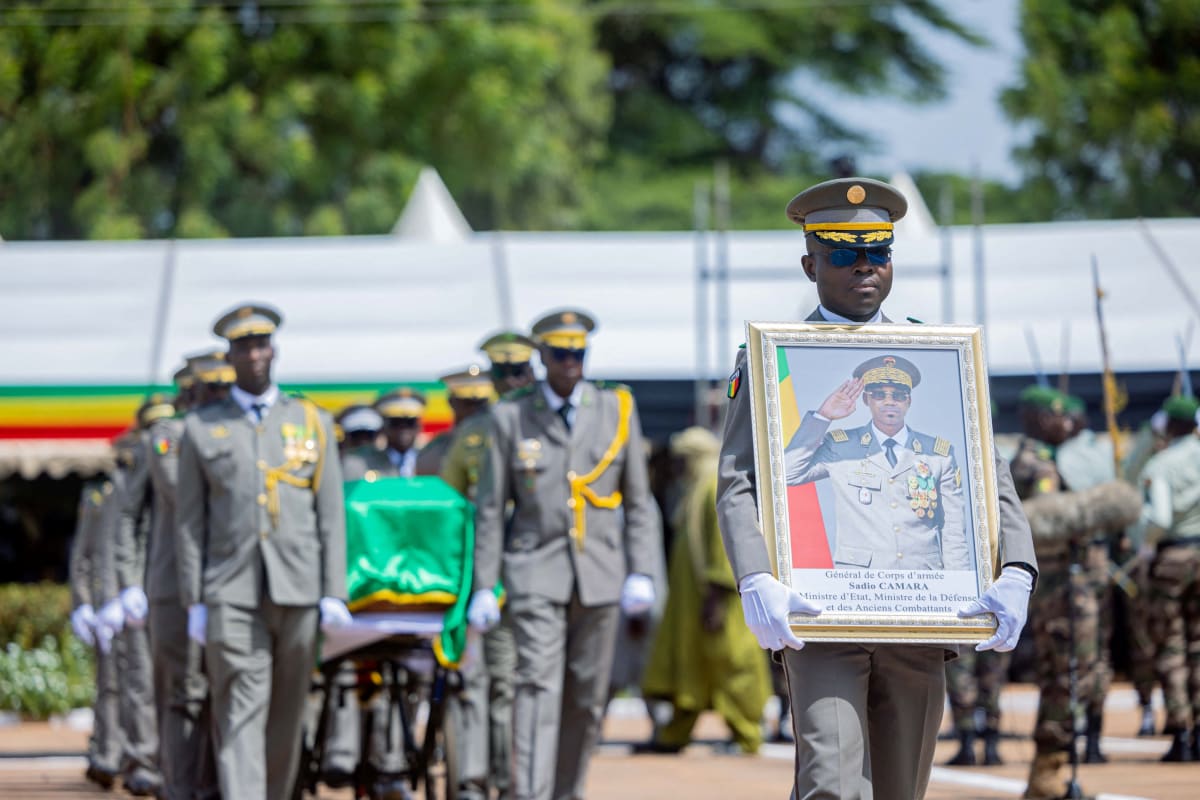
A key event was the assassination of the Malian defence minister, carried out by groups that are not natural allies: Tuareg separatists and al-Qaeda-linked militants (JNIM).[8] Such cooperation illustrates a pragmatic alliance in which shared objectives override ideological differences. In addition, attacks were carried out in other parts of Mali, primarily targeting military objectives, though casualty figures are not known. The towns of Kidal (which represents a “historical capital” for the Tuareg), Kati, and Bamako were targeted in coordinated strikes aimed at overwhelming the opponent.[9] The Malian defence minister was an important link in Mali’s alliance with Russia and in overseeing the Russian “Africa Corps” unit.[10]
Such coordination between otherwise rival groups points to a shift from fragmented insurgency towards more adaptive operations. Violence and attacks by Boko Haram and the Islamic State’s affiliate (ISWAP) have reached their highest level since 2015 so far this year, with more than 350 attacks recorded by April 2026.[11] In northern provinces of Nigeria (Niger and Kebbi), more than 40 people were killed across villages in the first week of attacks in April, allegedly carried out by the regional al-Qaeda affiliate.[12] This means that the population no longer lives within a single clear conflict, but in an environment of constant risk, where what matters is not who is attacking, but that the state fails to provide protection. There is also an increasingly institutionalised approach by insurgent movements, which no longer merely carry out attacks but maintain control over their territory.[13] Nevertheless, in Nigeria, a mass trial of more than 400 members of armed groups took place, resulting in various prison sentences.[14]
3. Democratic Republic of Congo
Throughout the month, clashes continued in the eastern part of the Democratic Republic of Congo despite a signed ceasefire. The most intense fighting took place in North and South Kivu, where armed groups carried out attacks on settlements and military positions, frequently using unmanned aerial systems.[15] In South Kivu, operations were conducted in several villages around Minembwe between 13 and 17 April. The attacks were not directed at individual targets but encompassed both settlements and infrastructure, including the local airfield.[16]
According to humanitarian organisations, hundreds of thousands of people have been displaced in recent months, further confirming that the ceasefire had no real effect on the security situation.[17] The clashes are directly linked to the control of areas rich in natural resources, particularly gold and coltan, which remain the key financial basis for the operation of armed groups. The conflict involves M23 forces, backed by Rwanda, and government FARDC forces alongside local militias, further increasing the complexity and regional dimension of the fighting.[18]
Throughout the conflict, there has been growing privatisation and internationalisation of the fighting on both sides. The eastern Congo conflict is no longer driven solely by domestic forces but also by groups motivated by a combination of economic interests, regional ties, and military opportunities. Some groups are reported to have more than 1,000 fighters in the area. The conflict continues to be rooted in the exploitation of natural resources and the control of territory.[19]
Diplomatic processes also took place in April, including negotiations in Switzerland and discussions within the UN Security Council, where the issue of humanitarian access was highlighted. Nevertheless, no new measures were adopted that would have a direct impact on conditions on the ground.[20] The conflict in the Congo is not based solely on political disagreements but on an interplay of economic interests and regional influences that govern its duration.
* Views and opinions of the authors of this paper do not necessarily correspond to the views of the Euro-Atlantic Council of Slovenia.
Sources
[1] Dabanga Sudan. “Civilian Death Toll from North Darfur Drone Attack on Wedding Procession Rises to 58.” Dabanga Sudan. (12. 4. 2026) https://www.dabangasudan.org/en/all-news/article/civilian-death-toll-from-north-darfur-drone-attack-on-wedding-procession-rises-to-58
[2] Moneycontrol World Desk. “Drone Strikes in Sudan kill 11 in Rabak, hospital damaged in Khartoum state.” Moneycontrol. (29. 4. 2026) https://www.moneycontrol.com/world/drone-strikes-in-sudan-kill-11-in-rabak-hospital-damaged-in-khartoum-state-article-13902497.html
[3] Al Jazeera, AFP, Reuters. “ Drones, Iran war escalating horror as Sudan war enters fourth year.” Al Jazeera (14. 4. 2026) https://www.aljazeera.com/news/2026/4/14/drones-iran-war-escalating-horror-as-sudan-war-enters-fourth-year
[4] Khalili-Tari, D. “ Khartoum drone strike kills five in Sudan, NGO reports.” Al Jazeera. (2. 5. 2026) https://www.aljazeera.com/amp/news/2026/5/2/khartoum-drone-strike-kills-five-sudan-ngo-reports
[5] Federal Foreign Office (Germany). “International Sudan Conference in Berlin.” Auswärtiges Amt. (15. 4. 2026) https://www.auswaertiges-amt.de/en/newsroom/news/international-sudan-conference-berlin-2766850
[6] Kossaify, E. “ UN Security Council sanctions brother of Rapid Support Forces leader over atrocities in Sudan.” Arab News Japan. (29. 4. 2026) https://www.arabnews.jp/en/middle-east/article_169170/
[7] Center for Preventive Action. “Violent Extremism in the Sahel.” CFR Global Conflict Tracker. (1. 5. 2026) https://www.cfr.org/global-conflict-tracker/conflict/violent-extremism-sahel
[8] Reuters. “ Mali army bases hit in large-scale attacks claimed by al Qaeda-linked militants.” Reuters. (25.4.2026) https://www.reuters.com/world/africa/loud-blasts-gunfire-heard-near-malis-main-military-camp-reuters-witness-says-2026-04-25/
[9] Dideberg, R., Melly, P. “Mali Attacks Show Security Cannot Be Delivered by Military Means Alone.” Chatham House. (30.4.2026) https://www.chathamhouse.org/2026/04/mali-attacks-show-security-cannot-be-delivered-military-means-alone
[10] Ibid.
[11] Chason, R., Ombuor, R., Jamiu, A. “ Airstrike by Nigeria, a U.S. ally against Islamist militants, kills scores.” The Washington Post. (16.4.2026) https://www.washingtonpost.com/world/2026/04/16/nigeria-market-attack-boko-haram-iswap/
[12] Taha, R. “Nigeria: At Least 20 Killed in Attack, Residents Say.” DW. (8. 4. 2026) https://www.dw.com/en/nigeria-at-least-20-killed-in-attack-residents-say/a-76711053
[13] Center for Preventive Action. “Violent Extremism in the Sahel.” CFR Global Conflict Tracker. (1. 5. 2026) https://www.cfr.org/global-conflict-tracker/conflict/violent-extremism-sahel
[14] Chothia, F. “ Nearly 400 sentenced in Nigeria for links to militant Islamists.” BBC News. (11. 4. 2026) https://www.bbc.com/news/articles/cvge1kdmpzwo
[15] Critical Threats Project. “Congo War Security Review.” Critical Threats. (24.4.2026) https://www.criticalthreats.org/briefs/congo-war-security-review/april-24-2026
[16] Ibid.
[17] Reuters. “Congo Launches $100 Million US-Backed Mining Guard to Secure Sites.” Reuters. (27.4.2026) https://www.reuters.com/world/africa/congo-launches-100-million-us-backed-mining-guard-secure-sites-2026-04-27/?
[18] Karamuka, B. “Privatization of War in Eastern Democratic Republic of Congo.” Jamestown Foundation. (5. 1. 2026) https://jamestown.org/privatization-of-war-in-eastern-democratic-republic-of-congo/
[19] Ibid.
[20] United Nations Security Council. “ Security fears rise in eastern DR Congo.” UN News. (15. 4. 2026) https://news.un.org/en/story/2026/04/1167304