
The Iran Conflict
Throughout April 2026, the conflict between Israel and the US on one side and Iran and its allies on the other – at least within Iranian territory – narrowed to tensions in the Strait of Hormuz, where both sides imposed naval blockades to prevent the passage of the opposing side’s merchant ships. Following repeated threats by President Trump, a ceasefire between Iran and the US went into effect, followed by several unsuccessful rounds of negotiations on a possible end to the conflict. As diplomatic efforts to resolve the conflict appear to have failed, Iran is seeking support from its allies in Russia and Belarus, while the US is looking for ways to sanction those allies who have refused to cooperate in military action against Iran. This report will focus on the Iranian and American blockades of the Strait of Hormuz and efforts to end the conflict.
1. Double blockade of the strait of Hormuz
Iran and the United States both imposed naval blockades on the Strait of Hormuz, thereby preventing commercial vessels from the opposing sides from passing through. On 11 April, US Central Command (CENTCOM) announced that US forces would begin an operation to locate and remove naval mines laid by Iran’s Islamic Revolutionary Guard Corps (IRGC) to block the sea route. Two US Navy guided-missile destroyers, the USS Frank E. Peterson and the USS Michael Murphy, along with additional naval forces equipped with unmanned underwater vehicles, are expected to participate in the operation.[1] Emma Salisbury, a researcher in the National Security Program at the Foreign Policy Research Institute, notes that the operation to search for and remove sea mines and other underwater explosives could last several months, even though it is not at all certain that such explosive devices are actually deployed in the Strait of Hormuz, as the mere mention of them by Iranian authorities has a strong psychological impact on the naval personnel of civilian and military vessels.[2]
On 13 April, following an order from US President Donald Trump, CENTCOM established a naval blockade of the Strait of Hormuz with its forces, prohibiting all vessels entering or leaving Iranian ports, regardless of the flag under which they sail. All other vessels bound for or departing from other ports will be allowed to pass through the blockade by the US Navy without hindrance.[3] This US move was a response to the closure of the Strait of Hormuz by Iranian authorities, who have been enforcing a blockade there since 2 March. It should be noted that Iran’s position on the Strait of Hormuz is rather unclear, as Iranian Foreign Minister Abbas Araghchi, stated on 17 April, that the strait was open to all cargo traffic, but just one day later, the IRGC rejected his statements and announced that the strait was closed again until further notice.[4]
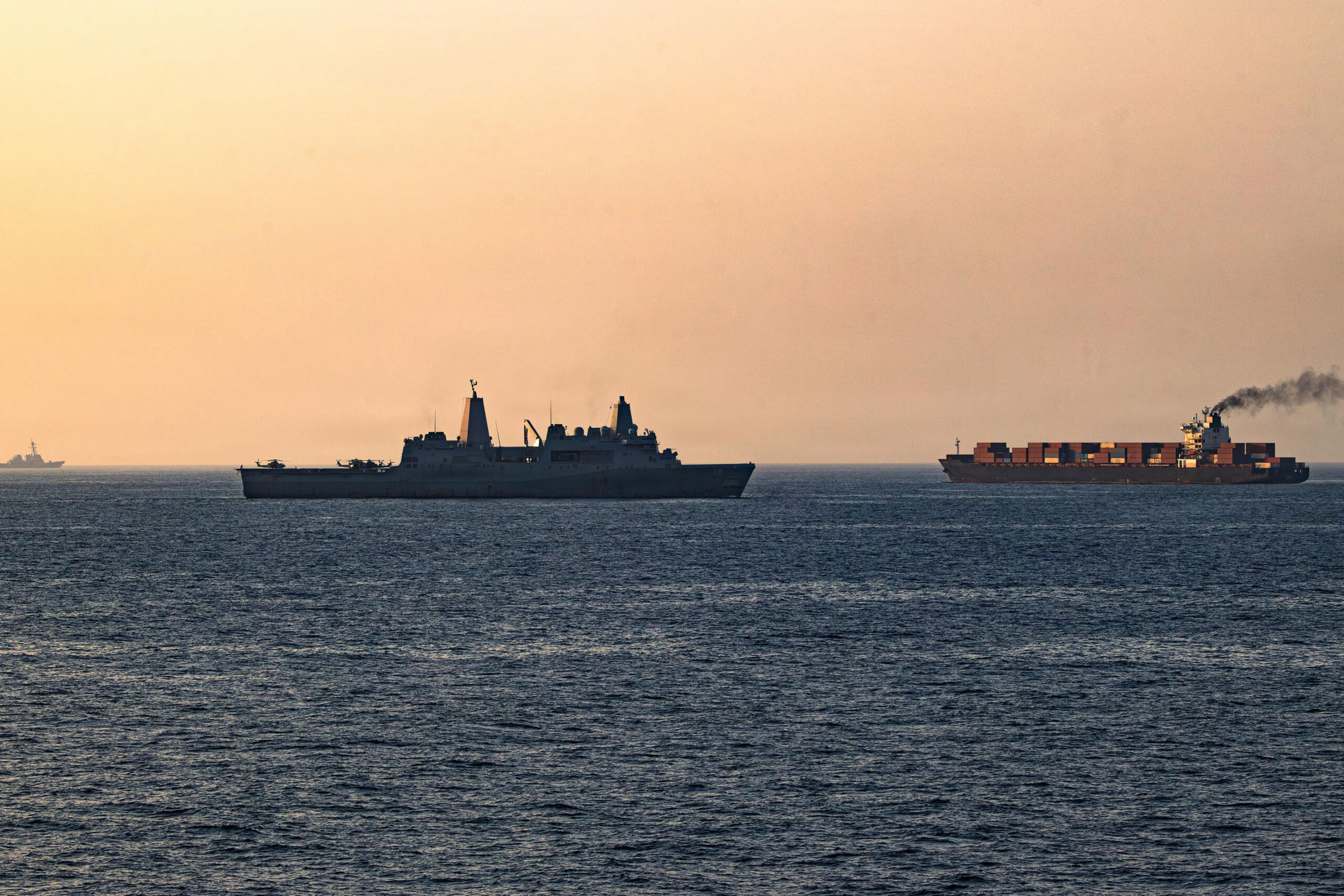
The US blockade proved relatively effective, as on 19 April, the US guided-missile destroyer USS Spruance intercepted the cargo ship M/V Touska in the northern Arabian Sea; the vessel was sailing under the Iranian flag and was bound for the Iranian port of Bandar Abbas. After the crew of the Iranian cargo ship failed to respond to US calls to change course, the USS Spruance destroyed its engine room with its deck gun, rendering it inoperable. This was followed by the boarding of the ship by members of the 31st Marine Expeditionary Unit (31st MEU) and the seizure of the cargo ship.[5] According to maritime security experts, the M/V Touska was reportedly transporting dual-use parts from Asia, which CENTCOM classifies as metals, pipes, electronic components, and other products that can be used in both industrial processes and military manufacturing.[6]
On 22 April, the Islamic Revolutionary Guard Corps – Navy (IRGC-N) intercepted and seized two cargo ships in the Strait of Hormuz for the first time since the start of the conflict. It is reported that the IRGC-N also fired upon the two seized vessels and a third ship. Following these events, the IRGC-N announced that it would take similar action against any vessels that violate peace and security in the strategically important strait.[7]
These events indicate that Iran still possesses sufficient capabilities to influence the security situation in the Strait of Hormuz, despite the fact that most of its vessels were destroyed during US and Israeli air and naval strikes. Specifically, it was primarily Iran’s conventional naval capabilities – belonging to the regular Iranian armed forces, known as the Artesh – that were destroyed, while the vast majority of asymmetric naval capabilities under the command of the IRGC-N remained intact. The structure of the IRGC-N is designed to prioritize speed, mobility, and numbers within the so-called ”mosquito fleet” – the use of smaller armed vessels in coordination with auxiliary assets such as fishing boats and other civilian vessels, unmanned maritime systems, underwater mines, and anti-ship and ballistic missiles. The IRGC-N objective is not to establish superiority over a more advanced enemy navy, but to deplete the enemy’s naval capabilities and, over the long term, disrupt their operations in the Strait of Hormuz.[8]
By 25 April, the US Navy prevented 37 Iran-linked vessels, including six tankers carrying a total of 10.5 million barrels of oil, from passing through the Strait of Hormuz. Nevertheless, some vessels managed to break through the blockade, though some analysts suggest that the US Navy will likely intercept them before they reach their final destination.[9]
2. Ceasefire and diplomatic efforts
Tensions in the Strait of Hormuz and the double blockade of the strait are accompanied by modest diplomatic efforts to end the conflict. Following repeated threats by President Trump, a ceasefire between Iran and the US went into effect on 8 April. This was soon followed by the first negotiations on a possible end to the conflict between 11 and 12 April, organized by Pakistan in its capital, Islamabad. The negotiations, attended on the US side by Vice President J. D. Vance, were unsuccessful, but President Trump nevertheless declared that he would extend the ceasefire indefinitely.[10] Despite the extension of the ceasefire, which is set to remain in effect until the end of the diplomatic talks, President Trump confirmed that the US would continue its naval blockade of the Strait of Hormuz, which Iran has labelled an act of war.[11]
Despite the failure of the first round of peace talks, Pakistani Prime Minister Shehbaz Sharif remained optimistic and sought to continue them, even though the White House had halted preparations for Vance’s return trip to Islamabad for the second round of negotiations. Efforts to end the conflict and extend the ceasefire were also welcomed by representatives of the United Nations.[12]
Despite the efforts of various actors to hold a second round of negotiations, which was scheduled to take place between 25 and 26 April, the talks did not materialise because President Trump cancelled the trip of US representatives to Islamabad. Both sides continue to insist on demands that are too divergent to resolve the conflict. Iran demands that the US lift its blockade of the Strait of Hormuz and end the war in exchange for the Iranian authorities reopening the strait, while the US demands that Iran completely dismantle its nuclear program, comprehensively restricts its missile program, and ends support for its allies in the Middle East. Iran has proposed postponing a decision on the nuclear program to some point in the future, but US Secretary of State Marco Rubio added that the US will not accept any agreement that does not include provisions for its complete cessation.[13]
In parallel with the failed diplomatic solutions, both sides are attempting, in one way or another, to influence the stance of their allies regarding the current state of the conflict. An email from US officials has been made public, outlining possible ways to sanction those NATO members that have taken a different stance on the Iranian conflict than the US. Among other things, the options reportedly on the table include suspending Spain’s membership in NATO, reconsidering British sovereignty over the Falkland Islands, and a complete withdrawal from NATO.[14]
Meanwhile, on 27 April, Iranian Foreign Minister Abbas Araghchi visited the Russian Federation, where he met with President Vladimir Putin in St. Petersburg. The latter emphasised that Russia would do everything to ensure peace in the Middle East and praised the Iranian people for defending their sovereignty.[15] At the same time, Iranian Deputy Defence Minister Reza Talaei-Nik met with Russian Defence Minister Andrei Belousov in Kyrgyzstan and later travelled to Belarus, where he held talks with Belarusian Defence Minister Viktor Khrenin. Both meetings between the defence officials were intended to discuss the situation in the Middle East and the conflict in Iran.[16]
3. April 2026 Iran conflict assessment
The situation regarding the Iran conflict remains highly uncertain and is heading in two completely different directions. On the one hand, both Iran and the US are striving to end the conflict, but each with its own maximalist conditions, which are unacceptable to the opposing side. Both sides are seeking broader support among allies and other external actors, which could give them an additional advantage in the currently stalled diplomatic negotiations. At the same time, both sides view complete control over the Strait of Hormuz as a key element in successful negotiations, as evidenced by the efforts of both countries to use their naval blockades to prevent the passage of the opposing side’s civilian cargo and military ships through the strategically important strait. Both Iran and the US seized several ships in April and prevented the free passage of many other vessels. Through its naval operations, Iran has demonstrated that, despite numerous claims by US officials, its naval capabilities have not been completely destroyed. In parallel with developments in the diplomatic arena, both sides are preparing for renewed clashes in the Strait of Hormuz and beyond should talks come to a complete standstill or if neither side is willing to yield to the other – a scenario that many regional and global actors would like to avoid.
* Views and opinions of the authors of this paper do not necessarily correspond to the views of the Euro-Atlantic Council of Slovenia.
Sources
[1] US Central Command, ”U.S. Forces Start Mine Clearance Mission in Strait of Hormuz,” press release, (11.4.2026), https://www.centcom.mil/MEDIA/PRESS-RELEASES/Press-Release-View/Article/4457220/us-forces-start-mine-clearance-mission-in-strait-of-hormuz/
[2] Ben Finley, David McHugh and Konstantin Toropin, ”US says it’s hunting for explosive mines in latest push to open the Strait of Hormuz,” AP News, (25.4.2026), https://apnews.com/article/iran-war-strait-hormuz-minesweeping-navy-underwater-edef3201f6e227c4b5e5edf1a28f6f77
[3] US Central Command, ”U.S. to Blockade Ships Entering or Exiting Iranian Ports,” press release, (12.4.2026), https://www.centcom.mil/MEDIA/PRESS-RELEASES/Press-Release-View/Article/4457255/us-to-blockade-ships-entering-or-exiting-iranian-ports/
[4] Matthew P. Funaiole, Aidan Powers-Riggs, Harrison Prétat and Jasper Verschuur, ”The Strait of Hormuz in 8 Charts,” Center for Strategic and International Studies, (22.4.2026), https://www.csis.org/analysis/strait-hormuz-8-charts
[5] US Central Command, ”U.S. Forces Disable Vessel Attempting to Enter Iranian Port, Violate Blockade,” press release, (19.4.2026), https://www.centcom.mil/MEDIA/PRESS-RELEASES/Press-Release-View/Article/4464037/us-forces-disable-vessel-attempting-to-enter-iranian-port-violate-blockade/
[6] Jonathan Saul, ”Seized Iranian ship likely carrying equipment deemed dual-use by US, sources say,” Reuters, (20.4.2026), https://www.reuters.com/world/middle-east/seized-iranian-ship-likely-carrying-equipment-deemed-dual-use-by-us-sources-2026-04-20/
[7] Renee Maltezou, Jonathan Saul and Yannis Souliotis ”Iran seizes two container ships attempting to leave Gulf,” Reuters, (22.4.2026), https://www.reuters.com/world/europe/three-vessels-hit-by-gunfire-strait-hormuz-crews-safe-2026-04-22/
[8] Can Kasapoğlu ”The Strait of Hormuz Under Pressure: Asymmetric Naval War and Signs of Elite Fragmentation in Iran,” Hudson Institute, (24.4.2026), https://www.hudson.org/national-security-defense/strait-hormuz-under-pressure-asymmetric-naval-war-signs-elite-can-kasapoglu
[9] Jonathan Saul, ”Iran oil tankers turned back by US blockade, Hormuz traffic sparse,” Reuters, (27.4.2026), https://www.reuters.com/world/middle-east/shipping-traffic-through-hormuz-remains-muted-with-no-us-iran-deal-sight-data-2026-04-27/
[10] Jon Gambrell, ”Despite a new proposal from Iran, ceasefire negotiations with US are in flux,” AP News, (28.4.2026), https://apnews.com/article/iran-us-israel-war-what-to-know-beb5625f8537ceaf22c061cf073210aa
[11] Christina Anagnostopoulos, Vanessa Balintec, Anusha Devang Shah, Howard Goller, Kay Johnson, Shubham Kalia, Zoe Law, Farah Master, Kylie McLellan, Neha Mustafi, Estelle Shirbon, Farouq Suleiman, Gnaneshwar Rajan and Alexander Villegas, ”Trump extends US ceasefire after Pakistan request but will continue blockade of Iranian ports – as it happened,” Reuters, (22.4.2026), https://www.reuters.com/world/iran-war-live-us-pushes-new-peace-talks-ceasefire-deadline-looms-2026-04-21/
[12] Munir Ahmed, Jon Gambrell and Matthew Lee, ”Trump says the US will extend its ceasefire with Iran at Pakistan’s request,” AP News, (22.4.2026), https://apnews.com/article/us-iran-war-pakistan-april-21-2026-177a2d0701ef172c3e51686bc1f18f30
[13] Jon Gambrell, ”Despite a new proposal from Iran, ceasefire negotiations with US are in flux,” AP News.
[14] Phil Stewart, ”Exclusive: Pentagon email floats suspending Spain from NATO, other steps over Iran rift, source says,” Reuters, (24.4.2026), https://www.reuters.com/world/pentagon-email-floats-suspending-spain-nato-other-steps-over-iran-rift-source-2026-04-24/
[15] Elena Becatoros, Jon Gambrell and Samy Magdy, ”Iran offers to reopen Strait of Hormuz if US lifts its blockade and the war ends, officials say,” AP News, (28.4.2026), https://apnews.com/article/us-iran-war-hormuz-april-27-2026-374d81d1aac6d8f19c21e1d1e10ab103
[16] ”Iranian defence official holds talks with Russian, Belarusian ministers,” Reuters, (28.4.2026), https://www.reuters.com/world/europe/iranian-defence-official-holds-talks-with-russian-belarusian-ministers-2026-04-27/