
The Western Balkans
June 2026 marked an important turning point for the geopolitical and institutional future of the Western Balkans. The month was defined by the EU-Western Balkans Summit in Tivat on 5 June, hosted by Montenegro.1 The summit brought together leaders of the EU Member States and the six Western Balkan partners: Albania, Bosnia and Herzegovina, Montenegro, Kosovo, North Macedonia and Serbia. French President Emmanuel Macron and German Chancellor Friedrich Merz used the summit to present a new strategic enlargement proposal. It introduces the concept of “associated membership”, or the gradual inclusion of countries from the region in selected policies and institutions of the European Union.2
This renewed momentum is accompanied by deep uncertainty in the central Balkans. In June, the mandate of Christian Schmidt, the High Representative for Bosnia and Herzegovina, officially came to an end,3 while the search for his successor stalled because of disagreements among key international actors. This created a political and administrative vacuum, increasing the risks of internal destabilisation in BiH.4
As host of the EU-Western Balkans Summit in Tivat, Montenegro strengthened its position as the leading candidate to become the next EU Member State.5 The other partners in the region, Albania, Bosnia and Herzegovina, Kosovo, North Macedonia and Serbia, remain under varying degrees of pressure to meet the conditions set out in the Growth Plan. Brussels is not softening its approach: financial assistance remains tied to progress on fundamental reforms, particularly in the areas of the rule of law, democratic institutions and public administration.6
1. Military and Security Developments
Security vacuum in BiH after Schmidt’s departure
In June 2026, German diplomat Christian Schmidt officially ended his almost five-year mandate as High Representative for Bosnia and Herzegovina.3 His previously announced departure triggered intensive negotiations within the Peace Implementation Council over the choice of his successor. In diplomatic circles, former Italian ambassador Antonio Zanardi Landi was most frequently mentioned as the most serious candidate.7
Because the confirmation of a successor is being complicated by tensions in the United Nations Security Council, a legal and political space of uncertainty has opened in BiH.8 This quickly increased security risks in the country and strengthened secessionist narratives in Republika Srpska, particularly ahead of the forthcoming local elections.9
The security and defence dimension of the Tivat summit
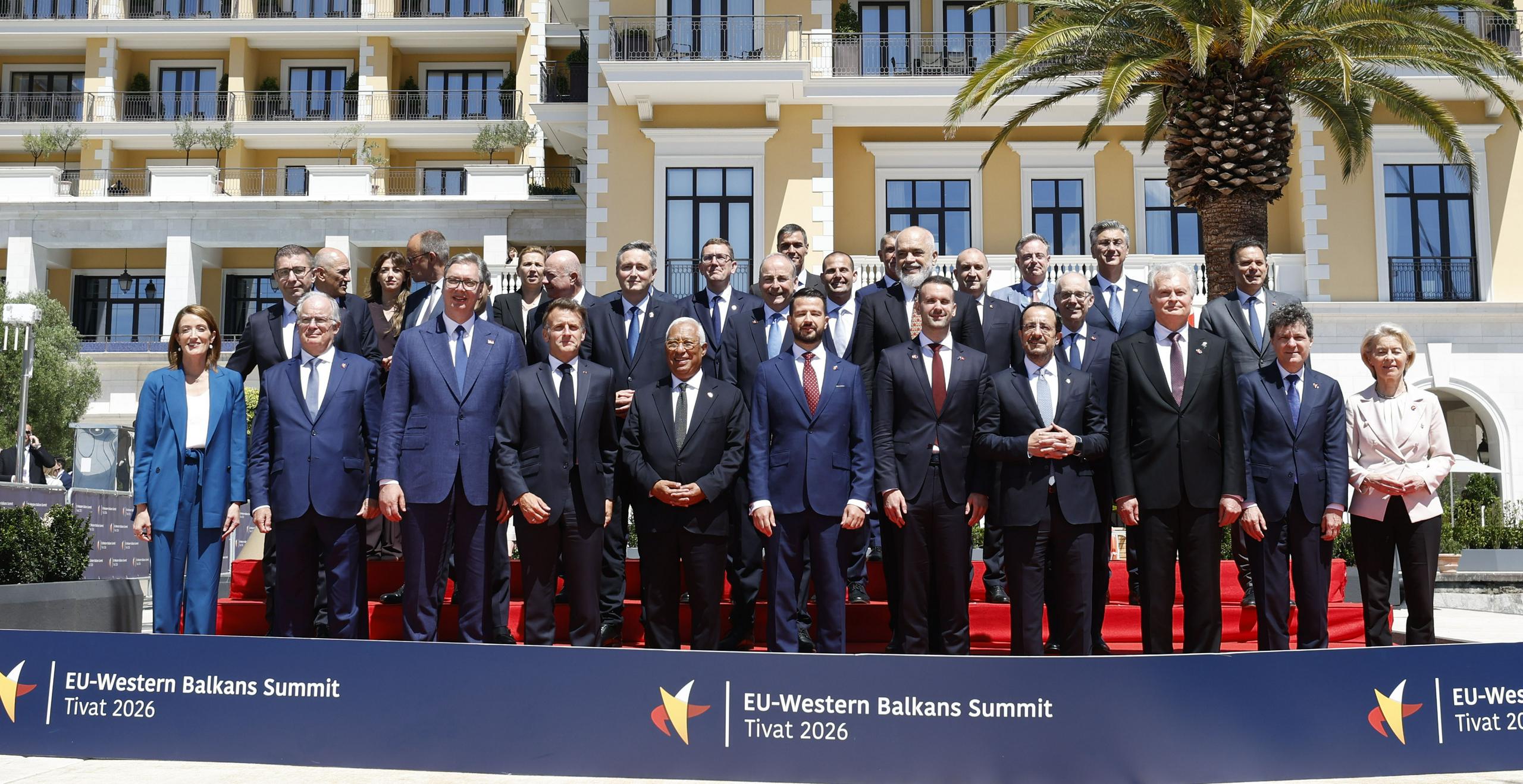
The EU–Western Balkans Summit in Tivat, hosted by Montenegro, focused not only on economic cooperation but also on the region’s resilience against external hybrid influence.10 Leaders of the EU Member States, together with those of Albania, Bosnia and Herzegovina, Montenegro, Kosovo, North Macedonia and Serbia, underlined the need for closer cooperation with the European Union in the field of the Common Security and Defence Policy. Particular emphasis was placed on intelligence sharing, joint cyber initiatives and the protection of state institutions from external attempts at destabilisation.11
2. Energy and Digital Infrastructure
Gradual integration into the EU single market
In June, the leaders of the six Western Balkan partners, Albania, Bosnia and Herzegovina, Montenegro, Kosovo, North Macedonia and Serbia, confirmed progress, in the context of the Growth Plan discussions, on priority areas for integrating the region into the EU single market.12 The key areas remain accession to the Single Euro Payments Area, facilitation of road transport and alignment with the digital single market.13
These initiatives also have wider strategic significance. They reduce transaction costs, strengthen economic ties with the EU and narrow the space for external actors that exploit the economic dependence of Western Balkan countries.14
Energy transition and market diversification
In the field of energy, the region faces increasingly strict demands from Brussels on market integration and emissions reduction.15 The proposals presented at the EU-Western Balkans Summit in Tivat envisage the gradual integration of the energy networks of Albania, Bosnia and Herzegovina, Montenegro, Kosovo, North Macedonia and Serbia into the EU system.16
However, this process will depend on the consistent adoption of the EU acquis and on reducing long-term energy dependence on third countries. 17 This means that energy policy remains one of the key areas where economic development, security policy and EU enlargement intersect.
3. The Growth Plan and EU Integration
The European Council meeting in Brussels on 18 and 19 June, attended by the heads of state or government of the EU Member States, confirmed that the EU will maintain strict conditionality in the disbursement of the EUR 6 billion Reform and Growth Facility.18 European leaders announced a strategic discussion on enlargement and internal EU reforms for October 2026.19
This decision points to the dual dynamic of European enlargement policy. On the one hand, the Franco-German proposal on associated membership and Montenegro’s progress created renewed political momentum. On the other hand, Brussels made it clear that there will be no shortcuts. Disbursements under the Growth Plan remain linked to the concrete implementation of reforms, particularly under the fundamentals cluster.18
The status of individual countries in June 2026 reflects the increasingly pronounced multi-speed dynamic in the region.
Montenegro established itself as the leading candidate in the enlargement process through the successful hosting of the EU-Western Balkans Summit in Tivat.1 Its readiness for membership and relatively stable reform path currently position it as a model for the rest of the region.5
Albania is also maintaining steady progress in gradual integration with the EU. Tirana is meeting interim benchmarks, while the new enlargement initiative offers it faster access to some of the benefits of the European single market.6
Bosnia and Herzegovina faces greater risks. The stalling of reform agendas has been further deepened by the political uncertainty following Schmidt’s departure.8 Long-running domestic political blockages are slowing the preparation of key documents, placing the country at risk of losing part of its EU funding.20
Serbia and Kosovo remain subject to a strict conditionality regime. The European Council reiterated that disbursements under the Growth Plan for Belgrade and Pristina are directly tied to constructive engagement and tangible progress in the dialogue on the normalisation of relations.18
4. Domestic Politics and Regional Tensions
The Merz–Macron strategic proposal in Tivat
German Chancellor Friedrich Merz and French President Emmanuel Macron presented a joint proposal for a new phase of EU enlargement at the EU-Western Balkans Summit in Tivat on 5 June.1 The initiative seeks to address two key questions: what to offer Western Balkan countries once they meet the conditions but membership remains blocked by the opposition of individual EU Member States; and how to organise the region’s position if Montenegro and Albania cross the finish line faster than the other candidates.
The proposal envisages the possibility of associated membership in selected institutions, including the Council and the European Parliament, as well as additional security guarantees. At the same time, it maintains a strict requirement to uphold the rule of law.2
Political uncertainty in BiH over OHR succession
The official end of Schmidt’s mandate triggered renewed political uncertainty in Sarajevo. Because the Peace Implementation Council has not yet reached agreement on a new candidate owing to external pressure, pro-European political structures have expressed concern about the future of the international role in BiH.4
The absence of clear international arbitration threatens the stability of state institutions ahead of the autumn elections.21 In this environment, domestic political actors can more easily exploit institutional blockages, ethnic tensions and secessionist demands.
European Council conclusions and pressure for reform
At the end of June, the European Council clearly set out the next stage of the timetable. October 2026 will bring a strategic discussion on internal EU reforms and enlargement, in the spirit of the Granada Declaration.19
The message to the region was clear: the economic benefits of gradual integration will be possible only with tangible progress in the judiciary, democratic standards and the functioning of public administration.18 Brussels is therefore both accelerating and tightening the enlargement process. It is offering the region more gradual benefits, but in return it is demanding more consistent implementation of reforms.
* Views and opinions of the authors of this paper do not necessarily correspond to the views of the Euro-Atlantic Council of Slovenia.
Sources
- European Council. (5 June 2026). EU-Western Balkans summit in Tivat, Montenegro. Newsroom. https://newsroom.consilium.europa.eu/events/20260605-eu-western-balkans-summit
- Stiftung Wissenschaft und Politik. (14 May 2026). The Merz-Macron Proposal: Associated Membership as a Pathway for EU Integration. SWP Comment. https://www.swp-berlin.org/en/publication/the-merz-macron-proposal-associated-membership-as-a-pathway-for-eu-integration
- European Western Balkans. (11 May 2026). Christian Schmidt resigns as High Representative in BiH. https://europeanwesternbalkans.com/2026/05/11/christian-schmidt-resigns-as-high-representative-in-bih/
- Borger, J. (30 June 2026). Europe and US on collision course over next high representative for Bosnia. The Guardian. https://www.theguardian.com/world/2026/jun/30/europe-us-high-representative-for-bosnia
- Center for Western Balkan Studies. (11 June 2026). “The Tivat Deployment,” a Hungry Vučić, and Montenegro’s European Integration. https://cfwbs.org/the-tivat-deployment-a-hungry-vucic-and-montenegros-european-integration/
- European Commission. (20 May 2026). Commission implementing decision approving the release of funds to Albania, Montenegro and North Macedonia under the Reform and Growth Facility for the Western Balkans. https://enlargement.ec.europa.eu/enlargement-policy/growth-plan-western-balkans_en
- Dnevni Avaz. (29 May 2026). Zanardi Landi je i službeno kandidat za nasljednika Šmita. https://avaz.ba/vijesti/bih/zanardi-landi-je-i-sluzbeno-kandidat-za-nasljednika-smita
- China-CEE Institute. (26 June 2026). Bosnia and Herzegovina monthly briefing: Christian Schmidt’s resignation: US turn away from EU in the Balkans. https://china-cee.eu/2026/06/26/bosnia-and-herzegovina-monthly-briefing-christian-schmidts-resignation-us-turn-away-from-eu-in-the-balkans/
- IISS. (June 2026). Bosnia-Herzegovina: an end to international consensus and the future of Dayton. Strategic Comments, 32(5). https://www.iiss.org/publications/strategic-comments/2026/06/bosnia-herzegovina-an-end-to-international-consensus-and-the-future-of-dayton/
- EUalive. (4 June 2026). Hybrid warfare? Why Montenegro blocked a Serbian charter flight before the Tivat summit. https://eualive.net/hybrid-warfare-why-montenegro-blocked-a-serbian-charter-flight-before-the-tivat-summit/
- European External Action Service. (3 June 2026). Security cooperation at heart of European defence during EU-Western Balkans Summit. https://www.eeas.europa.eu/eeas/security-cooperation-heart-european-defence-during-eu-western-balkans-summit_en
- Center for Democracy and Integration. (15 January 2026). Background document for the 3rd Dialogue on the Reform and Growth Facility for the Western Balkans. https://cdinstitute.eu/wp-content/uploads/2026/01/Facility_WesternBalkan_Backgrounddocument_EN.pdf
- The Vienna Institute for International Economic Studies. (18 March 2024). The EU’s new Growth Plan for the Western Balkans: Solid foundations but shaky details. https://wiiw.ac.at/the-eu-s-new-growth-plan-for-the-western-balkans-solid-foundations-but-shaky-details-n-622.html
- The New Union Post. (20 May 2026). Albania, Montenegro and North Macedonia to receive fresh EU funds under the Growth Plan. https://newunionpost.eu/2026/05/20/eu-growth-plan-funds-albania-montenegro/
- Balkan Green Energy News. (11 May 2026). Belgrade Energy Forum 2026: EU’s support necessary for decarbonization in Western Balkans. https://balkangreenenergynews.com/belgrade-energy-forum-2026-eus-support-necessary-for-decarbonization-in-western-balkans/
- BiEPAG. (9 June 2026). EU-Western Balkans Summit 2026: New Impetus for the Enlargement Debate? https://www.biepag.eu/blog/euwestern-balkans-summit-2026-new-impetus-for-the-enlargement-debate
- Energy Community Secretariat. (2025). Energy and Climate Diplomacy: Extension of the EU environment and climate acquis to the Western Balkans. https://www.energy-community.org/dam/jcr:bc024cab-6c45-44bb-9a73-0e0cc73f1bbb/EnCS_Recommendations_acquis.pdf
- European Council. (19 June 2026). European Council conclusions on the next multiannual financial framework, migration, illicit drugs, enlargement and reforms, the Republic of Moldova, Western Balkans and other items. https://www.consilium.europa.eu/en/press/press-releases/2026/06/19/european-council-conclusions-on-the-next-multiannual-financial-framework-migration-illicit-drugs-the-republic-of-moldova-western-balkans-and-other-items/
- European Western Balkans. (19 June 2026). The European Council to hold a strategic discussion on enlargement at its meeting in October 2026. https://europeanwesternbalkans.com/2026/06/19/the-european-council-to-hold-a-strategic-discussion-on-enlargement-at-its-meeting-in-october-2026/
- The Western Balkans. (19 June 2026). European Council – 18 and 19 June 2026 – The Western Balkans. https://thewesternbalkans.com/european-council-18-and-19-june-2026/
- Wintour, P. (12 May 2026). Bosnia and Herzegovina left vulnerable by policy clash with US, representative says. The Guardian. https://www.theguardian.com/world/2026/may/12/bosnia-and-herzegovina-vulnerable-policy-clash-us-representative-says