

Serbia at a Political Crossroads: The 2026 Parliamentary Elections
The early parliamentary elections held on 25 October 2026 ended in defeat for the Serbian Progressive Party (SNS), which had dominated Serbian politics since 2012, and victory for an electoral list that emerged from the student-led protest movement. This report examines how the student movement managed to translate protest mobilisation into electoral victory despite the structural advantages enjoyed by the ruling SNS. It traces the movement’s development, the campaign strategies pursued by the main political actors, the institutional conditions under which the elections took place, and the implications of the result for the distribution of political power.
The analysis draws on reports by the OSCE Office for Democratic Institutions and Human Rights (ODIHR) and the Serbian election-monitoring organisation CRTA, assessments by the Centre for Eastern Studies (OSW), opinion polls, and reporting by Serbian and international media. It argues that the student movement developed an electoral alternative with broader appeal than the established opposition by placing institutional accountability at the centre of its campaign and bringing together voters from different political backgrounds. Electoral victory, however, does not remove the institutional and political constraints facing the incoming government. The analysis is based on preliminary election results, as the final allocation of parliamentary seats and the international observers’ comprehensive assessment were not yet available at the time of writing.
Key words: Serbia, 2026 parliamentary elections, student movement, Serbian Progressive Party, political mobilisation, electoral conditions
1. From the Novi Sad Tragedy to a Political Alternative
The collapse of the concrete canopy at Novi Sad railway station on 1 November 2024, which killed 16 people, triggered one of Serbia’s most serious political crises in recent years.[1] As the station had undergone extensive modernisation works before the accident, public scrutiny quickly turned to the reconstruction project, oversight of the works and the accountability of the institutions involved. Investigative reporting identified discrepancies between official explanations and project documentation, as well as the use of the facility without an occupancy permit.[2] The resignations in November of Goran Vesić, Minister of Construction, Transport and Infrastructure; Tomislav Momirović, Minister of Internal and Foreign Trade; and Jelena Tanasković, acting director of Serbian Railway Infrastructure, failed to bring the protests to an end.[3] The political significance of the tragedy therefore extended beyond the scale of the loss of life. It raised a more fundamental question about whether state institutions were capable of independently investigating the decisions and conduct of those in power.
1.1 Student Mobilisation and the Expansion of the Protest Movement
A turning point in the mobilisation came in late November 2024, when students and other participants observing a fifteen-minute silence outside the Faculty of Dramatic Arts in Belgrade were physically attacked by individuals whom students and protest organisers linked to the Serbian Progressive Party (SNS). On 25 November, students began occupying the faculty, and the blockade subsequently spread to other higher education institutions. Their demands included the publication of documentation relating to the railway station reconstruction, the prosecution of those responsible for attacks on protesters, the dropping of charges against detained demonstrators, and a 20 per cent increase in public funding for higher education.[4][5]
The movement organised itself through student plenums, without a central leadership or formal ties to opposition parties. This approach helped it gain support among citizens who had little confidence in the established opposition. The protests gradually spread beyond university campuses, culminating in one of their largest demonstrations in Belgrade on 15 March 2025.[6] [7] The absence of party leadership helped shield the movement from being identified with established opposition elites, but it also complicated efforts to reach common political decisions. This tension became particularly significant when the movement subsequently entered electoral politics.
1.2 Prime Minister Miloš Vučević’s Resignation and the Institutional Response
Following months of protests, a 24-hour blockade of the Autokomanda junction in Belgrade and an attack on students in Novi Sad, Prime Minister Miloš Vučević resigned on 28 January 2025. He presented his decision as an act of political responsibility intended to ease tensions. His resignation did little to reduce the pressure from protesters, whose demands centred less on replacing individual officeholders than on holding institutions accountable.
The ruling coalition retained its parliamentary majority, and on 16 April 2025, parliament approved a new government led by Đuro Macut with 153 votes. The change of prime minister thus preserved institutional continuity without altering the underlying balance of political power. The authorities were able to replace the head of government, but this did not address the distrust that had given rise to the protests.[8]
1.3 From Protest Movement to Electoral Alternative
When the protests and the resignations of government officials failed to produce the changes sought by the movement, students called on 5 May 2025 for the dissolution of the National Assembly and early parliamentary elections.[9] 8 This marked a change in the nature of the political confrontation. Rather than demanding accountability solely from existing institutions, the movement now sought to change the parliamentary majority and, with it, the political leadership responsible for those institutions.
On 15 September 2026, the Republic Electoral Commission approved the electoral list Studentska lista – Studenti pobeđuju, supported by 69,099 valid signatures.1 The protest movement had thereby become a direct electoral challenger to the SNS. Its task was no longer simply to sustain public support, but to convert that support into parliamentary seats and potentially form a government.
2. Vučić’s Resignation and His Strategy for Retaining Political Power
Aleksandar Vučić resigned as President of Serbia on 27 September 2026, less than a month before the early parliamentary elections. He explained his decision by stating that he intended to participate in the election campaign as an ordinary citizen. The following day, Ana Brnabić, Speaker of the National Assembly, assumed the presidential duties on an interim basis. Under Serbian law, an early termination of the presidential mandate requires a new presidential election to be held within three months.[10] [11]
Vučić’s resignation did not mark his withdrawal from political decision-making. According to the Polish Centre for Eastern Studies (OSW), the move was linked to the possibility of his return as prime minister, provided that the SNS and its coalition partners retained their parliamentary majority.[12] Becoming prime minister would have allowed him to exercise direct control over the executive branch, but it would also have made his political future more dependent on the SNS’s electoral performance. A return to the premiership could have allowed Vučić to retain political control, but only if the SNS won enough seats to form a government.
Vučić remained the central figure in the ruling party’s campaign even after leaving office. According to CRTA, his share of airtime devoted to political actors on the monitored television channels fell from more than half to approximately one-third, yet he remained the most prominent individual in the pre-election media coverage.[13] Relinquishing the presidency therefore did not bring about a corresponding decline in his political visibility.
The separation of the presidential and parliamentary elections also had strategic implications. In OSW’s assessment, it allowed the ruling party to concentrate its organisational resources on successive electoral contests, while making it more difficult for the opposition to coordinate its mobilisation across both elections.12 Vučić’s decision thus illustrated the distinction between holding formal constitutional office and retaining political influence through party structures and established organisational networks.
3. Pre-election Dynamics and Political Mobilisation
3.1 The Serbian Progressive Party’s Electoral Strategy
The SNS framed the election as a choice between continued stability and the uncertainty of political change. With the emergence of the student electoral list, the party faced a challenger capable of attracting support beyond the traditional opposition electorate for the first time in several years. The SNS relied on its record in office and portrayed a change of government as a risk to economic and social stability.12
Promises of infrastructure investment, higher wages and increased pensions were accompanied by allegations that the student movement served foreign interests and threatened the country’s stability. Socio-economic measures introduced in September, together with Vučić’s letters to pensioners, also raised questions about the distinction between government activity and party campaigning.[14] The SNS sought to capitalise on two advantages: its established record in government and its ability to portray political change as a threat to economic and social security.
The SNS also benefited from an extensive local party organisation and established links with the public sector. OSW has highlighted the importance of clientelist networks in sustaining support for the ruling party, particularly in areas where opposition organisations have a weaker presence.[15] While the student electoral list was still developing its campaign infrastructure, the SNS could rely on existing channels for reaching and mobilising voters. Its campaign therefore rested not only on political persuasion but also on the organisational advantages accumulated over almost 14 years in power.
3.2 The Student Electoral List as a New Political Alternative
The student electoral list, Studentska lista – Studenti pobeđuju, campaigned on an anti-corruption platform centred on strengthening the rule of law and restoring public trust in state institutions. Its list of 250 candidates brought together individuals from different professional backgrounds, with student plenums playing an important role in the selection process. By restricting the participation of former political officeholders, the movement sought to maintain a clear distinction between itself and the established opposition parties.[16]
The eleven-point programme presented in September combined institutional reform with social and economic proposals. The list avoided setting out detailed positions on relations with the European Union and Russia or on Kosovo, an approach that helped it retain support among voters with differing political views.15 This broad platform was both an advantage and a potential constraint. It brought together voters opposed to the incumbent government but did not necessarily imply agreement on the policies a future administration would be expected to pursue.
A similar tension characterised the movement’s organisational structure. The absence of a single leader strengthened its credibility among voters distrustful of established political elites but could complicate coordination within a parliamentary group and the formation of an executive. The mechanisms that had enabled mass protest mobilisation were not necessarily equally suited to making difficult policy decisions.
The student campaign relied primarily on volunteer networks and direct engagement with voters. Between 9 September and 18 October, CRTA recorded 701 campaign activities by the student list, compared with 2,255 by the ruling electoral list.[17] The difference illustrates the scale of the SNS’s organisational advantage, although it does not necessarily indicate that its individual campaign activities were more effective in generating electoral support.
3.3 The Traditional Opposition and the Question of Political Coordination
The rise of the student electoral list further altered the position of Serbia’s traditional opposition, which had failed to maintain a united front following the 2023 elections. The student movement occupied part of the political space previously held by opposition parties, while refusing to incorporate their leading figures. Established opposition parties therefore faced a choice between supporting the new movement and maintaining an independent electoral presence.[18]
Most opposition parties endorsed the student list, while the pro-European European Serbia coalition and the national-conservative Authentic Right chose to contest the elections independently. Their decision was not necessarily attributable solely to opposition fragmentation. By running separately, these groups could also appeal to voters who were reluctant to support the student movement’s less clearly defined political programme.[19]
A wider range of electoral options, however, did not necessarily translate into greater parliamentary representation for the opposition. Under Serbia’s three per cent electoral threshold, votes cast for lists that failed to qualify would not result in direct representation, while smaller coalitions crossing the threshold could have helped form a parliamentary majority if the student list had fallen short of securing one independently. The central question was therefore not simply whether the opposition would stand united, but whether its fragmentation would broaden its overall electoral appeal or weaken the prospects for replacing the ruling party in parliament.[20] 15
4. Pre-election Balance of Power and Conditions of Electoral Competition
4.1 Opinion Polls and Uncertainty over the Election Outcome
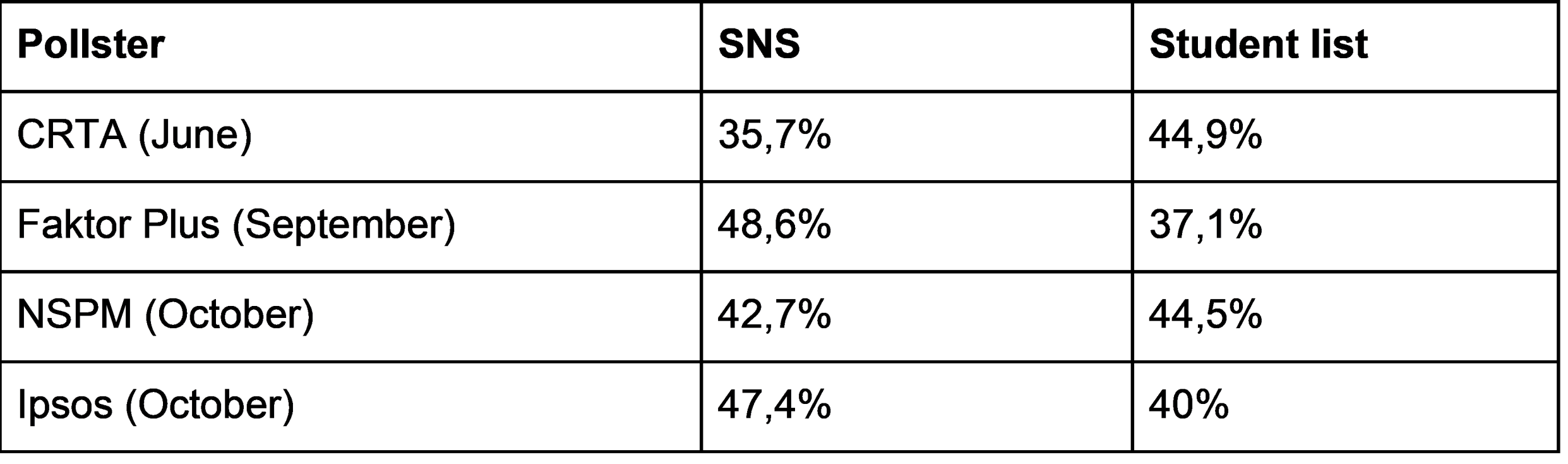
Pre-election polls showed that support was concentrated around the SNS and the student electoral list, but differed considerably in their estimates of the two sides’ relative strength. CRTA and NSPM placed the student list ahead, while Faktor Plus and Ipsos reported a lead for the ruling coalition. The differences exceeded the sampling error normally associated with individual surveys. Without accounting for methodological differences, however, they cannot be taken as evidence of shifts in voter preferences.
The surveys differed in when they were conducted, how respondents were interviewed and how the published percentages were calculated. CRTA used face-to-face interviews with a random sample, while Ipsos combined telephone interviews with an online panel. The Ipsos poll was commissioned by the ruling electoral list, although the political affiliation of a survey’s commissioner does not, in and of itself, establish bias. Without comparable methodological information, it is difficult to determine how much of the variation reflected genuine changes in support and how much resulted from differences in measurement.
The distribution of parliamentary seats depended on more than the relative strength of the two leading lists. With a three per cent electoral threshold, the performance of smaller opposition coalitions and the Socialist Party of Serbia (SPS) could have a significant bearing on the composition of parliament. Turnout added another element of uncertainty. The student list sought to mobilise citizens who had previously been less politically active, while the SNS relied on its established party organisation. There was therefore insufficient evidence to assume that higher turnout would necessarily favour either side.
Table 1: Selected opinion polls ahead of the 2026 parliamentary elections
4.2 Institutional Conditions and the Incumbent’s Structural Advantages
Although the same electoral rules formally applied to all contestants, parties differed considerably in their ability to use the institutional environment to their advantage. Despite amendments to electoral legislation, concerns remained over campaign financing, pressure on voters and the accuracy of the electoral register. The audit of the register had not been completed before polling day, while the accessibility of polling stations for Serbian citizens abroad raised further questions.[23] 15
Years in office had enabled the SNS to build close ties between its party organisation, the public sector and local institutions. OSW has noted the importance of patronage networks, particularly in communities where dependence on public-sector employment and services may limit individuals’ freedom to make political choices.15 The SNS’s advantage therefore extended beyond its organisational capacity to its position within the system through which public resources were allocated.
During the campaign, CRTA recorded more than 650 cases involving indications of possible misuse of public resources or official positions, alongside more than 250 instances of alleged political pressure linked to employment, assistance or access to public services.17 These figures reflect the findings of election observers rather than violations established by final judicial decisions. They nevertheless point to the risk of an electoral contest in which competing political actors have markedly unequal access to state resources.
4.3 The Media Environment and Democratic Standards
The structure of Serbia’s media market gave the ruling camp a further advantage. According to OSW, the SNS retained considerable influence over national television broadcasters and much of the commercial media, while critical outlets reached audiences mainly through cable networks and online platforms. CRTA’s monitoring between 14 September and 16 October found that government representatives accounted for 72 per cent of political airtime on television channels with national coverage, while 81 per cent of coverage of the student electoral list was negative.15 17
Unequal media access also affected which issues dominated the campaign and how voters encountered the competing political messages. The ruling camp had greater scope to set the campaign agenda and shape public perceptions of its political opponents. Although the student list reached large audiences through demonstrations, local initiatives and direct contact with voters, these channels could not provide the same access to viewers as national television.
The campaign was also marked by pressure on journalists and incidents of violence. United Nations special rapporteurs and international journalists’ organisations raised concerns about threats to editorial independence and journalists’ safety. CRTA documented threats and violent incidents during the campaign, while the authorities rejected allegations of systematic intimidation and accused observers of bias.[24] [25]
The election was therefore not simply a contest over which list commanded greater public support. The institutional and media advantages of the incumbent also shaped the conditions under which that support could be translated into votes. The SNS faced a challenger that had emerged outside the established opposition and could mobilise a broad range of dissatisfied citizens. Yet the student movement entered the campaign without comparable access to state resources, national media or established local party structures.
These inequalities do not, in themselves, establish that voting irregularities occurred or affected the result. Such conclusions require an assessment of the official results, documented violations and findings from post-election observation.
5. Election Results and the New Balance of Political Power
5.1 Election Results and the Reshaping of Serbia’s Political Landscape
The early parliamentary elections held on 25 October 2026 ended in defeat for the Serbian Progressive Party (SNS), which had dominated Serbian politics since 2012. According to preliminary figures released by the Republic Electoral Commission (RIK) on 26 October, with results processed from 7,926 of the country’s 8,392 polling stations, the student list Studenti pobeđuju received 52.19 per cent of the vote (2,116,719 votes), compared with 39.52 per cent (1,602,913 votes) for the Aleksandar Vučić – Ujedinjena Srbija list. Turnout stood at 68.73 per cent.
A seat projection by CeSID/Ipsos gave the student list 140 of the 250 seats in the National Assembly, the SNS 103 and national minority lists seven. If confirmed, this distribution would give the student list a sufficient majority to form a government without coalition partners. Aleksandar Vučić conceded defeat on election night.[26]
The election also altered the position of other political actors. According to preliminary results, the Socialist Party of Serbia (SPS), the SNS’s longstanding coalition partner, received 2.21 per cent of the vote and failed to clear the three per cent electoral threshold. No other major non-minority list crossed the threshold either. The result therefore amounted to more than the replacement of the dominant political force: it also marked a substantial redistribution of support within the opposition electorate.
The student list emerged as the principal alternative to the SNS, while established opposition parties were left without direct parliamentary influence. The concentration of votes around the two leading lists should not, however, be interpreted as evidence that a stable two-party system has emerged. The student list brings together politically diverse figures whose ability to maintain a coherent organisation over the longer term remains uncertain (M. V., 2026).[27]
The outcome also differed from the findings of several pre-election polls. Faktor Plus and Ipsos had reported an SNS lead, while NSPM suggested a much closer contest. All three underestimated the student list’s eventual share of the vote. The discrepancies may reflect differences in survey methods, the timing of fieldwork and difficulties in estimating turnout. They do not, in themselves, establish political bias on the part of pollsters, but indicate that the surveys failed to capture the full extent of support for the student list by polling day.26 [28] 22
5.2 From Protest Mobilisation to a Parliamentary Majority
Public visibility gained through protests did not automatically translate into electoral success. The movement had to register a candidate list, collect supporting signatures, organise a campaign and reach voters beyond the main university centres. Demonstrations, student journeys across the country and local initiatives helped establish networks that could subsequently be used during the election campaign. The available evidence does not allow the electoral contribution of each form of mobilisation to be quantified. Nevertheless, these activities helped the movement develop the organisational capacity needed to compete in a national election.[29] 13
Turnout provides a further indication of the scale of political mobilisation. According to preliminary figures, 68.73 per cent of eligible voters participated, approximately ten percentage points more than in the 2023 parliamentary elections. The increase coincided with the student list’s decisive victory, but aggregate results cannot establish whether the outcome was driven primarily by previously inactive voters, supporters of established opposition parties or former SNS voters. Identifying the relative contribution of these groups would require further post-election research.12
The SNS’s defeat also exposed the limits of its campaign strategy, which emphasised political stability, economic achievements and the risks associated with a change of government. Despite its extensive party infrastructure and substantial advantages in media access, the ruling party failed to retain a parliamentary majority.
The result must nevertheless be considered in the context of the conditions under which the election took place. In its interim report, ODIHR raised concerns about the use of public resources and the media environment, while CRTA reported irregularities on election day. The SNS’s defeat does not diminish the significance of these concerns. Rather, it indicates that the ruling party’s structural advantages were insufficient to secure continued majority support.13
The result points above all to successful mobilisation against the previous system of government. It should not be taken as an endorsement of a single economic or foreign policy orientation. The student list built its majority around demands for institutional change rather than a comprehensive programme for governing.
5.3 The Transfer of Power and the New Government’s Political and Economic Challenges
The student list’s projected parliamentary majority would allow it to form a government without entering into coalition negotiations with established political parties. The loss of the SNS’s parliamentary majority, however, would not immediately remove its influence within the civil service, state-owned enterprises and local political structures. A central test for the incoming government will be whether it can reduce political dependence within state institutions and establish more effective oversight of their activities.
Further uncertainty stems from the presidential election required following Aleksandar Vučić’s resignation in September. The election of an SNS-backed candidate could result in a period of cohabitation, with political differences between the president and the government complicating the implementation of reforms.[30] Vučić himself cannot run for a third term as the office is limited by the Serbian constitution to a maximum of two terms.
Energy security is among the most immediate economic challenges. Russian shareholders control approximately 56 per cent of Naftna industrija Srbije (NIS), which operates Serbia’s only oil refinery. Because of its Russian ownership, NIS is subject to US sanctions, and its operations depend on temporary authorisations issued by the US Office of Foreign Assets Control (OFAC). The current authorisation expires on 30 October 2026, and the company has already applied for an extension. The sale of the Russian stake could reduce the sanctions risk, but would depend on an agreement between the shareholders and decisions by the relevant US authorities. The incoming government would therefore inherit an urgent issue over which it has limited direct control.[31]
Dependence on Russian natural gas presents a separate challenge. In September, the supply agreement with Gazprom was extended until the end of 2026, securing short-term continuity but leaving the longer-term question of diversification unresolved. Reducing Serbia’s dependence on Russian supplies would require alternative import routes, infrastructure investment and changes to existing contractual arrangements. Energy policy will therefore test the new government’s ability to reconcile the country’s economic needs with any shift in its foreign policy priorities.[32]
The EXPO 2027 project and associated infrastructure investments will present another test of economic policy continuity. Transparency Serbia has raised concerns about the special legal framework governing these projects, which permits departures from standard public procurement procedures. The new government will have to decide how to proceed with investments already under way while reviewing their financing and oversight arrangements. The central issue will not simply be whether to continue the projects, but whether they can be carried out under more transparent rules for the use of public funds.[33]
In foreign policy, relations with the European Union and Russia, together with the status of Kosovo, remain the most difficult issues. During the campaign, the student list focused primarily on institutional reform, leaving its positions on these questions less clearly defined. This approach helped it attract voters from different ideological backgrounds, but may make it harder to develop a coherent government policy. Kosovo, in particular, could expose divisions within the new majority, given the limited scope for political compromise and the constraints imposed by domestic expectations.15
The student list’s most demanding task will therefore be the transition from political mobilisation to governing. Its victory makes a change of political leadership possible, but does not remove the institutional, economic and foreign policy constraints that will shape the scope of future reforms.
6. Conclusion
The student list’s electoral victory followed the gradual transformation of a protest movement into a political alternative with an appeal extending beyond the established Serbian opposition. The movement’s focus on institutional accountability was central to this development. Following the Novi Sad tragedy, demands for those responsible to be held accountable grew into a broader challenge to political interference in state institutions. By concentrating on these concerns rather than adopting a clearly defined ideological position, the students attracted support from voters with different political preferences whom traditional opposition parties had struggled to unite.
The SNS entered the election with substantial structural advantages, including an extensive party organisation, a dominant presence in the media and access to public resources. These advantages were nevertheless insufficient to preserve its parliamentary majority. This does not mean that they had no bearing on the electoral contest. The findings of domestic election observers and the concerns raised by ODIHR before polling day remain relevant to assessing the integrity of the electoral process, irrespective of the outcome. High turnout demonstrates the scale of political mobilisation, but without post-election surveys it is not possible to determine reliably which groups of voters contributed most to the student list’s victory.
The election also changed the position of the traditional opposition. The student list became the main political alternative to the SNS, while established opposition parties were left with little parliamentary representation. Yet the political diversity that enabled the movement to attract broad support may prove difficult to sustain in government. Its relatively open programme helped bring together different constituencies during the protests and the election campaign. Decisions on economic and foreign policy, however, will require agreement among groups whose priorities may not always coincide.
The SNS’s defeat shows that its organisational and institutional advantages did not guarantee electoral victory. Whether that coalition can remain intact after taking office is less certain. The new government’s ability to agree on policy priorities and carry out institutional reforms will determine whether the student movement has achieved a change in political leadership alone or laid the foundations for a more lasting transformation of governance.
* Views and opinions of the authors of this paper do not necessarily correspond to the views of the Euro-Atlantic Council of Slovenia.
7. References
[1]RTS. (2026, September 30). Srbijagas CEO Bajatovic: Gas supply deal with Russia extended through end of year. N1. https://n1info.rs/english/news/srbijagas-ceo-bajatovic-gas-supply-deal-with-russia-extended-through-end-of-year/
[2]Insajder. (2024, December 31). Događaj koji je obeležio 2024. godinu: Za pad nadstrešnice odgovorni svi u lancu odgovornih (VIDEO). https://insajder.net/vesti/dogadaj-koji-je-obelezio-2024-godinu-za-pad-nadstresnice-odgovorni-svi-u-lancu-odgovornih-video
[3]BBC News na srpskom. (2024, November 21). Tragedija u Novom Sadu: Ostavke još jednog ministra i direktorke Infrastruktura železnice. RTCG. https://rtcg.me/vijesti/bbc/629234/tragedija-u-novom-sadu-ostavke-jos-jednog-ministra-i-direktorke-infrastruktura-zeleznice.html
[4]Radio Slobodna Evropa. (2026, June 27). Vučić najavio ostavku na mitingu Srpske napredne stranke u Beogradu. https://www.slobodnaevropa.org/a/sns-miting-beograd-srbija-vucic/33790077.html
[5]Karović, B. (2025, November 19). One year since the first blockades of faculties: Generations have awakened and posed the right questions. NIN. https://www.nin.rs/english/news/95596/one-year-since-the-first-blockades-of-faculties
[6]N1. (2024, December 9). Student blockades spread to over 30 university faculties across Serbia. https://n1info.rs/english/news/student-blockades-spread-to-over-30-university-faculties-across-serbia/
[7]Studenti u blokadi. (n.d.). O blokadama. Students Win. https://studenti.org.rs/en/o-blokadama/
[8]Szpala, M. (2025, January 29). Resignation of Serbia’s prime minister: A failed attempt to quell the protests. Ośrodek Studiów Wschodnich. https://www.osw.waw.pl/en/publikacje/analyses/2025-01-29/resignation-serbias-prime-minister-a-failed-attempt-to-quell
[9]D. D. (2025, April 25). Plenum studenata FTN izglasao zahtev da se raspišu vanredni parlamentarni izbori. Danas. https://www.danas.rs/vesti/drustvo/plenum-studenata-ftn-izglasao-zahtev-da-se-raspisu-vanredni-parlamentarni-izbori/
[10]Vlada Republike Srbije. (2026, September 27). Predsednik Republike Srbije Aleksandar Vučić podneo ostavku. https://www.srbija.gov.rs/vest/1003502/predsednik-republike-srbije-aleksandar-vucic-podneo-ostavku.php
[11]Ustava Republike Srbije. (2006). Službeni glasnik Republike Srbije, No. 98/2006 and 115/2021 (amendments). https://ustavni.sud.rs/ustav-rs-i-propisi/ustav-republike-srbije
[12]Nowinowski, J. (2026a, March 2). Protests in Serbia: The government and its opponents close ranks. Ośrodek Studiów Wschodnich. https://www.osw.waw.pl/en/publikacje/analyses/2026-03-02/protests-serbia-government-and-its-opponents-close-ranks
[13]CRTA. (2026a). Parliamentary elections 2026. https://crta.plus/elections-voting-integrity/elections-2026/
[14]Tanjug & RTS. (2026, September 15). RIK proglasio listu „Studentska lista – studenti pobeđuju“. Radio-televizija Srbije. https://www.rts.rs/lat/vesti/izbori-2026/6041046/rik-proglasio-listu-studentska-lista—studenti-pobedjuju.html
[15]Nowinowski, J. (2026b, September 28). Serbia’s president Vučić resigns: A one-man show. Ośrodek Studiów Wschodnich. https://www.osw.waw.pl/en/publikacje/analyses/2026-09-28/serbias-president-vucic-resigns-a-one-man-show
[16]Zarris, S. (2026, October 21). From plenums to parliament: The rulebook behind Serbia’s Student List. The Loop. https://theloop.ecpr.eu/from-plenums-to-parliament-the-rulebook-behind-serbias-student-list/
[17]CRTA. (2026b, October 21). Izveštaj posmatračke misije CRTE o izbornoj kampanji: Manje slobode, više neravnopravnosti. https://crta.rs/izvestaj-posmatracke-misije-crte-o-izbornoj-kampanji-manje-slobode-vise-neravnopravnosti/
[18]Milenković, M. R. (2024, November 3). Kako se koalicija Srbija protiv nasilja raspadala i delila u poslednjih godinu dana. Danas. https://www.danas.rs/vesti/politika/kako-se-koalicija-srbija-protiv-nasilja-raspadala-i-delila-u-poslednjih-godinu-dana/
[19]FoNet. (2026, October 21). Jovanović („Autentična desnica“): Nema koalicije sa SNS-om, sa studentima moguća samo oročena i tehnička vlada. Insajder. https://www.insajder.net/vesti/jovanovic-autenticna-desnica-nema-koalicije-sa-sns-om-sa-studentima-moguca-samo-orocena-i-tehnicka-vlada
[20]Bieber, F. (2026, October 8). Serbian elections on a tightrope. The Balkans in Europe Policy Advisory Group (BiEPAG). https://www.biepag.eu/op-ed/serbian-elections-on-a-tightrope
[21]CRTA & Democracy Action Lab. (2026, June). Stavovi građana Srbije: Istraživanje javnog mnjenja [Research report]. https://crta.rs/wp-content/uploads/2026/07/Istrazivanje-javnog-mnjenja-jun-2026-CRTA-i-Stanford-DAL.pdf
[22]Ipsos Strategic Marketing. (2026, October 22). Rezultati istraživanja pred parlamentarne izbore – oktobar 2026. https://www.ipsos.com/sr-rs/rezultati-istrazivanja-pred-parlamentarne-izbore-oktobar-2026
[23]OSCE Office for Democratic Institutions and Human Rights. (2026, October 9). Republic of Serbia: Early parliamentary elections, 25 October 2026. Interim report (16 September–7 October 2026). https://odihr.osce.org/sites/default/files/documents/official_documents/2026/10/SRB%20Early%20Parliamentary%202026%20Interim%20Report_09.10.2026.pdf
[24]Office of the United Nations High Commissioner for Human Rights. (2026, October). Serbia: UN experts raise alarm over media freedom and shrinking civic space. https://www.ohchr.org/en/press-releases/2026/10/serbia-un-experts-raise-alarm-over-media-freedom-and-shrinking-civic-space
[25]International Federation of Journalists. (2026, October 22). Serbia: Media freedom is a cornerstone of democratic elections. https://www.ifj.org/media-centre/visuals/detail/serbia-media-freedom-is-a-cornerstone-of-democratic-elections/category/press-releases
[26]Tanjug. (2026, October 26). RIK: Na osnovu 7.998 obrađenih biračkih mesta, Studentska lista 52,33, Ujedinjena Srbija 39,44 odsto. Radio-televizija Vojvodine (RTV). https://naslovi.net/2026-10-26/rtv/rik-na-osnovu-7-998-obradjenih-birackih-mesta-studentska-lista-52-33-ujedinjena-srbija-39-44-odsto/42529879
[27] M. V. (25. oktober 2026). SPS nije prešao cenzus, prvi put od 1990. godine bez parlamentarnog statusa. RTCG. https://rtcg.me/vijesti/region/896408/sps-nije-presao-cenzus-prvi-put-od-1990-godine-bez-parlamentarnog-statusa.html
[28]Nova srpska politička misao. (2026, October 20). Srbija, jesen 2026. (I). https://www.nspm.rs/istrazivanja-javnog-mnjenja/srbija-jesen-2026.-i.html
[29]Nowinowski, J. (2026c, October 21). Vučić or the students? Serbia ahead of parliamentary elections. Ośrodek Studiów Wschodnich. https://www.osw.waw.pl/en/publikacje/osw-commentary/2026-10-21/vucic-or-students-serbia-ahead-parliamentary-elections
[30]Karović, B. (2026a, September 30). „Glasanje 25. oktobra je politički popis snaga“: Da li parlamentarni izbori mogu da utiču na ishod predsedničkih? NIN. https://www.nin.rs/politika/vesti/124649/predsednicki-izbori-posle-vuciceve-ostavke-sta-moze-da-promeni-glasanje-25-oktobra
[31]Reuters. (2026, September 24). Serbia’s Russian-owned NIS oil firm seeks new US sanctions waiver. https://www.reuters.com/business/energy/serbias-russian-owned-nis-oil-firm-seeks-new-us-sanctions-waiver-2026-09-24/
[32]Radio-televizija Srbije. (2024, April 1). Obeleženo 17 meseci od pada nadstrešnice. https://www.rts.rs/lat/vesti/drustvo/5917782/pad-nadstresnice-17-meseci.html
[33]Transparency Serbia. (n.d.). No public procurement for EXPO 2027 project. https://mail.transparentnost.org.rs/en/ts-and-media/press-isues/12535-no-public-procurement-for-expo-2027-project