
The Western Balkans
July 2026 was a month of positive and negative shocks. On 14 July, four intergovernmental conferences held in a single day allowed Montenegro to close two further negotiating chapters and Albania to close its first three, while Serbia’s Cluster 3 stayed shut and North Macedonia opened nothing at all. Bosnia and Herzegovina began and ended the month without a High Representative, and Kosovo remained under caretaker administration. Beneath the diplomacy, state capacity failed twice: faecal contamination of the water supply in Gostivar sickened thousands, and a record-low Danube cut Serbia’s fuel imports to a quarter of the target.
1. Enlargement dynamics: divergence in Brussels and administrative failure in Gostivar
On 14 July 2026, the European Union held four accession conferences in a single day with Albania, Montenegro, Ukraine and Moldova, the first such concentration since the early 2000s.1 Montenegro provisionally closed Chapter 8 (competition policy) and Chapter 29 (customs union), reaching eighteen of thirty-three.2 Albania closed Chapters 25 (science and research), 26 (education and culture) and 30 (external relations), the first it has closed since negotiations began.1
The omissions matter more than the announcements. Chapter 14 (transport policy) was technically ready on the Montenegrin side but did not receive Croatian agreement, Zagreb raising the question of cabotage rights; Chapter 31 was withheld as well.3 Because opening and closing chapters requires unanimity, any member state can convert an unresolved bilateral file into an accession instrument.
The second omission is Skopje. Enlargement Commissioner Marta Kos visited North Macedonia on 8 July and stated that the agreed constitutional amendments recognising the Bulgarian minority remain the necessary next step before the following phase can begin, urging the government not to waste time on justifications.4,5 Prime Minister Hristijan Mickoski’s conditions have not moved: guarantees for the Macedonian language and identity, rights for Macedonians in Bulgaria, and an assurance that no further bilateral vetoes will follow.6 Albania and North Macedonia opened accession negotiations on the same day in July 2022; four years on, one has closed three chapters, and the other has not opened a single one, in a state that has held candidate status since 2005.
While Skopje argued over identity clauses, one of its municipalities failed at something more elementary. From 25 June, managers at the Gostivar public utility Komunalec ordered three submersible pumps installed in a surface water channel near the town’s drinking-water overflow chamber. They operated for more than twenty days before being discovered on 16 July.7 Laboratory tests found coliform bacteria at roughly fifty times the permitted limit.8 Use of the supply was banned on 17 July9 and an epidemic declared on 20 July, after some 3,100 residents sought medical help, three utility officials were arrested.7 Accession is measured in chapters, but it is experienced as whether the tap water is safe to drink.
2. Institutional vacuums: contested arbitration in Sarajevo and Pristina
Christian Schmidt’s resignation, announced in May, took effect on 1 July. On 30 June the Steering Board of the Peace Implementation Council appointed Principal Deputy High Representative Louis J. Crishock as Acting High Representative and committed to naming a permanent successor no later than 14 July.10,11 That date passed without agreement. European members of the Council declined the Italian candidate Antonio Zanardi Landi, backed by Washington and Rome, while the United States withheld support from the French candidate René Troccaz, backed by Paris, Berlin and London; a third, compromise name was still being sought.12 Schmidt himself attributed his departure to unexpected pressure from Washington.13
The office has been contested since it acquired the Bonn powers in 1997, and the leadership of Republika Srpska has spent two decades arguing for its abolition. What is new is that the binding constraint no longer runs between Sarajevo and Banja Luka but between Washington and European capitals, and that it binds during the run-up to general elections, when the office’s supervisory role matters most.
Pristina’s deadlock is domestic in origin but structurally similar. The Central Election Commission certified the 7 June snap election results on 8 July, starting a thirty-day constitutional clock for the Assembly to constitute itself.14 Vetëvendosje took 53 of 120 seats, short of a majority. Acting President Albulena Haxhiu scheduled the constitutive session for 6 August, one day before expiry.15 The obstacle is not the government but the presidency: the Democratic Party of Kosovo has refused to support a head of state proposed unilaterally by Vetëvendosje, and failure to elect a president would dissolve the Assembly and trigger yet another election.14 Kosovo has now spent most of 2026 under caretaker administration.
In both capitals, the mechanism designed to arbitrate an international office in one case, a constitutional timetable in the other, has become the object of the dispute rather than its solution.
3. Domestic politics and security: protest and parliamentary conflict in Tirana
Albania closed its first chapters during the largest wave of anti-government protest the country has seen in years. The demonstrations, known as the Flamingo Revolution, began in mid-May in Zvërnec near the Narta lagoon over preparatory works for luxury developments on Sazan island and inside the Vjosa–Narta protected landscape, tied to Atlantic Incubation Partners, a firm affiliated with Jared Kushner’s Affinity Partners fund. The special anti-corruption prosecutor’s office is investigating the alteration of the area’s protected status, the bypassing of public tenders and the origin of the funds used to acquire land titles.16
The dispute reached parliament on 27 July, when deputies debated an agreement with Washington financing military equipment purchases worth 302 million dollars, presented by the government as strengthening Albania’s role in NATO. Protesters clashed with police outside the building and arrests were made. The opposition Democratic Party said it supported the agreement in principle but that deputies had not been given time to read the full text and that constitutional procedure had been disregarded. Agron Shehaj, leader of the opposition Mundësia party, removed a copy of the confidential agreement from the chamber after which the parliamentary ethics secretariat suspended him for sixty days the following morning.17
Thirteen days separated the closure of Chapter 30 on external relations from a session in which the country’s largest foreign security commitment in years was approved over objections that deputies had not read it.
4. Energy-economic flows: sanctions, drought and supply risk in Belgrade
On 3 July the European Commission circulated an information note arguing that Cluster 3 should be opened with Serbia, citing the reversal of contested judicial reforms and progress on media regulation and electoral legislation.18 At the meeting of permanent representatives on 8 July, eight member states – the Netherlands, Belgium, Bulgaria, Croatia, Sweden, Estonia, Latvia and Lithuania declined, citing the rule of law and insufficient alignment with the Union’s foreign and security policy, including the absence of sanctions against Russia.19 The Commission itself records that Serbia has technically met the opening conditions for over four years, so the file is no longer technical. President Aleksandar Vučić’s announcement that he would resign and call early elections moves the contest onto domestic ground, where twenty months of protest since Novi Sad remain unresolved.
The United States Office of Foreign Assets Control has kept the Oil Industry of Serbia operating on successive short waivers, the July licence expiring on 31 July, while MOL’s purchase of the Russian-held stake remains uncompleted. Pančevo supplies roughly 80 per cent of Serbian demand and depends on crude delivered through Croatia’s JANAF pipeline; the energy minister warned that without an extension the market would rely entirely on state reserves of some 269,000 tonnes of diesel.20
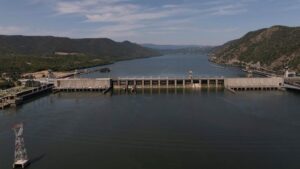
Nature then applied a second constraint. Serbian fuel imports in July reached only about a quarter of the monthly target as record-low water on the Danube forced barges and tankers to operate at 30 to 40 per cent of capacity, while drought also reduced output at the Đerdap I hydropower plant.21 With the sale of the Russian-held stake still not concluded, Serbian energy sovereignty is now measured in thirty-day licences issued in Washington and in centimetres of water at Apatin.
* Views and opinions of the authors of this paper do not necessarily correspond to the views of the Euro-Atlantic Council of Slovenia.
Sources
[1] European Western Balkans. (15. julij 2026). “Albania closes its first three negotiating chapters”. European Western Balkans. https://europeanwesternbalkans.com/2026/07/15/albania-closes-its-first-three-negotiating-chapters/
[2] European Western Balkans. (14. julij 2026). “Montenegro closes two more chapters with EU, reaches 18 out of 33”. European Western Balkans. https://europeanwesternbalkans.com/2026/07/14/montenegro-closes-two-more-chapters-with-eu-reaches-18-out-of-33/
[3] Bulgarian National Radio. (17. julij 2026). “Balkan developments”. BNR News. https://bnrnews.bg/en/post/504230/balkan-developments
[4] Balkan Insight. (8. julij 2026). “EU Presses North Macedonia to Alter Constitution to Aid Membership Bid”. Balkan Insight. https://balkaninsight.com/2026/07/08/eu-presses-north-macedonia-to-alter-constitution-to-aid-membership-bid/
[5] Novinite. (8. julij 2026). “EU’s Kos to Skopje: Don’t Waste Time! Write Bulgarians Into the Constitution”. Novinite – Sofia News Agency. https://www.novinite.com/articles/239495/
[6] BTA. (29. januar 2026). “North Macedonia PM Mickoski Sets Two Conditions for Constitutional Amendments”. Bulgarian News Agency. https://www.bta.bg/en/news/balkans/1053499-north-macedonia-pm-mickoski-sets-two-conditions-for-constitutional-amendments
[7] BTA. (21. julij 2026). “Prosecution in North Macedonia’s Gostivar Launches Investigation into Drinking Water Contamination amid Local Epidemic”. Bulgarian News Agency. https://www.bta.bg/en/news/balkans/1170754-prosecution-in-north-macedonia-s-gostivar-launches-investigation-into-drinking-w
[8] Balkan Insight. (21. julij 2026). “Tests Show Faeces Contaminated North Macedonia Town’s Water Supply”. Balkan Insight. https://balkaninsight.com/2026/07/21/tests-show-faeces-contaminated-north-macedonia-towns-water-supply/
[9] bne IntelliNews. (18. julij 2026). “Suspected water contamination leaves over 1,000 ill in North Macedonia’s Gostivar”. bne IntelliNews. https://www.intellinews.com/suspected-water-contamination-leaves-over-1-000-ill-in-north-macedonia-s-gostivar-455381/
[10] Office of the High Representative. (30. junij 2026). “Statement of the Steering Board of the Peace Implementation Council”. OHR. https://www.ohr.int/statement-of-the-steering-board-of-the-peace-implementation-council/
[11] European Western Balkans. (1. julij 2026). “Louis J. Crishock appointed as the Acting High Representative for BiH”. European Western Balkans. https://europeanwesternbalkans.com/2026/07/01/louis-j-crishock-appointed-as-the-acting-high-representative-for-bih/
[12] European Western Balkans. (14. julij 2026). “Still no agreement on the new High Representative for Bosnia and Herzegovina”. European Western Balkans. https://europeanwesternbalkans.com/2026/07/14/still-no-agreement-on-the-new-high-representative-for-bosnia-and-herzegovina/
[13] AFP. (1. julij 2026). “US diplomat named acting Bosnia top envoy”. BSS News. https://www.bssnews.net/international/401508
[14] Kosovo Online. (30. julij 2026). “Forming the Assembly at the eleventh hour: greater chances of agreement or a tactical manoeuvre?”. Kosovo Online. https://www.kosovo-online.com/en/news/analysis/forming-assembly-eleventh-hour-greater-chances-agreement-all-institutions-or-self
[15] IBNA. (20. julij 2026). “Kosovo Parliament Formation Delay Tests Political Consensus”. Independent Balkan News Agency. https://www.ibnaeu.com/en/2026/07/20/kosovo-parliament-formation-delay-political-consensus/
[16] Al Jazeera. (5. junij 2026). “Kushner Island? Why a planned resort has provoked protests in Albania”. Al Jazeera. https://www.aljazeera.com/news/2026/6/5/why-the-kushners-plan-to-build-an-albanian-resort-has-sparked-protests
[17] bne IntelliNews. (28. julij 2026). “Protesters arrested outside Albanian parliament as MPs debate US defence loan”. bne IntelliNews. https://www.intellinews.com/protesters-arrested-outside-albanian-parliament-as-mps-debate-us-defence-loan-457154/
[18] Euronews. (6. julij 2026). “European Commission renews pressure to open new accession cluster with Serbia”. Euronews. https://www.euronews.com/my-europe/2026/07/06/european-commission-renews-pressure-to-open-new-accession-cluster-with-serbia
[19] European Western Balkans. (8. julij 2026). “Eight EU member states oppose opening of Cluster 3 for Serbia”. European Western Balkans. https://europeanwesternbalkans.com/2026/07/08/eight-eu-member-states-oppose-opening-of-claster-3-for-serbia/
[20] Reuters. (22. julij 2026). “Low Danube river levels choke Serbia’s July fuel imports”. Baird Maritime. https://www.bairdmaritime.com/story/shipping/tankers/low-danube-river-levels-choke-serbias-july-fuel-imports
[21] Reuters. (27. julij 2026). “Record-Low Danube Water Levels Leave Boats Beached, Reveal Decades-Old Shipwrecks”. Insurance Journal. https://www.insurancejournal.com/news/international/2026/07/27/879010.htm