

The Iran Conflict
In July, the fragile ceasefire between the United States and Iran came to an end amid renewed attacks. Attacks by both sides were temporarily halted at several points throughout the month, following negotiations between Iran and Oman, but the pause lasted only a few days. Exchanges of fire continued into August. In addition to airstrikes, the United States reimposed a naval blockade of Iranian ports following the renewed outbreak of fighting. Funeral processions were also held in July for the late Supreme Leader, Ayatollah Ali Khamenei. During these events, crowds, along with his successor and son, called for revenge against President Donald Trump.
Yemen experienced its most significant escalation since the cessation of fighting in 2022. Alongside an airstrike on Sana’a airport carried out by forces of the internationally recognised government and Houthi shelling of southern Saudi Arabia, the Houthis established a naval blockade in the Bab al-Mandab Strait, targeting exclusively Saudi-owned vessels.
French President Emmanuel Macron and UN Secretary-General António Guterres visited Syria. During Macron’s visit, two explosions occurred near the hotel where he was staying. A terrorist cell directly linked to ISIS was responsible, and its members were later arrested by Syrian security forces. Both visits contributed to strengthening diplomatic relations between Syria and the international community.
1. Conflict between US and Iran
Although peace negotiations between Iran and the United States were ongoing in the first days of the month and showed signs of gradual progress, the situation quickly changed. On 7 July, three tankers were struck by Iranian projectiles while transiting the Strait of Hormuz.[1] On the same day, the US Treasury Department revoked the license allowing the sale of Iranian oil in the United States, which had been granted as part of the peace process.[2] In response, President Trump announced the suspension of the ceasefire while also expressing willingness to continue negotiations. The US military resumed airstrikes on targets inside Iran,[3] which in turn attacked US military bases in Bahrain and Kuwait.[4] The exchange of fire between the two sides was temporarily halted on 24 July. The main reason was reportedly negotiations between Iran and Oman regarding control of the Strait of Hormuz.[5] However, the ceasefire lasted only a few days as hostilities resumed on 29 July, when Iran fired missiles at a US base in Jordan.[6] The attacks did not cease at the end of July and have continued into August.
1.1 Situation in the state of Hormuz
The aforementioned negotiations between Oman and Iran focused on establishing a new system for the passage of vessels through the Strait of Hormuz. The Omani side proposed a joint regional mechanism for managing the strait, based on voluntary financial contributions from transiting vessels. The proposal drew on a similar mechanism implemented by Indonesia, Singapore, and Malaysia in the Strait of Malacca. Under this proposal, Iran would not have exclusive control over the strait but would share it with Oman. After four days of negotiations, the proposal was rejected. Iranian representatives emphasised that the system governing passage through the strait could not revert to its pre-war state. Despite the rejection, both sides expressed willingness to continue negotiations. Following the renewed outbreak of hostilities, the United States reimposed a naval blockade of Iranian ports on 14 July. The blockade remained in place throughout the rest of July and continues into August.[7]
On 14 July, the US reimposed a naval blockade of Iranian ports,[8] which remained in effect for the remainder of July and continues into August.
1.2 Funeral processions for the late supreme leader
Funeral processions for former Supreme Leader Ayatollah Ali Khamenei, who was killed in the February attacks at the start of the war between Iran and the United States, began on 4 July and lasted for one week.[9] During the processions, crowds called for revenge and the assassination of President Trump.[10] These calls were later publicly endorsed by the son and successor of the late leader Ayatollah Mojtaba Khamenei, who expressed a desire for revenge for his father’s death and for all victims of the conflict.[11] In response, President Trump stated that in the event of an assassination or attempted assassination against him, the intensity of US airstrikes would increase significantly.[12]
2. Yemen
Tensions also increased in Yemen over the past month. On 13 July, military forces of the internationally recognised Yemeni government carried out an airstrike on the airport in Sana’a, where a plane carrying a Houthi delegation returning from Iran was attempting to land. The strike damaged the airport’s runway, forcing the plane to land at an alternative location. The Houthis accused not only government forces but also Saudi Arabia, which supports the internationally recognised government, of carrying out the attack. Saudi Arabia’s involvement remains unconfirmed. In response, the Houthis launched rockets at southern Saudi Arabia on the same day, which were intercepted by the Saudi-led coalition.[13]
This marks the first major escalation since the cessation of hostilities in 2022. Due to the blockade of ports and airports in northeastern Yemen, and according to a Houthi military spokesperson who cited a “12-year siege and exploitation of Yemen’s natural resources” by Saudi Arabia, the Houthis announced on 20 July the establishment of a naval blockade in the Bab al-Mandab Strait, targeting exclusively Saudi-owned vessels.[14] This maritime route is of critical importance to Saudi Arabia, as it has reportedly rerouted 70% of its crude oil exports to the port of Yanbu on the Red Sea due to the situation in the Strait of Hormuz. The blockade therefore poses a significant threat to the Saudi economy. By the end of July, the Houthis had fired on three Saudi tankers attempting to transit the strait.[15]
In response, decision-makers in Riyadh began forming a maritime coalition to protect shipping from such attacks. The Saudi Ministry of Defence announced that 14 countries have issued a joint statement in support of the initiative. Riyadh has also invited the United States and European countries to participate in securing maritime traffic,[16] however, it remains unclear whether they will join.
3. Syria
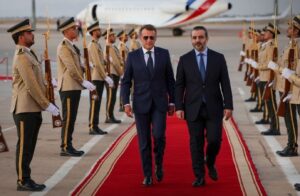
On 7 July, French President Emmanuel Macron visited Damascus, marking the first visit by a Western head of state since the fall of the Assad regime in December 2024. The purpose of the visit was to hold talks with Syrian President Ahmed al-Sharaa on improving bilateral relations between France and Syria, current regional and international developments, and economic cooperation between the two countries.[17] During the visit, two explosions occurred near the hotel, where the French president was staying.[18] The Ministry of the Interior announced that all members of the terrorist cell responsible for the explosions had been arrested. Investigations revealed that the cell was directly linked to the terrorist organisation ISIS.[19] Despite the bombings, Macron’s visit was not disrupted. Following the meeting, the two presidents announced that their countries would appoint ambassadors, marking a significant step toward restoring diplomatic relations. Macron was also accompanied by representatives of French companies. Several agreements were concluded, including in the areas of reconstruction of water and electricity infrastructure, expansion of Damascus Airport’s capacity, and the provision of technical support to the Syrian Central Bank. 18
In addition to the French President’s visit, UN Secretary-General António Guterres visited Syria on 25 July. During his visit, he met with President al-Sharaa and Foreign Minister Asaad al-Shaibani. The Secretary-General emphasised the importance of international assistance for Syria’s reconstruction and for laying the foundations for a better future, and assured continued UN support throughout this process.[20] The Secretary-General’s visit is the first of its kind since the fall of the Assad regime and the first in 17 years. This visit is crucial for Syria and its new government, as it represents progress in the restoration of diplomatic relations with the international community and the UN.[21]
* Views and opinions of the authors of this paper do not necessarily correspond to the views of the Euro-Atlantic Council of Slovenia.
Sources
[1] Arab News. “Three ships struck in Hormuz flare-up, Qatar slams Iran”. Arab News. (7.7.2026). https://www.arabnews.com/node/2649988/middle-east
[2] Kimball, S. in Cassella, M. (7.7.2026). “U.S. revokes Iran oil sales authorization after tanker attacks”. CNBC. https://www.cnbc.com/2026/07/07/us-revokes-iran-oil-sanctions-waiver-tanker-attacks.html
[3] Anna, C. “A timeline of the Iran conflict and talks aimed at ending it”. AP News. https://apnews.com/article/iran-us-timeline-trump-hormuz-war-ceasefire-04da58cbae991183f8b52ef5bf615963
[4] Arab News. (8.7.2026). “Iran targets sites in Bahrain, Kuwait after wave of US strikes
Previous”. Arab News. https://www.arabnews.com/node/2650053/middle-east
[5] Financial Times. “US pauses Iran strikes as Oman pursues Hormuz transit deal”. Financial Times. (26.7.2026). https://www.ft.com/content/ffdeacf0-91b8-48fd-9ff8-d8d134ef5f11?syn-25a6b1a6=1
[6] Serdar, R. “Iran missiles target US forces in Jordan after a five-day pause in war”. Al Jazeera. (29.7.2026). https://www.aljazeera.com/video/newsfeed/2026/7/29/iran-missiles-target-us-forces-in-jordan-after-a-five-day-pause-in-war
[7] Al Jazeera Staff and Reuters. “Iran and Oman exchange proposals to manage Strait of Hormuz”. Al Jazeera. (28.7.2026). https://www.aljazeera.com/news/2026/7/28/iran-and-oman-exchange-proposals-to-manage-strait-of-hormuz
[8] Le Monde in AFP. “US launches new Iran strikes, reimposes naval blockade”. Le Monde. (14.7.2026). https://www.lemonde.fr/en/international/article/2026/07/14/trump-backtracks-on-plan-to-toll-ships-in-strait-of-hormuz_6755469_4.html?srsltid=AfmBOoqD3vJRKKoJZCJ71MeXRKribFjYtAiKhDSb1QIZmYDSNdvEO2h8
[9] Al Jazeera Staff and AFP. “Funeral events for Iran’s slain Supreme Leader Khamenei under way in Iraq”. Al Jazeera. (8.7.2026). https://www.aljazeera.com/news/2026/7/8/funeral-events-for-irans-slain-supreme-leader-khamenei-under-way-in-iraq
[10] Wintour, P. “Calls for killing of Trump at funeral of Iran supreme leader Ali Khamenei”. The Guardian. (5.7.2026). https://www.theguardian.com/world/2026/jul/05/iran-ali-khamenei-funeral-supreme-leader-mojtaba-absent
[11] Arab News. “Iran’s supreme leader pledges revenge for slain father and predecessor”. Arab News. (11.7.2026). https://www.arabnews.com/node/2650505/middle-east
[12] Gambrell, J., Price, M. L. in Weissert, W. “Fate of Strait of Hormuz challenges talks as Trump and Iran’s supreme leader trade threats”. PBS News. (11.7.2026). https://www.pbs.org/newshour/world/fate-of-strait-of-hormuz-challenges-talks-as-trump-and-irans-supreme-leader-trade-threats
[13] Al Jazeera Staff, AFP and Reuters. “Tension rising as Yemen gov’t attacks Sanaa airport, Houthis fire missiles”. Al Jazeera. (13.7.2026). https://www.aljazeera.com/news/2026/7/13/yemen-govt-says-its-forces-attacked-sanaa-airport
[14] Gritten, D. “Yemen’s Houthis announce ‘maritime embargo’ on Saudi Arabia”. BBC. (20.7.2026). https://www.bbc.com/news/articles/cm2gmddx1ldo
[15] Al Jazeera Staff and Reuters. “Yemen’s Houthis claim missile attack on Saudi Arabia oil tanker”. Al Jazeera. (28.7.2026). https://www.aljazeera.com/news/2026/7/28/yemens-houthis-claim-missile-attack-on-saudi-arabia-oil-tanker
[16] The Guardian. “Saudi Arabia prepares sea and possible land offensive against Houthis”. The Guardian. (30.7.2026). https://www.theguardian.com/world/2026/jul/30/saudi-forces-planning-major-offensive-against-houthis-central-yemen
[17] France 24 in AFP. “Macron lands in Syria in first post-Assad visit by Western head of state”. France 24. (6.7.2026). https://www.france24.com/en/middle-east/20260706-macron-expected-in-syria-in-first-post-assad-visit-by-western-leader-damascus-says
[18] Christou, W. “Bombs explode near Damascus hotel housing Macron on Syria visit”. The Guardian. (7.7.2026). https://www.theguardian.com/world/2026/jul/07/explosions-rock-damascus-near-hotel-where-french-president-was-staying
[19] Al Jazeera Staff and Reuters. “Syria says captured Damascus bombing suspects are affiliated with ISIL”. Al Jazeera. (9.7.2026). https://www.aljazeera.com/news/2026/7/9/syria-says-cell-behind-terrorist-bombings-in-damascus-arrested
[20] United Nations. “UN chief hails Syria’s ‘moment of possibility’ on first visit since fall of Assad regime”. United Nations. (25.7.2026). https://news.un.org/en/story/2026/07/1168027
[21] Ramadan, T. in Makieh, K. “Guterres meets Syria’s Sharaa on first visit to Damascus by UN chief in 17 years”. Reuters. (25.7.2026). https://www.reuters.com/world/middle-east/guterres-set-be-first-un-chief-visit-syria-since-before-2011-war-2026-07-25/