
Eastern Europe
July 2026 was marked by a further escalation of the war in Ukraine, accompanied by intensified political, military, and economic responses from Western states. Russia expanded its large-scale missile and drone attacks on Ukrainian cities, while Ukraine continued targeting Russian energy and logistics infrastructure. At the same time, NATO, the European Union, and individual European states strengthened their political, military, and economic support for Ukraine, while continuing efforts to reinforce European and Euro-Atlantic security. Simultaneously, hybrid and cyber threats intensified along NATO’s eastern flank, migratory pressure increased on the Latvia–Belarus border, and countries across the region enhanced the protection of critical infrastructure and strengthened their preparedness for potential security incidents.
1. Russia – Ukraine
At the NATO Summit in Ankara, Allied leaders adopted the Ankara Declaration, reaffirming their commitment to collective defence under Article 5 of the North Atlantic Treaty and to a 360-degree approach to deterrence and defence.[1] They also announced further increases in defence investment, the strengthening of the defence industrial base, and the development of key military capabilities. NATO Allies committed to providing Ukraine with at least €70 billion annually in military assistance, equipment, and training for 2026 and 2027.[2] Subsequently, the North Atlantic Council adopted NATO’s multi-year funding framework, as well as a plan to strengthen the Alliance’s fuel supply chain.[3]
On 13 July, representatives of the member states of the Coalition of the Willing met in Paris to discuss continued support for Ukraine and long-term security guarantees following the potential conclusion of a ceasefire.[4] The meeting was attended by the leaders of several European countries, NATO Secretary General Mark Rutte, and Ukrainian President Volodymyr Zelenskyy.[5] Participants reaffirmed their commitment to continued military, financial, and political support for Ukraine and underscored the need for closer coordination of European efforts to strengthen the security of both Ukraine and Europe. Particular attention was devoted to long-term security guarantees for Ukraine in the event of a cessation of hostilities, the continued delivery of air defence systems and interceptors, the establishment of multinational forces to support Ukraine, and the creation of a Coalition for the Ballistic Missile Defence of Europe. [6]
Kyiv hosted the fifth Ukraine–Southeast Europe Summit on 15 July, during which the leaders of Southeast European countries reaffirmed their political, military, and economic support for Ukraine, emphasising that Ukraine’s security and the stability of Southeast Europe are inextricably linked. The Kyiv Declaration, adopted at the summit, condemned Russia’s aggression, endorsed the further strengthening of sanctions against Russia, and expressed support for the European Union accession aspirations of Ukraine and Moldova, as well as for the continuation of EU enlargement in the Western Balkans. The leaders also called for enhanced regional cooperation in the areas of security, resilience against hybrid threats, and Ukraine’s reconstruction. Slovenia will host the next summit in 2027.[7]
The EU accession process for Ukraine and Moldova advanced further in July with the opening of Cluster 6 – External Relations, covering the common commercial policy as well as the Common Foreign and Security Policy (CFSP) and the Common Security and Defence Policy (CSDP). EU Member States approved the decision on 10 July, while the formal accession conferences with Ukraine and Moldova were held four days later in Brussels. The European Commission emphasised that further progress would continue to be based on the merit-based principle, with each country’s advancement depending on its own achievements and the implementation of the necessary reforms.[8][9] Moldova also reaffirmed its objective of concluding accession negotiations by 2028, achieving readiness for EU membership by 2030, and continuing to align its foreign, security, and defence policy with that of the European Union.[10]
The European Union maintained economic pressure on Russia in July by adopting its 21st package of restrictive measures. The sanctions primarily target the energy, financial, and military-industrial sectors and include additional restrictions on banks, crypto-asset service providers, the Russian shadow fleet, oil refineries, and companies associated with Russia’s military-industrial complex. The measures also extend trade restrictions to Belarus in order to prevent sanctions circumvention, while a further 218 individuals and entities were added to the sanctions list.[11]
July was also marked by an escalation of Russian missile and drone attacks against Ukrainian cities, particularly Kyiv and Odesa. At the beginning of the month, Russia launched one of its largest aerial assaults since the start of the full-scale invasion, firing dozens of missiles and nearly 500 unmanned aerial vehicles (UAVs) at targets across Ukraine. The attacks damaged residential buildings, hotels, logistics infrastructure, and other civilian objects, and by mid-month had expanded to include Odesa.[12] In response to the intensified attacks, the European Union imposed additional sanctions on individuals and companies within Russia’s military-industrial complex involved in the production of unmanned aerial vehicles.[13] Russia also continued large-scale air operations, exploiting the limited capabilities of Ukraine’s air defence system and shortages of Patriot interceptors.[14]
Throughout July, Ukraine continued its long-range drone campaign against Russian energy and logistics infrastructure. The primary targets included oil refineries, fuel storage facilities, oil terminals, pumping stations, and tankers associated with the supply of the Russian Armed Forces and the export of energy resources. Among the facilities struck were refineries in Omsk, Ryazan, Saratov, and Tyumen, as well as the ports of Vysotsk, Ust-Luga, and Novorossiysk. According to the Ukrainian authorities, the objective of these strikes was to reduce Russia’s export revenues from energy resources and to constrain its logistical capacity to sustain military operations. The attacks triggered fires, temporarily disrupted the operation of energy facilities, and further exacerbated Russia’s fuel supply challenges. These developments confirm the continuation of Ukraine’s strategy of targeting Russia’s logistical and economic capacity to sustain its war effort.[15] [16]
At the end of July, the Russian government extended its ban on exports of gasoline, diesel fuel, marine fuel, and gas oils until 31 January 2027 in an effort to stabilize the domestic fuel market. The measure followed several months of supply disruptions and rising fuel prices caused by Ukrainian strikes on Russian oil refineries. The export ban includes exemptions for deliveries made pursuant to interstate agreements and for humanitarian assistance. The government also introduced additional measures to ensure adequate fuel supplies for the agricultural harvest season and for the needs of state and local authorities. The measure indicates that Ukrainian strikes are exerting an increasingly significant impact on the functioning of Russia’s energy sector and domestic fuel supply.[17]
The security situation in the Black Sea further deteriorated in July as a result of continued Russian attacks on Ukrainian ports and ongoing Ukrainian strikes against Russian maritime logistics. Russian attacks in the Odesa region targeted port, industrial, and civilian infrastructure.[18] In response to the heightened security risks, the three largest Russian grain export terminals in Novorossiysk and Taman restricted road deliveries of grain, while Russia also introduced a nighttime navigation ban at the Port of Novorossiysk. These developments confirm that the Black Sea remains one of the principal operational theatres of the war, where military activities continue to have a direct impact on maritime transport and the export of grain and energy commodities.[19]
During Russian attacks on Ukrainian ports along the Danube, Romania shot down a Russian drone that had violated its airspace on 24 July, marking the first such incident since the start of the war.[20] In the following days, additional violations of Romanian airspace prompted Bucharest to once again scramble fighter aircraft and reinforce surveillance along the border with Ukraine. Romanian authorities described the incidents as unacceptable, while Russia denied responsibility. These developments underscore the growing risk of the war spilling over into the territory of NATO member states and highlight the increasing security challenges along the western coast of the Black Sea.[21] [22]
In July, Romania, Bulgaria, and Türkiye expanded the mandate of the Mine Countermeasures Task Group Black Sea (MCM Black Sea), which will now, in addition to mine clearance operations, be responsible for the protection of subsea critical infrastructure, including energy and telecommunications links. The expanded mandate is intended to strengthen the security of maritime transport and enhance the protection of critical infrastructure in the Black Sea. This development reflects the growing importance of safeguarding critical maritime infrastructure and the adaptation of regional security cooperation to the evolving security environment in the Black Sea.[23]
The area around Kostiantynivka remained one of the principal hotspots of fighting in Donetsk Oblast throughout July. On 3 July, the Russian Ministry of Defence announced that its forces had captured the settlement of Kostiantynivka in Donetsk Oblast and were continuing offensive operations aimed at gaining control of the entire region; however, these claims were not confirmed by the Ukrainian authorities.[24] According to assessments by the Institute for the Study of War (ISW), Russian forces achieved only limited tactical gains during the first half of the month, without securing an operational breakthrough or establishing full control over the Kostiantynivka area. Fighting continued even after Russia’s claims of having captured the settlement, while Russian operations remained focused on expanding control in the Kostiantynivka–Druzhkivka area as part of the broader offensive in Donetsk Oblast. These developments indicate the continuation of Russia’s gradual advance, albeit without achieving a decisive operational breakthrough along this sector of the front.[25]
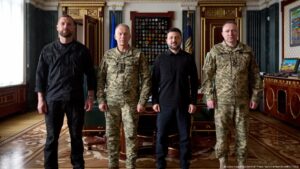
Ukraine’s domestic political landscape in July was marked by a political crisis triggered by the dismissal of Defence Minister Mykhailo Fedorov as part of a broader government reshuffle.[26] The personnel changes sparked several days of protests in Kyiv, where demonstrators called for his reinstatement and demanded greater transparency in wartime decision-making. During the reshuffle, President Volodymyr Zelenskyy appointed Mykhailo Drapatyi as the new Commander-in-Chief of the Armed Forces of Ukraine. Fedorov declined an offer to assume another position within the state administration, arguing that defence reforms could only be effectively pursued if he remained Minister of Defence.[27] These developments demonstrated that domestic political tensions, despite the continuation of the war, can also affect the governance of the defence sector and the implementation of defence reforms.
2. Eastern Europe
On 13 July, the North Atlantic Council condemned the persistent Russian cyberattacks targeting NATO member states and partner states. In its statement, the Council noted that the attacks had targeted critical infrastructure and government authorities and that such activities constitute a threat to the security of the Alliance. NATO called on Russia to cease these activities, announced further measures to strengthen its cyber posture, and reaffirmed its readiness to deter, defend against, and respond to the full spectrum of cyber threats, while reiterating its continued support for Ukraine.[28] The statement underscores the growing importance of cyberspace as a key domain of the Alliance’s collective defence and deterrence posture.
The security situation on NATO’s eastern flank in July was marked by warnings from Poland, Lithuania, and Latvia regarding the heightened risk of Russian hybrid activities. Polish intelligence services assessed that Russia was seeking to exploit political tensions between Poland and Ukraine through disinformation campaigns and potential sabotage operations targeting military facilities, critical infrastructure, and organisations supporting Ukraine.[29] The Presidents of Lithuania and Latvia also warned of the possibility of limited hybrid or military attacks against critical energy and transport infrastructure in the Baltic states or Poland, aimed at testing NATO’s response. In response, the countries strengthened the protection of critical infrastructure and emphasised the need for continued preparedness and a coordinated Allied response.[30] These developments indicate that hybrid threats remain one of the principal security challenges on NATO’s eastern flank.
Migratory pressure along the Latvia–Belarus border increased significantly in July. Latvian authorities reported a record number of attempted irregular border crossings from Belarus and assessed that this represents a continuation of Belarus’s use of migration as an instrument of hybrid pressure against the eastern members of the European Union and NATO. In response to the growing number of incidents, Latvia reinforced border security, with Lithuanian and Estonian border authorities and the Latvian Armed Forces also participating in border surveillance operations.[31] [32]At the end of the month, Latvia temporarily closed the Pāternieki border crossing for technical reasons. Following the earlier closure of the Silene border crossing, Pāternieki had remained the only operational road border crossing between Latvia and Belarus.[33] These developments confirm the continued use of migration as an instrument of political and security pressure against the eastern member states of the European Union and NATO.
* Views and opinions of the authors of this paper do not necessarily correspond to the views of the Euro-Atlantic Council of Slovenia.
Sources
[1] NATO (8. 7. 2026). The Ankara Summit Declaration. NATO. https://www.nato.int/en/about-us/official-texts-and-resources/official-texts/2026/07/08/the-ankara-summit-declaration
[2] NATO (8. 7. 2026). Statement by the Secretary General at the Ankara summit: “NATO is fulfilling its commitments”. NATO. https://www.nato.int/fr/news-and-events/articles/news/2026/07/08/secretary-general-on-the-ankara-summit-nato-delivers
[3]NATO (22. 7. 2026). North Atlantic Council approves NATO-funding for upcoming years, agrees Fuel Supply Chain Plan. NATO. https://www.nato.int/en/news-and-events/articles/news/2026/07/22/north-atlantic-council-approves-nato-funding-for-upcoming-years-agrees-fuel-supply-chain-plan
[4] Prime Minister’s Office, 10 Downing Street (13. 7. 2026). Statement of the co-chairs of the Coalition of the Willing: 13 July 2026. Gov.UK. https://www.gov.uk/government/news/statement-of-the-co-chairs-of-the-coalition-of-the-willing-13-july-2026
[5] NATO (13. 7. 2026). NATO Secretary General attends meeting of the Coalition of the Willing in Paris. NATO. https://www.nato.int/en/news-and-events/articles/news/2026/07/13/nato-secretary-general-attends-meeting-of-the-coalition-of-the-willing-in-paris
[6] Carmichael, E. and Novikov, I. (13. 7. 2026). Ukraine and 9 other countries announce a coalition to protect Europe from ballistic missiles. AP. https://apnews.com/article/russia-ukraine-war-europe-coalition-putin-d813eb18fba24a57f7cb2000b302ef4d
[7] President of Ukraine (15. 7. 2026). The 5th Ukraine–Southeast Europe Summit Held in Kyiv: Key Outcomes. The Presidential Office of Ukraine, Official site. https://www.president.gov.ua/en/news/u-kiyevi-vidbuvsya-v-samit-ukrayina-pivdenno-shidna-yevropa-105477
[8] Enlargement and Eastern Neighbourhood (14. 7. 2026). Enlargement: EU and Moldova start negotiations on external relations policies. European Commission. https://enlargement.ec.europa.eu/news/enlargement-eu-and-moldova-start-negotiations-external-relations-policies-2026-07-14_en
[9] Liboreiro, J. (10. 7. 2026). EU agrees to open new phase of membership talks with Ukraine and Moldova. Euro News. https://www.euronews.com/my-europe/2026/07/10/eu-agrees-to-open-a-new-accession-cluster-with-ukraine-and-moldova
[10] EU (14. 7. 2026). Moldova maintains EU accession timeline. Moldpres. https://www.moldpres.md/eng/eu-1/moldova-maintains-eu-accession-timeline
[11] Council of the EU (23. 7. 2026). 21st package of sanctions: EU hits Russian energy, financial services and crypto hard. European Council. https://www.consilium.europa.eu/en/press/press-releases/2026/07/23/21st-package-of-sanctions-eu-hits-russian-energy-financial-services-and-crypto-hard/
[12] Reuters (2. 7. 2026). Russia, after heavy strike on Kyiv, says it will keep increasing pressure on Ukraine. Reuters. https://www.reuters.com/world/russia-after-heavy-strike-kyiv-says-it-will-keep-increasing-pressure-ukraine-2026-07-02/
[13] Council of the EU (17. 7. 2026). Russian military-industrial complex: EU agrees six listings related to deadly strikes on Kyiv. European Council. https://www.consilium.europa.eu/en/press/press-releases/2026/07/17/russian-military-industrial-complex-eu-agrees-six-listings-related-to-deadly-strikes-on-kyiv/
[14] Arhirova, H., Kullab, S. and Novikov, I. (7. 7. 2026). Russia’s missile and drone attacks on Ukraine kill at least 22. AP. https://apnews.com/article/russia-ukraine-war-july-6-2026-0280e3d86022720fd5fa0236122ad90e
[15] Meredith, S. (10. 7. 2026). Ukraine escalates attacks on tankers near Crimea as Russian fuel shortages bite. CNBC. https://www.cnbc.com/2026/07/10/ukraine-russia-crimea-fuel-oil.html
[16] Arhirova, H. and Hatton, B. (29. 7. 2026). Ukraine says it hit a major Russian oil refinery, hours after Zelenskyy’s meeting with Trump. The Washington Times. https://www.washingtontimes.com/news/2026/jul/29/ukraine-says-struck-major-russian-oil-refinery-hours-zelenskyys/
[17] Reuters (30. 7. 2026). Russia extends diesel, gasoline export bans until end of January 2027. Reuters. https://www.reuters.com/business/energy/russia-extends-diesel-gasoline-export-bans-until-end-january-2027-2026-07-30/
[18] Reuters (15. 7. 2026). Russian strike on Ukraine’s Odesa kills three as Moscow, Kyiv battle over Black Sea. Reuters. https://www.reuters.com/world/europe/russian-attack-ukraines-odesa-kills-three-official-says-2026-07-15/
[19] Reuters (28. 7. 2026). Three Russian Black Sea terminals restrict grain intake by truck amid shipping risks, sources say. Reuters. https://www.reuters.com/world/three-russian-black-sea-terminals-restrict-grain-intake-by-truck-amid-shipping-2026-07-28/
[20] Reuters (24. 7. 2026). Romania shoots down drone in airspace incursion for first time. Internazionale. https://www.internazionale.it/ultime-notizie-reuters/2026/07/24/romania-shoots-down-drone-breaching-its-airspace-president-says
[21] Reuters (25. 7. 2026). Romania says it shot down second drone breaching its airspace. Reuters. https://www.reuters.com/world/europe/romania-says-it-shot-down-second-drone-breaching-its-airspace-2026-07-25/
[22] McGrath, S. and Ghirda, V. (28. 7. 2026). NATO member Romania shoots down stray drones from Ukraine war after years of incursions. AP. https://apnews.com/article/romania-europe-russia-ukraine-war-drones-nato-ee9775ba338f5408bfa9ab3cb5f2ad1d
[23] Reuters (8. 7. 2026). Black Sea NATO states expand mine force to protect infrastructure. Reuters. https://www.reuters.com/world/black-sea-nato-states-expand-mine-force-protect-infrastructure-2026-07-08/
[24] Reuters (4. 7. 2026). Russian defence ministry says its forces captured Kostiantynivka in eastern Ukraine. Reuters. https://www.reuters.com/business/aerospace-defense/russian-defence-ministry-says-its-forces-captured-kostiantynivka-eastern-ukraine-2026-07-03/
[25] Trach, T., Thacker, A., Frykholm, S. et. al. (16. 7. 2026). Russian Offensive Campaign Assessment. ISW. https://understandingwar.org/research/russia-ukraine/russian-offensive-campaign-assessment-july-16-2026/
[26] Kullab, S. (12. 7. 2026). Ukraine’s prime minister steps down as Zelenskyy announces government reshuffle. AP. https://apnews.com/article/russia-ukraine-war-oil-refinery-strike-f0bab8086a84705db07c74b3b1b99c49
[27] Krupa, J. (22. 7. 2026). New Ukraine army chief vows to step up counteroffensive as EU bids to finalise fresh Russia sanctions – as it happened. The Guardian. https://www.theguardian.com/world/live/2026/jul/22/ukraine-war-russia-sanctions-europe-eu-latest-news-updates
[28] NATO (13. 7. 2026). Statement from the North Atlantic Council condemning Russia’s acts of cyberattacks. NATO. https://www.nato.int/fr/about-us/official-texts-and-resources/official-texts/2026/07/13/statement-of-condemnation-by-the-north-atlantic-council-of-russias-malicious-cyber-activities
[29] Reuters (1. 7 . 2026). Poland warns Russia seeks to exploit Ukraine tensions with sabotage operations. Reuters. https://www.reuters.com/world/poland-warns-russia-seeks-exploit-ukraine-tensions-with-sabotage-operations-2026-07-01/
[30] Dapkus, L. and Ciobanu, C. (15. 7. 2026). Baltics and Poland warn Russia could launch limited military or hybrid provocation against NATO. AP. https://apnews.com/article/lithuania-baltics-poland-russia-attack-infrastructure-nato-fb3d17fac66f23568cd3cd27264a4c75
[31] Chmielewski, B. (17. 7. 2024). Latvia: significant increase in migratory pressure from Belarus. OSW. https://www.osw.waw.pl/en/publikacje/analyses/2026-07-17/latvia-significant-increase-migratory-pressure-belarus
[32] Peseckyte, G. (17. 7. 2026). Latvia becomes Lukashenka’s latest pressure point for the EU. EuroNews. https://www.euronews.com/my-europe/2026/07/17/latvia-becomes-lukashenkas-latest-pressure-point-for-the-eu
[33] Reuters (31. 7. 2026). Latvia closes border with Belarus, interior minister says. Reuters. https://www.reuters.com/world/latvia-closes-border-with-belarus-interior-minister-says-2026-07-31/