
Counter-Offensives and Spillover: Sudan, Mali and The Central African Republic
July 2026 brought the first significant shifts in front lines across Africa’s crisis zones after months of deadlock, while also exposing the limits of external security patrons. In Sudan, the army mounted its largest offensive since the recapture of Khartoum at the end of the month and took control of the key supply road to the besieged city of El Obeid, while the European Union banned imports of Sudanese gold. In Mali, JNIM and the Azawad Liberation Front (FLA) launched their second large offensive in three months on 4 July; the six-day battle for Anéfis was the longest sustained engagement in the country since 2012. In the Central African Republic, a newly formed rebel alliance coming from territory held by Sudan’s RSF attacked government and Russian positions. The common denominators of the month were the spillover of Sudan’s war across borders and the inability of external allies to hold ground.
In contrast to previous months, July 2026 produced some tangible movement. In Sudan, the army achieved its first major operational success since retaking the capital; in Mali, the government and Russian forces largely contained a large-scale insurgent offensive; and in the Central African Republic, the authorities, with Russian help, recovered a lost border town within days. This does not, however, amount to a reversal of the trend. All three cases point to two things: Sudan’s war is increasingly spilling across borders and reshaping conflicts in its neighbourhood, while external security patrons – Russia’s Africa Corps, the Wagner Group and United Nations missions – are finding it ever harder to hold the ground they are meant to protect.
1. Sudan: the army’s first major counter-offensive and European pressure on the war economy
July opened with the siege of El Obeid, the capital of North Kordofan and the hub of the army’s command in central Sudan. The Rapid Support Forces (RSF) squeezed the city with drone strikes on fuel depots and water stations.1 Around half a million people were trapped there, and the UN human rights office warned of an impending humanitarian catastrophe, as the siege followed the pattern that led to the fall of El Fasher last October.2 El Fasher itself received a legal designation on 9 July: the independent UN fact-finding mission concluded that the mass killings, gang rapes and deliberate starvation of the population were part of an intentional RSF policy meeting the definition of genocide.3
The European Union’s response followed in the same week and revealed its divisions. On 9 July the European Parliament, by 476 votes to 28, called for the RSF to be added to the list of terrorist organisations and for sanctions against external backers, among them an Emirati company alleged to have violated the UN arms embargo.4 The Council of the EU, however, adopted a narrower measure on 13 July: it banned the purchase and import of Sudanese gold and the export of mercury and cyanide to Sudan.5 Brussels chose the route of draining the war economy over the politically sensitive terrorist designation, and the effect will be limited if gold smuggling routes are redirected to non-European markets.
The military turn came at the end of the month. On 25 and 26 July the army, together with the allied Joint Forces, captured the town of Bara along with Um Sayala, Jabrat al-Sheikh, Um Qurfa and Al-Baraka, taking control of the entire 350-kilometre “export road” between Omdurman and El Obeid, which the RSF had held since the early months of the war.6 Army commander Abdel Fattah al-Burhan visited the captured towns on 27 July and announced that the offensive would continue westward, including a push towards Um Dafuq on the border with the Central African Republic.7, 8 Some of the most intense air strikes of the war followed.9 This is the army’s first substantial success since retaking Khartoum, as the restored supply route relieves El Obeid,10 but the siege has been loosened rather than lifted – the war is increasingly being fought over supply corridors rather than for the cities themselves.
2. Mali: a second JNIM offensive and a test of Russian support
In Mali, the al-Qaeda-linked JNIM and the Tuareg Azawad Liberation Front (FLA) launched their second large coordinated offensive in three months on 4 July. In the north, the attackers struck the military base in Gao and the towns of Aguelhok and Anéfis, the last two locations in the Kidal region where the army still maintained a presence; positions in Sévaré and central Mali were hit in parallel, as was the high-security prison at Kénieroba, roughly 70 kilometres from Bamako.11 The army initially claimed to have repelled every attack, but later publicly acknowledged the help of Russia’s Africa Corps in defending Konna and Somadougou – a rare admission.13
The central event was the battle for Anéfis, which lasted six consecutive days and was the longest sustained engagement in Mali since the 2012 rebellion. After 54 air strikes between 6 and 8 July, the army claimed to have killed more than 300 fighters and retook the town on 8 July, but the insurgents shelled the camp again the following day.12 Anéfis carries disproportionate weight: since November 2023 it has served as a forward base for Turkish Bayraktar TB2 drones, and it controls the junction of the roads towards Kidal, Tessalit and Aguelhok.
July was above all a test of Russian support. Unlike after the April offensive, when it withdrew from Kidal and Tessalit through negotiations, the Africa Corps this time publicly rejected any agreed withdrawal – yet attempts to resupply the besieged units failed: a convoy from Gao was forced to turn back by an ambush on 5 July, in which a Russian Mi-24 helicopter was destroyed, and a second, considerably larger convoy was attacked south of Anéfis on 9 July. Geran drones, the Russian derivative of Iran’s Shahed, were also recorded in Mali for the first time.12 Support therefore exists, but is not sufficient to hold ground. The blockade of Bamako, which JNIM has maintained since September 2025 through attacks on fuel tankers, remains in place,14 and for Europe the further erosion of Malian state structures is a direct question of migration and smuggling flows towards the Mediterranean.
3. The Central African Republic: Sudan’s war crosses the border
The strategically most telling development of the month took place on the border between Sudan and the Central African Republic. On 30 June, more than 700 fighters of the newly formed Patriotic Awakening Alliance (ASP) attacked positions of the Central African Armed Forces (FACA) and their Russian allies from the Wagner Group in the border town of Am Dafok in Vakaga prefecture. The attackers overran the positions, wounded three UN peacekeepers and controlled the town for roughly five days, until FACA and Wagner retook it on 5 July. It was the most serious escalation in the country’s north-east since early 2023.12
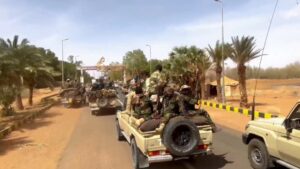
The composition of the alliance explains why the episode reaches beyond a local frame. The ASP was formed only in mid-May 2026 under the warlord Noureddine Adam and brings together former fighters of the Séléka and CPC coalitions; the attack was launched from territory in South Darfur controlled by Sudan’s RSF, and most of the fighters were reportedly Sudanese. It came during a contraction of the international presence: the UN mission (MINUSCA) closed more than two dozen bases in early June, driven in part by financial and political pressure from the United States.12
On 15 July the mission reported that the situation had calmed since 5 July but remained fragile and unpredictable,15 and at the end of the month it reported the first voluntary returns of displaced people;16 most of Am Dafok’s population had fled, and some sought refuge at the UN base.17 The geography here is no coincidence: Am Dafok lies directly opposite the Sudanese town of Um Dafuq – precisely where Burhan directed the continuation of his offensive at the end of July – and Emirati supply routes to the RSF also run through this area.8, 12 The Central African Republic’s internal conflict is thereby being drawn into the logic of Sudan’s war. For European actors, the conclusion is uncomfortable: scaling back peacekeeping missions for budgetary reasons does not reduce costs but defers them.
* Views and opinions of the authors of this paper do not necessarily correspond to the views of the Euro-Atlantic Council of Slovenia.
Sources
- International Rescue Committee. „Sudan: An imminent RSF offensive is pushing North Kordofan toward humanitarian catastrophe, warns IRC.” IRC. (2 July 2026) https://www.rescue.org/uk/press-release/sudan-imminent-rsf-offensive-pushing-north-kordofan-toward-humanitarian-catastrophe
- Al Jazeera. „El-Obeid under siege by RSF: Could this be Sudan’s next el-Fasher?” Al Jazeera. (6 July 2026) https://www.aljazeera.com/news/2026/7/6/el-obeid-under-siege-by-rsf-could-this-be-sudans-next-el-fasher
- Al Jazeera. „UN probe finds mass killings, gang rapes by Sudan’s RSF amount to genocide.” Al Jazeera. (9 July 2026) https://www.aljazeera.com/news/2026/7/9/un-probe-finds-mass-killings-gang-rapes-by-sudans-rsf-amount-to-genocide
- Sudan Tribune. „EU parliament calls for terrorist listing of Sudan’s RSF over El-Obeid siege.” Sudan Tribune. (9 July 2026) https://sudantribune.com/article/316049
- Council of the European Union. „Sudan: Council strengthens EU sanctions regime by targeting gold trade.” Consilium. (13 July 2026) https://www.consilium.europa.eu/en/press/press-releases/2026/07/13/sudan-council-strengthens-eu-sanctions-regime-by-targeting-gold-trade/
- Sudan Tribune. „Sudanese army takes full control of Omdurman-El Obeid road.” Sudan Tribune. (26 July 2026) https://sudantribune.com/article/316641
- Dabanga Radio TV Online. „El Burhan visits newly captured North Kordofan towns.” Dabanga. (28 July 2026) https://www.dabangasudan.org/en/all-news/article/el-burhan-visits-newly-captured-north-kordofan-towns
- Mada Masr. „Sudan Nashra: Military’s largest offensive since Khartoum brings major RSF logistics corridor in North Kordofan under its control.” Mada Masr. (1 August 2026) https://www.madamasr.com/en/2026/08/01/news/u/sudan-nashra-militarys-largest-offensive-since-khartoum-brings-major-rsf-logistics-corridor-in-north-kordofan-under-its-control-military-rsf-prepare-detainee-records-in-response-to-un-exc/
- Sudan Tribune. „Sudanese army launches heavy airstrikes on RSF positions in Kordofan.” Sudan Tribune. (30 July 2026) https://sudantribune.com/article/316827
- Horn Review. „Can the Recapture of Bara Alter the Trajectory of Sudan’s War?” Horn Review. (29 July 2026) https://hornreview.org/2026/07/29/can-the-recapture-of-bara-alter-the-trajectory-of-sudans-war/
- Al Jazeera. „Mali’s army says rebels launch new attacks on towns and cities.” Al Jazeera. (4 July 2026) https://www.aljazeera.com/news/2026/7/4/armed-fighters-attack-multiple-towns-across-mali
- Critical Threats Project. „Another JNIM Offensive Across Mali; SAF Advances on Secondary Fronts; New CAR Rebellion: Africa File, July 9, 2026.” American Enterprise Institute. (9 July 2026) https://www.criticalthreats.org/analysis/jnim-fla-mali-sudan-rsf-saf-car-russia-burundi-drc-m23
- France 24. „Mali hit by new wave of coordinated rebel attacks.” France 24. (4 July 2026) https://www.france24.com/en/live-news/20260704-mali-hit-by-new-wave-of-coordinated-attacks
- Security Council Report. „West Africa and the Sahel, July 2026 Monthly Forecast.” Security Council Report. (1 July 2026) https://www.securitycouncilreport.org/monthly-forecast/2026-07/west-africa-and-the-sahel-17.php
- „Two weeks after the attack on Am-Dafock, MINUSCA continues its efforts to protect civilians, maintain State authority, and facilitate the delivery of humanitarian assistance.” United Nations Peace Operations. (15 July 2026) https://minusca.unmissions.org/en/news/two-weeks-after-the-attack-on-am-dafock-minusca-continues-its-efforts-to-protect
- „MINUSCA continues its DDR efforts and strengthens its action in Am-Dafock.” United Nations Peace Operations. (29 July 2026) https://minusca.unmissions.org/en/news/minusca-continues-its-ddr-efforts-and-strengthens-its-action-in-am-dafock
- Africanews. „Fleeing attack, Centrafricans try to ‘survive till help arrives’.” Africanews. (24 July 2026) https://www.africanews.com/2026/07/24/fleeing-attack-centrafricans-try-to-survive-till-help-arrives/