
The use of the Wagner Group by the Russian Federation as a tool of foreign policy in Mozambique
The region of Cabo Delgado has been plagued by endless violence for almost a decade due to an ongoing insurgency, which began in 2017. The Mozambican government has struggled to put an end to this conflict, as it has many internal problems, such as the poor state of its military forces and internal instability. Consequently, Mozambique had previously resorted to unconventional methods in order to suppress the insurgency in the north. One of those methods was hiring an illicit Russian armed group, known as the Wagner Group, in 2019, but its presence was ultimately short-lived. Wagner arrived in Mozambique in September 2019 and left two months later, stating that the whole operation was not profitable and had resulted in a high number of casualties among its operatives. Besides failing to fulfil the demands of the contract, Wagner’s early retreat also seemed to put a strain on relations between the Russian Federation and Mozambique. However, in the last few years, it has become apparent that Wagner’s failure did not jeopardise relations between the two countries; on the contrary, their relations appear to be improving. This opens the possibility of the Wagner Group returning to Mozambique in the future, but in the form of the so-called Africa Corps.
Key words: Russian Federation, Mozambique, Wagner Group, Cabo Delgado, insurgency, natural resources
Introduction
Mozambique has a turbulent past and present, marked by many challenges, mostly connected to the Islamist insurgency in its northern region of Cabo Delgado, which began in 2017. Mozambique’s government had turned to the Russian Federation for help in the middle of 2019.[1] The Wagner Group had deployed approximately 200 of its contractors and equipment. Two months after deployment, all of Wagner’s operations had ceased, and the group started to pull out of the country.[2] Its deployment in Mozambique as a tool in the Russian foreign policy repertoire was a failure in many aspects. However, Wagner’s failure was not necessarily Moscow’s as well.
Origins of the insurgency
We cannot attribute the start of the insurgency to a single factor. From unstable beginnings, a complicated political sphere [3], religious differences amongst the population[4][5] and so-called “natural resources curse.”[6][7] When examined collectively, these factors contributed to the creation of a complex environment of political mistrust, socioeconomic exclusion and growing frustration among parts of the population.[3]
What was the Wagner Group?
Private military companies often operate in legal grey zones because there is no comprehensive and binding international regulatory framework governing their activities. Oversight at the national level is frequently weak or non-existent, and contracts with such companies are rarely made public.[8] The only notable legal document is the Montreux Document from 2008, which does not affect PMCs directly, but states which hire them, and only in case those states are signatories of the document, which the Russian Federation is not.[9] According to Marten (2019), Wagner Group cannot be easily classified within existing typologies of private military companies, as its ambiguous legal status allowed it to operate in an even greater “grey zone” than traditional PMCs.[10] Such groups are, because of Russia’s criminal law and constitution. Due to this, they exist as unregistered entities and operate outside of Russia. This is possible because these groups are owned by oligarchs in Putin’s inner circle, operating according to Russia’s ambitions and objectives abroad.[11]
Founded around 2010 by Dmitry Utkin with the approval of the Russian General Staff and financed by Yevgeny Prigozhin, Wagner became an important tool of Russian foreign policy between 2019 and 2023, particularly in Africa, where Moscow sought to expand its influence and counter Western actors.[12] During this period, the group employed an estimated 35,000–45,000 contractors and operated fluidly between state and non-state roles through a network of private front organisations, while also engaging in diplomatic activities on behalf of the Kremlin.[13] Following Wagner’s failed rebellion in June 2023 and the deaths of Utkin and Prigozhin two months later, Moscow established a new entity called the Africa Corps to take over Wagner’s activities.[14]
Deal between the Mozambican and Russian governments
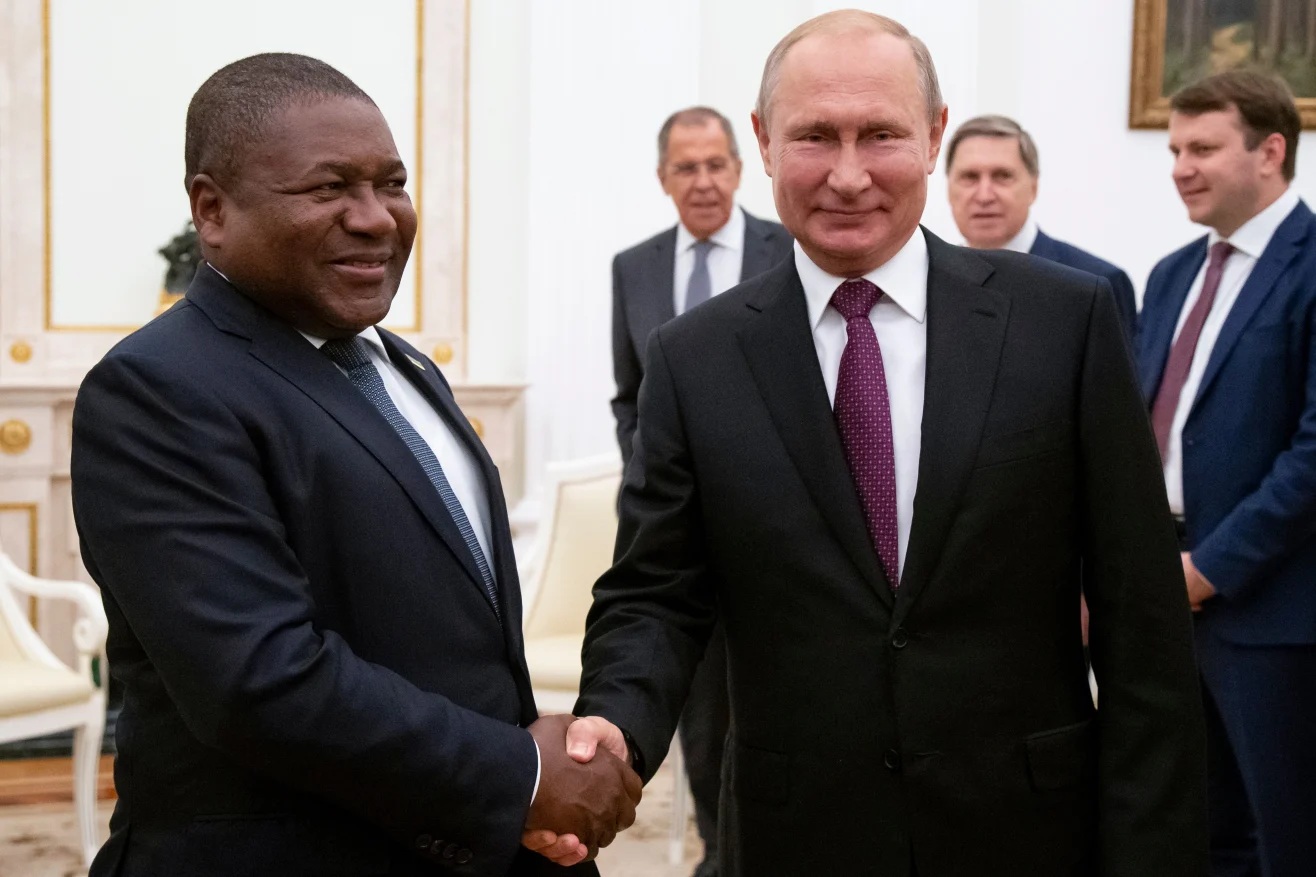
The Mozambican military was poorly equipped and lacked training to effectively fight against insurgents and reportedly suffered from problems related to organisation and politics. As a result, in August 2019, President Filipe Nyusi flew to Russia to strike a deal, which would help the government to even the odds in the armed conflict.1 Mozambique–Russia ties date back to Mozambique’s independence war in the 1960s and 70s, when the Soviet Union aided the liberation movement against Portuguese colonial rule (Mozambique also received this aid after the end of the independence war). In connection with this aid, Russia is reported to have pardoned over 90% of Mozambique’s debt. These two facts and the overall low cost of hiring Wagner Group compared to other Western PMCs probably contributed to hiring the Russian armed group. In addition, Mozambique had reportedly struck several deals with Russian companies, specialised in gas extraction, but the success of those deals was connected with Wagner’s success in combating insurgents.[15]
Deployment of Wagner Group in Mozambique and its eventual retreat
In September 2019, around 200 of Wagner’s contractors with ground combat equipment, assault helicopters and drones arrived in Mozambique.[12] One of the group’s initial tasks was reportedly to serve as presidential security during the October 2019 elections. After the elections, the group’s activity was diverted to conducting counterinsurgency operations.[16] Wagner was also tasked with commanding [12], training and advising Mozambican military units. In November, Wagner began its retreat from the country, deeming the situation to be unsustainable and not profitable enough in contrast to effort, costs and casualties.[2]
This decision stemmed from a range of internal and external problems faced by Wagner. The first problem was the lack of infrastructure and dense vegetation, which provided cover for insurgents and consequently obstructed Wagner’s reconnaissance and planned raids. The second problem was the insurgents’ use of guerrilla tactics, such as ambushes, which posed a significant challenge for Wagner’s forces, whose commando-style approach proved ineffective. Contractors also failed to establish a good relationship with Mozambican military units and soldiers. Both sides lacked coordination and displayed mutual distrust towards each other.[*] The relationship was even more strained since Wagner’s contractors failed to understand the complexity of the political situation in the region and the conflict itself. These problems had seriously hampered Wagner’s combat capability, which consequently led to casualties.[2] The precise number is difficult to determine, as various sources present different information. Some sources had reported that Wagner suffered around a dozen casualties in its first weeks in Mozambique [12], while others had estimated the number of casualties to be around 50.[2]
[*] This is evident from the reports of Wagner accusing Mozambican soldiers of not carrying out orders assigned to them, and simultaneously, Mozambican soldiers complaining that some of them are being bullied by the contractors. Reportedly, Wagner’s contractors regarded Mozambican soldiers as unprepared and undisciplined.[2]
Wagner’s failure as a tool of foreign policy in Mozambique
Wagner and similar groups are used by Russia as a means of indirect political influence. By delivering protection, spreading propaganda, offering infrastructure security and providing military support, they help with partnership building between Russia and host nations while simultaneously strengthening Russia’s image and stance abroad.[11] Analysing Wagner’s deployment in Mozambique, we can see that the group did not succeed in establishing a good relationship with local military forces. Due to Wagner’s failure to fully suppress the insurgency, the relationship between the group and the Mozambican government quickly deteriorated with mutual accusations of incompetence and betrayal. However, Mozambique did not link the group’s failures to the Russian government. Wagner’s contract was frozen, and in 2024, Mozambique started talks with Moscow about the future of the contract and conflict.[2] Mozambique’s neutral stance on the war in Ukraine and its abstentions in United Nations votes indicate that relations between the two countries are improving.[17]
The use of Wagner and similar groups is linked to the acquisition of rights for natural resource extraction and access to related markets. Reportedly, Wagner’s initial strategy was to provide its services to host nations in exchange for payment in the form of resources or commercial offerings.[11] Wagner’s early retreat could have caused the deals regarding the extraction of gas, made between the Mozambican government and several Russian companies, to fail.[15] No evidence has been found that would suggest that; however, Mozambican Minister for Foreign Affairs and Cooperation Maria dos Santos Lucas requested her Russian counterpart Sergey Lavrov to support the entry of Russian oil and gas companies into the Mozambican market in order to enhance diversification. This suggests that Wagner’s early withdrawal only stalled but did not stop them.[18] During the visit, the two ministers also discussed defence matters. Lavrov expressed Russia’s willingness to support Mozambique in developing its defence capabilities and counterterrorism efforts, which further indicates closer cooperation between the two countries.[19]
Russia’s strategic use of groups like Wagner is also meant for countering the influence of Western countries and preventing them from establishing a foothold in regions where Russia has an interest, as seen in Mali, where Wagner replaced French forces and consequently expanded Russian influence.[11] Following Wagner’s premature withdrawal and contractual failure, the Mozambican government turned to other PMCs, the Dyck Advisory Group and the Paramount–Burnham Global consortium, both of which are based in South Africa.[1] Although the companies are not Western, their arrival filled the resulting security gap and limited Russia’s ability to consolidate influence in the country. Consequently, this allowed the companies to expand their own influence and limit or even erase the foothold and influence of Russia in Mozambique.
Conclusion
We cannot say that Russia’s efforts in foreign policy were, as a whole, a failure, as evident from the cases stated above. In conclusion, Wagner was unsuccessful in its deployment in Mozambique, as it failed to satisfy the demands of its customer and sponsor, but its failure ultimately did not harm Russia’s ambitions and relationship with Mozambique. One of the things that can be studied more closely in the near future is the role of the so-called Africa Corps, which is expected to replace Wagner and similar groups in their roles and services in many African countries. Creation of this new entity is proof that Russia still exhibits great interest in the African continent.
* Views and opinions of the authors of this paper do not necessarily correspond to the views of the Euro-Atlantic Council of Slovenia.
Sources
[1] Nhamirre, B. “Will foreign intervention end terrorism in Cabo Delgado?”. Institute of security studies. (2021). https://www.jstor.org/stable/resrep62708
[2] Giustozzi, A., de Deus Pereira, J. and Lewis, D. “Did Wagner succeed in the eyes of its African and Middle Eastern clients? — The Wagner Group in Africa and Middle East”. Royal United Services Institute, Whitehall Report. (2024). https://static.rusi.org/wagner-in-africa-and-middle-east.pdf
[3] Ntaka, B. “The Cabo Delgado insurgency: a symptom of governance failure in Mozambique”. African Journal of Governance and Development (AJGD). (1.6.2023). https://doi.org/10.36369/2616-9045/2023/v12i1a2
[4] Mozambique News Reports & Clippings. “Religion is shaping Cabo Delgado civil war”. Mozambique News Reports & Clippings. (2020). https://university.open.ac.uk/technology/mozambique/sites/www.open.ac.uk.technology.mozambique/files/files/Mozambique_484-30Apr2020_Supplement-religion-vote.pdf
[5] Morier-Genoud, E. (interviewee) and Guilengue, F. (journalist). “Understanding the Jihadi Insurgency in Cabo Delgado”. Rosa Luxemburg Stiftung. (28.8.2025). https://www.rosalux.de/en/news/id/53832/understanding-the-jihadi-insurgency-in-cabo-delgado
[6] Matile, L. “Mozambique’s gas curse”. Alliance Sud. (n. d.). https://www.alliancesud.ch/en/mozambiques-gas-curse
[7] BBC. “Mozambique’s jihadists and the ‘curse’ of gas and rubies”. BBC. (18.9.2020). https://www.bbc.com/news/world-africa-54183948
[8] Gill, J. “Ghost networks and grey zones: How are PMSCs reshaping African security and democracy?”. Democracy in Africa. (2025). https://democracyinafrica.org/ghost-networks-and-grey-zones-how-are-pmscs-reshaping-african-security-and-democracy/
[9] Giles, K. and Akimenko, V. “Use and utility of Russia’s private military companies”. Conflict Studies Research Centre. (2019). https://www.researchgate.net/publication/350557003_Use_and_Utility_of_Russia’s_Private_Military_Companies
[10] Marten, K. “Russia’s use of semi-state security forces: the case of the Wagner Group”. Post-Soviet Affairs. (26.3.2019). https://doi.org/10.1080/1060586X.2019.1591142
[11] Uribe, E. J. “Mercenaries of influence: How Russian PMCs redefined power projection”. Geopolitical Monitor. (16.10.2024). https://www.geopoliticalmonitor.com/mercenaries-of-influence-how-russian-pmcs-redefined-power-projection/
[12] Olech, A. “The Wagner Group in Africa. The sham battle of Russian mercenaries against terrorism”. Terrorism – studies, analyses, prevention. (11.3.2024). https://doi.org/10.4467/27204383TER.24.010.19398
[13] Lauder, M. A. “State, non-state, or chimera? The rise and fall of the Wagner Group and recommendations for countering Russia’s employment of complex proxy networks”. Hybrid CoE. (2024). https://www.hybridcoe.fi/publications/hybrid-coe-working-paper-33-state-non-state-or-chimera-the-rise-and-fall-of-the-wagner-group-and-recommendations-for-countering-russias-employment-of-complex-proxy-networks/
[14] ACLED. “The Wagner Group and Africa Corps”. ACLED. (n. d.). https://acleddata.com/armed-group/wagner-group-and-africa-corps
[15] Sixto, D. “Russian Mercenaries in Africa: A String of Failures”. Geopolitical Monitor. (24.8.2020). https://www.geopoliticalmonitor.com/russian-mercenaries-a-string-of-failures-in-africa/
[16] Faulkner, C. “Undermining democracy and exploiting clients: The Wagner Group’s nefarious activities in Africa”. CTC Sentinel. (2022). https://ctc.westpoint.edu/undermining-democracy-and-exploiting-clients-the-wagner-groups-nefarious-activities-in-africa/
[17] Lima, F. “Understanding current Mozambique-Russia relations”. Zitamar News. (23.8.2023). https://www.zitamar.com/understanding-current-mozambique-russia-relations/
[18] Club of Mozambique. “Mozambique invites Russian companies to produce gas in country”. Club of Mozambique. (23.7.2025). https://clubofmozambique.com/news/mozambique-invites-russian-companies-to-produce-gas-in-country/
[19] Rédaction Africanews. “Russia and Mozambique reaffirm defence cooperation after foreign ministers’ meeting”. Rédaction Africanews . (2025). https://www.africanews.com/2025/07/22/russia-and-mozambique-reaffirm-defence-cooperation-after-foreign-ministers-meeting/