

The Iran Conflict
In May 2026, diplomatic negotiations continued regarding the end of the war between the US and Iran. In the Strait of Hormuz, Iran introduced a toll system for the safe passage of ships, administered by the newly established Persian Gulf Strait Authority (PGSA). In addition, Tehran discussed with Oman the establishment of an alternative maritime route through Omani territorial waters and a potential toll system; however, following US threats of sanctions, Oman announced that it would not help to implement such a system. A US delegation visited China, where Presidents Trump and Xi Jinping discussed important topics, including the war in Iran. As tensions in the Strait of Hormuz escalated, discussions within the EU regarding its response to security challenges in the region also intensified. Consequently, France and the United Kingdom have deployed military ships to the southern Red Sea as part of preparations for a planned international maritime mission following the end of hostilities. At the same time, High Representative Kaja Kallas stated that there is a possibility of extending the EUNAVFOR Aspides operation to the Strait of Hormuz.
1. State of the conflict between the US and Iran
The temporary ceasefire between the two countries, which was established on 8 April, held throughout May, although its stability was put to the test on several occasions. On 30 April, Tehran submitted a proposal to end the war, which the American side rejected on 1 May, citing the inadequacy of the stated conditions.[1] This pattern can be observed throughout the entire month, with both sides exchanging proposals, via a Pakistani mediator, rejecting and then revising them. The main reasons for the delay in the negotiations were the dispute over control of the Strait of Hormuz, the US blockade of Iranian ports, the status of Iran’s nuclear program, war reparations to Iran, and the cessation of fighting in Lebanon.[2] During the negotiations, an exchange of fire occurred, reportedly triggered by Iran firing on four ships attempting to cross the strait. On 28 May, the US carried out an attack near the airport in Bandar Abbas, shooting down four drones and destroying a control station. Iran responded with an attack on a US military base.[3] Such incidents have not significantly jeopardised negotiations between the two sides, as they are still ongoing and will continue into June.
1.1 The situation in the Strait of Hormuz
Control of the Strait of Hormuz is the central issue complicating the negotiations. After the war began, Iran established complete control over the strait, introduced a single shipping lane through which ships may pass only with Tehran’s explicit permission, and began charging transit fees to ships belonging to countries with which Iran does not have friendly relations. Tehran reinforced this policy with its 5 May announcement of the establishment of a new agency called the Persian Gulf Strait Authority (PGSA), whose task is to control the strait and charge ships for safe passage. The establishment of the PGSA is a direct response to the US operation Project Freedom, which the US announced on 3 May. As part of this operation, US military ships, with air support, escorted commercial vessels through the strait. The project lasted only two days, as the US suspended it due to alleged pressure from allied Gulf states, which expressed concern over the possibility of renewed escalation of the conflict.[4]
In May, talks took place between Iran and Oman regarding the establishment of a new maritime route that would pass through Omani territorial waters. This new route was established, but few ships used it. US military ships also escorted commercial vessels along the same route during Operation Project Freedom until its conclusion.[4] Discussions between Iran and Oman also touched on the subject of the fee system for safe passage through the strait.[5] In response to these talks, the US Treasury announced the imposition of heavy sanctions against Oman.[6] Consequently, Oman announced that it would not participate in the establishment of such a system and would not charge for passage through the strait.[7]
1.2 War between the US and Iran mentioned during a visit to China
An American high-level visit to China took place between 13 and 15 May. The visit had originally been scheduled for March but was postponed at the request of the US due to the war in Iran.[8] During the visit, Presidents Donald Trump and Xi Jinping discussed not only trade issues and the situation regarding Taiwan but also the war in Iran. They agreed that keeping the Strait of Hormuz open is essential and that Iran must not possess nuclear weapons. This position was further confirmed by the Chinese Ministry of Foreign Affairs, which expressed hope for an early end to the war and the restoration of maritime routes. According to Trump, President Xi also promised that China would not supply military equipment to Iran.[9]
2. France and the United Kingdom are preparing an international naval mission
In April, France and the United Kingdom announced that they would start planning and preparing an international naval mission in the Strait of Hormuz, which would take place after the end of the armed conflict. They also hosted the first meeting of leaders from countries willing to participate, as well as a planning conference.[10] On 12 May, a virtual meeting of defence ministers from all 38 participating countries took place, during which they confirmed the mandate and mission of the planned operation and expressed their political support. The mission will be conducted in cooperation with all relevant actors and in accordance with international law and national legislation. Its main purpose will be to support civilian maritime navigation, primarily by ensuring the safety of commercial vessels and conducting mine clearance operations.[11]
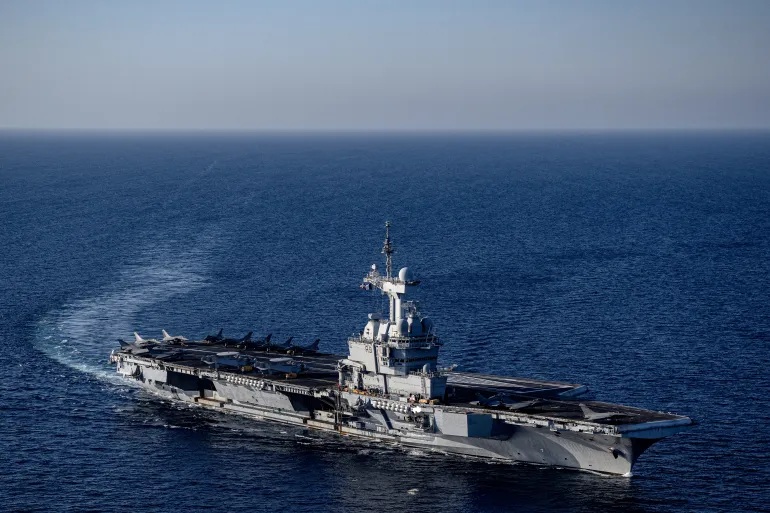
As part of preparations for this mission, the French carrier battle group, led by the aircraft carrier Charles de Gaulle and comprising Italian and Dutch warships, set sail on 6 May for the southern Red Sea.[12] Just a few days later, on 11 May, the British destroyer HMS Dragon[*] also set sail for the same destination.[13] It reached the southern Red Sea on 22 May and subsequently integrated into the French carrier battle group.[14]
[*] Both HMS Dragon and the French carrier battle group were present in the eastern Mediterranean before setting sail for the southern Red Sea. The presence of these ships was a direct response to the outbreak of war in the Middle East.[14]
3. The potential expansion of Operation Aspides to the Strait of Hormuz
Kaja Kallas, the EU’s High Representative for Foreign Affairs and Security Policy, stated on 12 May that, once the armed conflict ends, the EU could extend the EUNAVFOR Aspides naval operation to the Strait of Hormuz. Kallas added that some countries have already indicated their willingness to contribute additional military ships to the operation.[15]
Operation Aspides was launched in February 2024 in response to Houthi attacks on commercial and merchant ships in the Red Sea. The purpose of the operation is to protect such vessels and ensure freedom of navigation. The operation is conducted along maritime routes near the Bab al-Mandab Strait and also includes monitoring of developments in the Strait of Hormuz, the Gulf of Oman, the Arabian Sea, the Gulf of Aden, and international waters of the Red Sea. On 23 February, the EU Council extended the operation’s mandate until 28 February 2027 and allocated an additional 15 million euros to it. The extension of the mandate and the additional funding reflect the EU’s commitment to maritime security, regional stability, and protection of sea lanes.[16]
Following a meeting with the foreign ministers of the EU member states on 28 May, High Representative Kallas emphasised that expanding the mission to the Strait of Hormuz would primarily require a larger number of military vessels and possible changes to the operation’s operational plans. These changes depend on potential additional requirements, such as specialised mine-clearing vessels that would be needed in the Strait of Hormuz. Media reports cited a statement by an anonymous EU official who reportedly mentioned the possibility of merging Operation Aspides with the aforementioned international naval mission, led by France and the United Kingdom, but before any merger, it is necessary to determine under whose authority the operation would operate.[17]
* Views and opinions of the authors of this paper do not necessarily correspond to the views of the Euro-Atlantic Council of Slovenia.
Sources
[1] Ž. N. and B. R. “Iran: Pripravljeni smo tako na vojno kot na pogajanja. ZDA grozijo ladijskim družbam s sankcijami ”. RTV SLO. (2.5.2026). https://www.rtvslo.si/svet/vojna-v-iranu/iran-pripravljeni-smo-tako-na-vojno-kot-na-pogajanja-zda-grozijo-ladijskim-druzbam-s-sankcijami/780995
[2] Arab News. “Pakistan hands US revised Iranian proposal for ending war”. Arab News. (18.5.2026). https://www.arabnews.com/node/2644018/middle-east
[3] Arab News. “Iran and US trade air strikes after Trump dismisses report of Hormuz deal”. Arab News. (28.5.2026). https://www.arabnews.com/node/2645181/middle-east
[4] International Crisis Group. “The State of the Strait: The Role of Hormuz in the Middle East War So Far”. International Crisis Group. (29.5.2026). https://www.crisisgroup.org/visual-explainers/hormuz/
[5] Swai, F. “Iran, Oman discuss Strait of Hormuz toll system: Report”. The Hill. (22.5.2026). https://thehill.com/policy/international/5891356-strait-hormuz-toll-system-iran-oman/
[6] Al Jazeera Staff. “US Treasury threatens Oman with sanctions over Hormuz Strait”. Al Jazeera. (28.5.2026). https://www.aljazeera.com/news/2026/5/28/us-treasury-threatens-oman-with-sanctions-over-hormuz-strait
[7] Arab News. “Bessent: Oman assured US it has no plans to impose toll on Strait of Hormuz”. Arab News. (28.5.2026). https://www.arabnews.com/node/2645287/middle-east
[8] Ž. N. “Kitajska potrdila obisk ameriškega predsednika Donalda Trumpa”. RTV SLO. (11.5.2026). https://www.rtvslo.si/svet/azija-z-oceanijo/kitajska-potrdila-obisk-ameriskega-predsednika-donalda-trumpa/781788
[9] G. V. and B. V. “Po obisku Kitajske Trump posvaril Tajvan. Ši bo jeseni obiskal ZDA”. RTV SLO. (15.5.2026). https://www.rtvslo.si/svet/azija-z-oceanijo/po-obisku-kitajske-trump-posvaril-tajvan-si-bo-jeseni-obiskal-zda/782209
[10] Le Monde and AFP. “London hosts military talks on France and UK’s Hormuz mission”. Le Monde. (22.4.2026). https://www.lemonde.fr/en/international/article/2026/04/22/london-hosts-military-talks-on-france-and-uk-s-hormuz-mission_6752705_4.html
[11] Ministry of Defence and The Rt Hon John Healey MP. “Joint statement on the Multinational Military Mission for the Strait of Hormuz: 12 May 2026”. GOV.UK. (14.5.2026). https://www.gov.uk/government/news/joint-statement-on-the-multinational-military-mission-for-the-strait-of-hormuz-12-may-2026
[12] Irish, J. and Pineau, E. “France moves aircraft carrier to Red Sea with eye on Hormuz mission”. Reuters. (6.5.2026). https://www.reuters.com/world/middle-east/french-aircraft-carrier-group-moving-into-red-sea-gulf-aden-2026-05-06/
[13] Ministry of Defence and The Rt Hon John Healey MP. “UK and France set to host multinational Strait of Hormuz meeting as British Warship to pre-position in the region”. GOV.UK. (11.5.2026). https://www.gov.uk/government/news/uk-and-france-set-to-host-multinational-strait-of-hormuz-meeting-as-british-warship-to-pre-position-in-the-region
[14] Willett, L. “Dragon Adds More Air-Defence Firepower to French Carrier Strike Group”. Naval News. (22.5.2026). https://www.navalnews.com/naval-news/2026/05/dragon-adds-more-air-defence-firepower-to-french-carrier-strike-group/
[15] Ž. N. “Kallas: EU bi lahko misijo Aspides razširil na Hormuško ožino, vendar le po koncu vojne”. RTV SLO. (12.5.2026). https://www.rtvslo.si/evropska-unija/kallas-eu-bi-lahko-misijo-aspides-razsiril-na-hormusko-ozino-vendar-le-po-koncu-vojne/781980
[16] Council of the European Union. “Red Sea: Council extends the mandate of Operation ASPIDES to safeguard freedom of navigation”. Council of the European Union. (23.2.2026). https://www.consilium.europa.eu/en/press/press-releases/2026/02/23/red-sea-council-extends-the-mandate-of-operation-aspides-to-safeguard-freedom-of-navigation/
[17] Hadjicostis, M. “EU envoy seeks more vessels to secure Hormuz navigation once the war in Iran ends”. AP News. (28.5.2026). https://apnews.com/article/freedom-navigation-strait-hormuz-kallas-iran-eu-c6c0f0e72181e629a1b1f2b037d555d8