
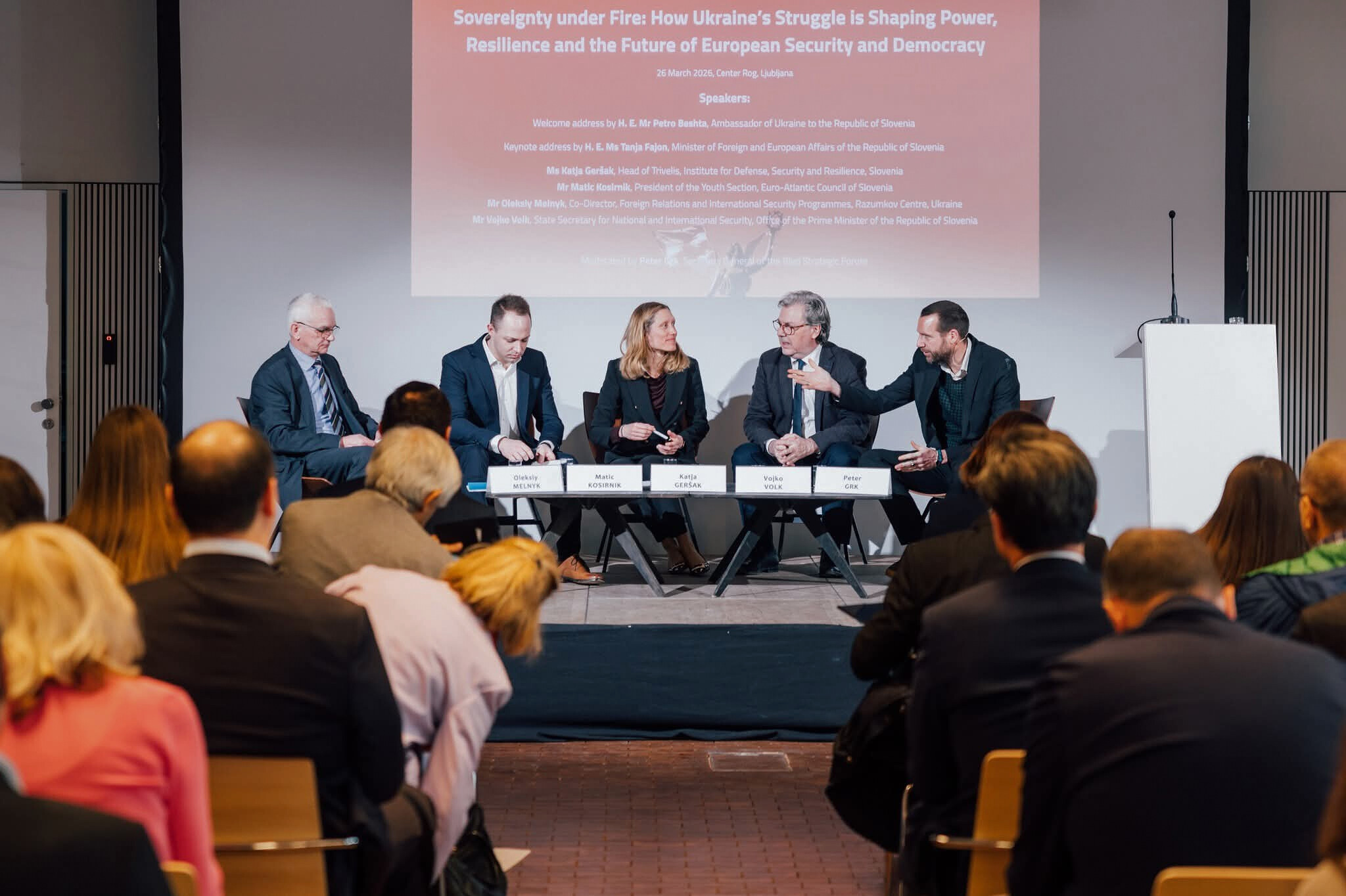
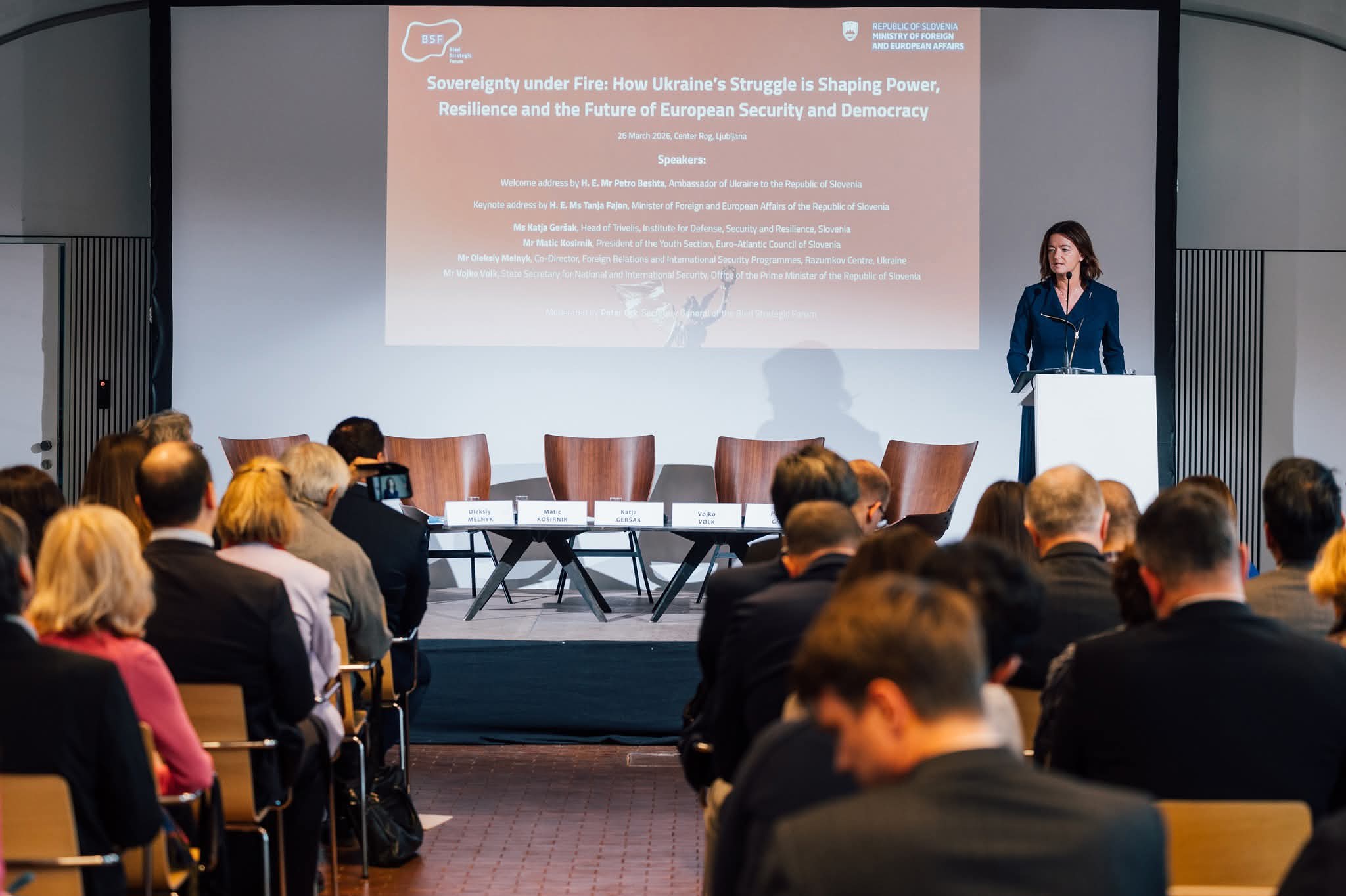
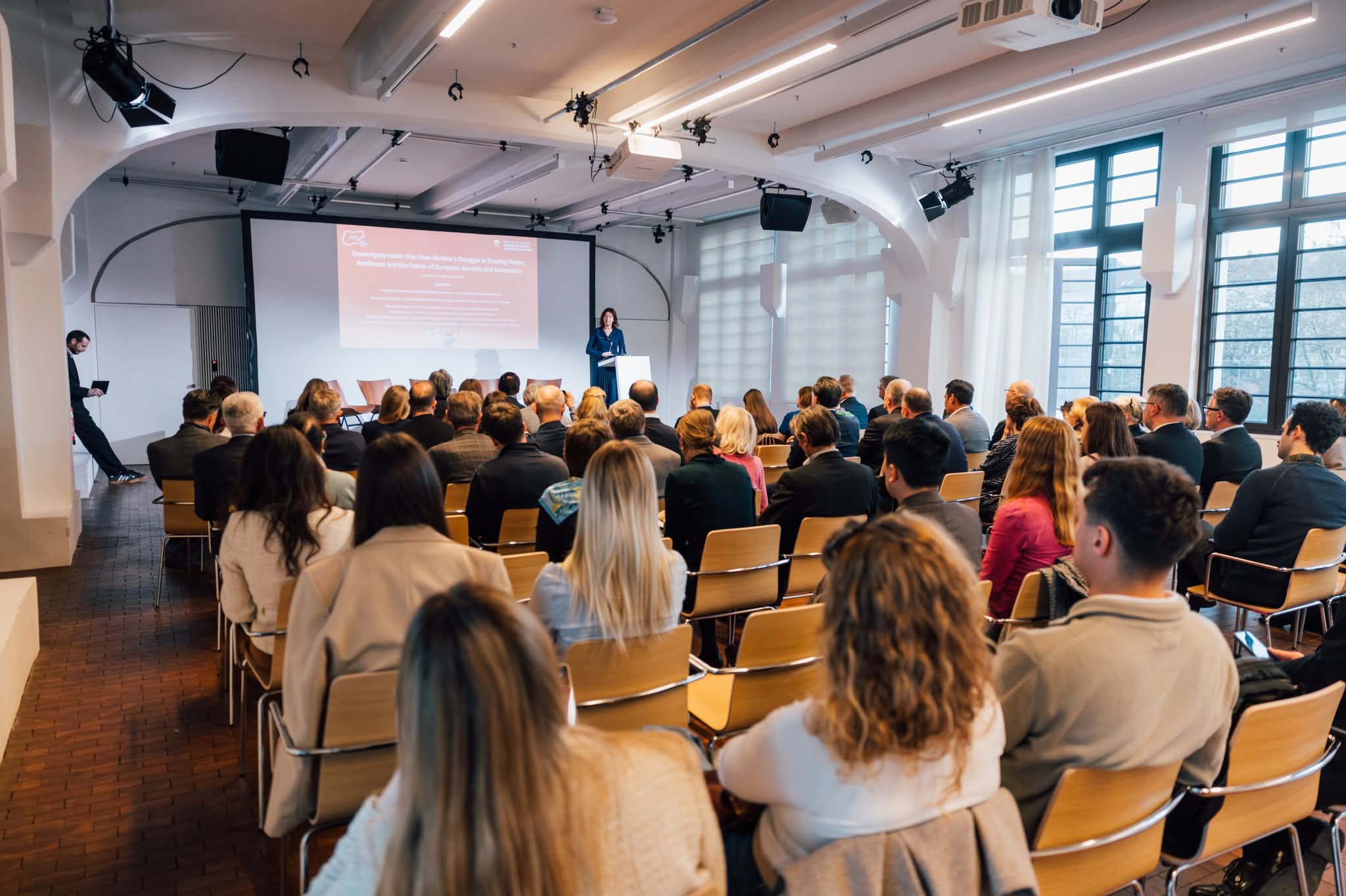
On 26 February 2026, the Bled Strategic Forum and the Ministry of Foreign and European Affairs of the Republic of Slovenia hosted a panel discussion in Ljubljana titled “Sovereignty under Fire: How Ukraine’s Struggle is Shaping Power, Resilience and the Future of European Security and Democracy.”
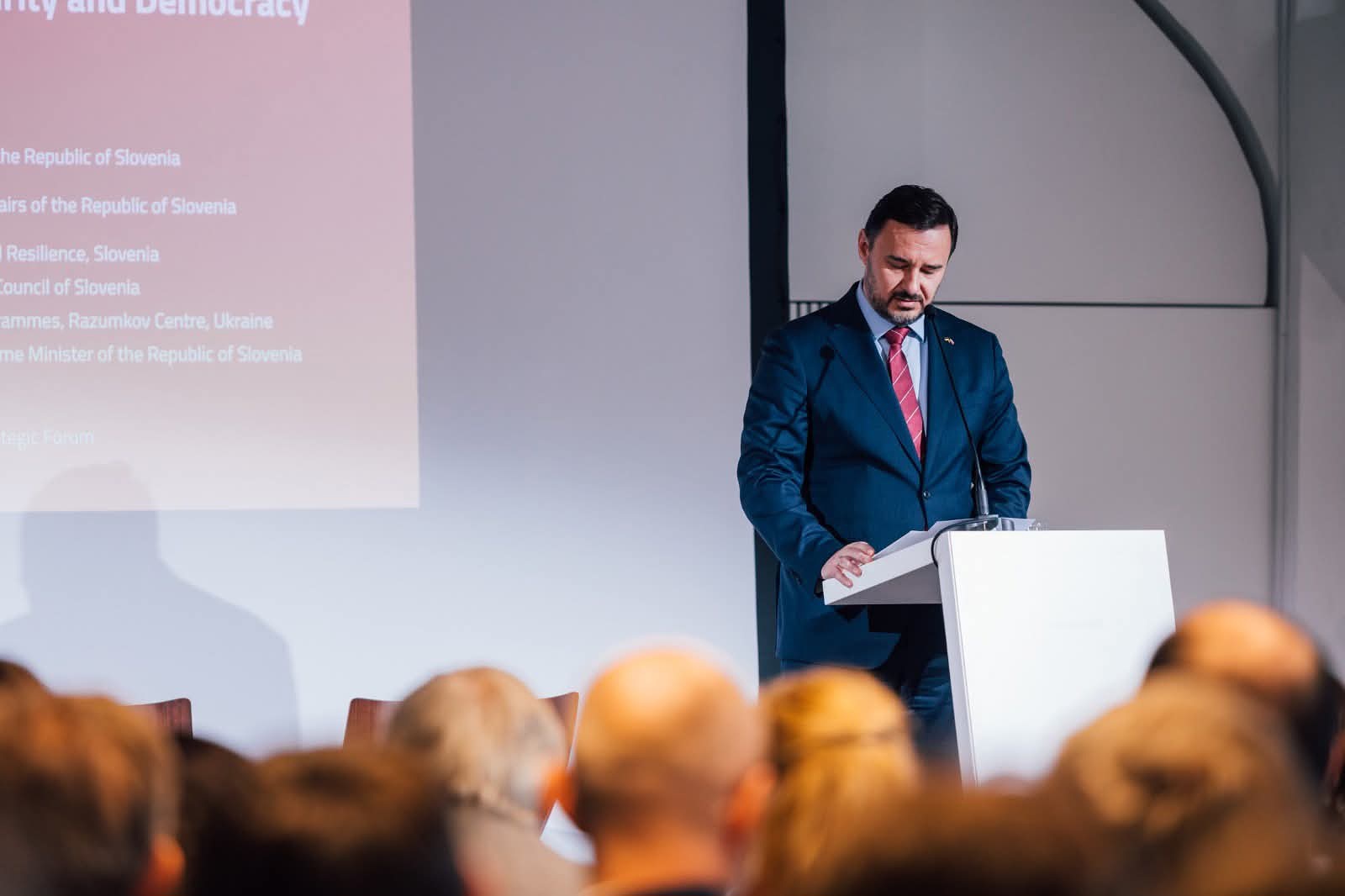
The discussion opened with a welcome address by H. E. Mr Petro Beshta, Ambassador of Ukraine to the Republic of Slovenia, followed by a keynote address by Ms Tanja Fajon, Minister of Foreign and European Affairs of the Republic of Slovenia.
The panel featured:
-
- Mr Vojko Volk, State Secretary for National and International Security, Office of the Prime Minister of the Republic of Slovenia
- Ms Katja Geršak, Head of Trivelis, Institute for Defence, Security and Resilience, Slovenia
- Mr Matic Kosirnik, President of the Youth Section, Euro-Atlantic Council of Slovenia (YATA Slovenia)
- Mr Oleksiy Melnyk, Co-Director, Foreign Relations and International Security Programmes, Razumkov Centre, Ukraine
The discussion was moderated by Mr Peter Grk, Secretary General of Bled Strategic Forum.
Below, Matic Kosirnik shares his reflections on how Ukraine’s struggle is shaping power, resilience and the future of European security and democracy*:
Four years into Russia’s full-scale aggression against Ukraine, one thing is clear: the war has fundamentally reshaped how we understand power and security in Europe.
For three decades after the Cold War, security in Europe was built on a specific set of assumptions. Large-scale interstate war on the Old Continent was considered highly unlikely — if not eradicated — seen as something belonging to the past, incompatible with a multilateral, cooperative and liberal order.
Security deepened and broadened beyond the state to include societal, economic, environmental and human dimensions. The nature of the threat changed, and the focus shifted away from traditional deterrence and territorial defence. Efficiency became the organising principle — lean forces, limited stockpiles and “just enough” at “just-in-time” logic.
That logic is no longer fit for purpose.
War has returned to Europe with alarming ferocity — at a scale we have not witnessed since the end of the Second World War. More broadly, we are witnessing the highest number of active state-based and violent conflicts in decades. Power politics has returned to the forefront of international relations. We find ourselves suspended between a multilateral order that is eroding and one that has not yet fully taken shape, and in which we try to find our place — intellectually, politically, and strategically.
And in terms of the organising principle of security, we are witnessing a structural return to state-centric logic. Deterrence, force posture, readiness and defence-industrial capacity are once again central. The hierarchy of threats has changed. This does not mean that societal or human security disappears — but it does mean that hard security has moved to the core again.
This shift is visible across Europe: unprecedented increases in defence spending, renewed focus on defence capability production and readiness, and a rethinking of energy dependency as a strategic vulnerability rather than safety. Adaptation is not optional — it is essential.
European unity cannot be taken for granted. Cohesion requires leadership, strategic patience and honest political communication. The informational dimension of this war has demonstrated how vulnerable open societies can be to manipulation, oversimplification and false moral equivalences. Safeguarding democratic institutions and strengthening societal resilience have therefore become core security tasks.
From a generational perspective, the implications are significant. Today’s youth were socialised entirely within the post-Cold War environment — shaped by open borders, interdependence and prosperity, and by the assumption that peace in Europe was permanent. Security was treated as an obscure background condition, rather than a strategic achievement requiring continuous reinforcement.
This created a strategic comfort bubble in which a significant portion of today’s youth grew up. It is not ignorance — it is generational socialisation into a different security logic.
As a result, many are not fully aware of what deterrence means and why it matters, of the implications of geopolitical shifts and renewed power politics, of the fragility of peace, or of the fact that prosperity ultimately rests on security and stability, underpinned by capabilities to maintain it.
In 2022, this comfort zone has been disrupted. Yet awareness has not followed to the expected extent and has not automatically translated into understanding. Exposure to events is not the same as understanding their structural consequences.
If resilience is to be credible, it must also be societal — and that includes awareness and understanding among all of us. This requires civic-security literacy, encouraging informed debate and communicating clearly that strong deterrence and defence capabilities are not militarisation or the opposite of peace — they are its precondition. Supporting Ukraine is not charity, nor merely solidarity; it is directly linked to our long-term security and strategic stability.
The key question for Europe is whether we will internalise this shift in mindset. We have moved from an era focused primarily on efficiency to one that demands effectiveness — from predictability to uncertainty, from “just enough” and “just-in-time” to spare capacity and large stocks.
Security can no longer be treated as a given. It must become a conscious societal choice.
So, how do I believe “Ukraine’s Struggle is Shaping Power, Resilience and the Future of European Security and Democracy”? Not only through developments on the battlefield, but through the way it compels us to adapt — militarily, politically, economically and mentally — to a new strategic security environment. In doing so, it pushes Europe to strengthen its resilience, restore credible deterrence and defend the peace that lies at the heart of the European project.
* Views and opinions of the author do not necessarily correspond to the views of the Euro-Atlantic Council of Slovenia.

Photos: MFEA Slovenia