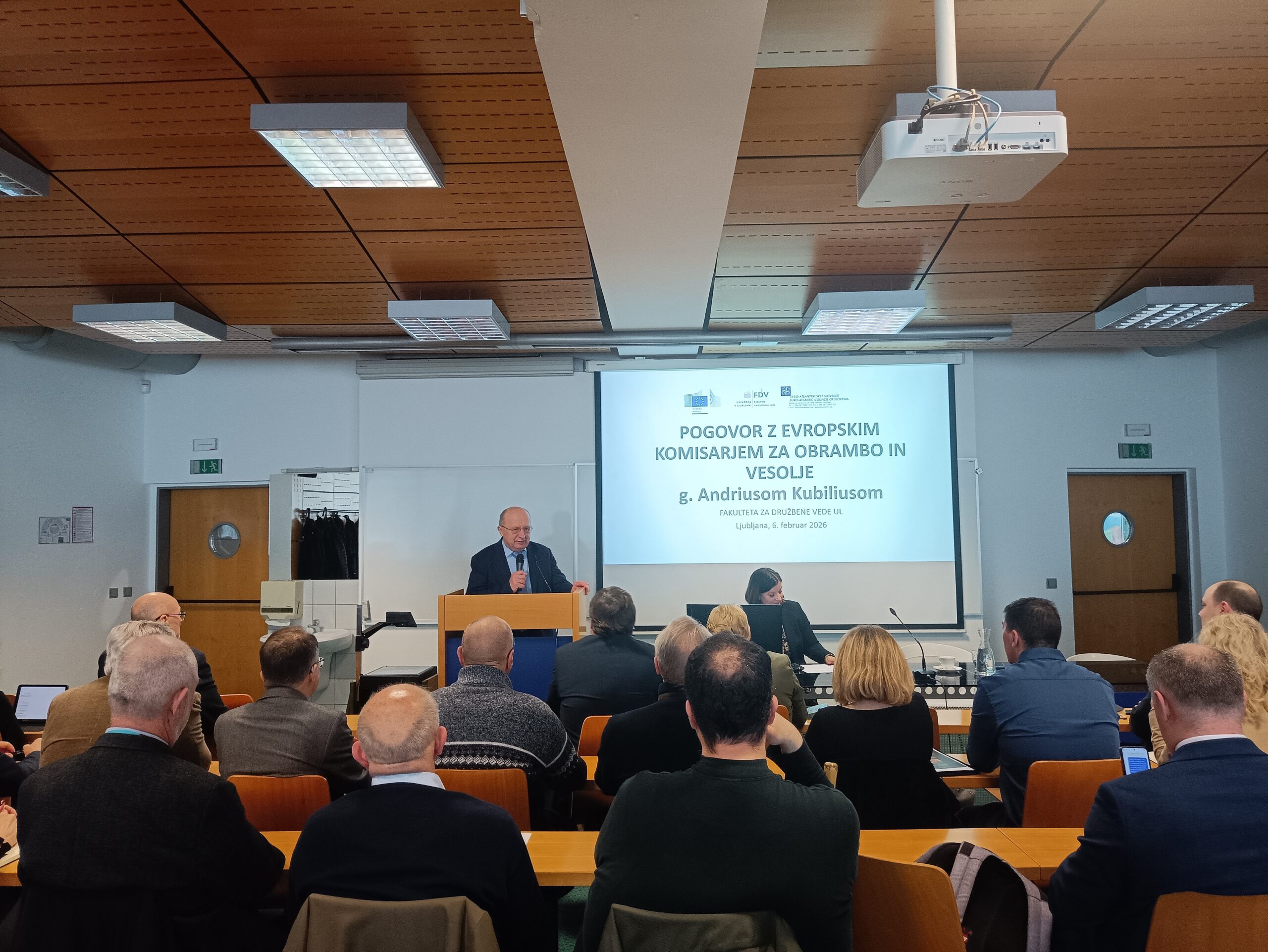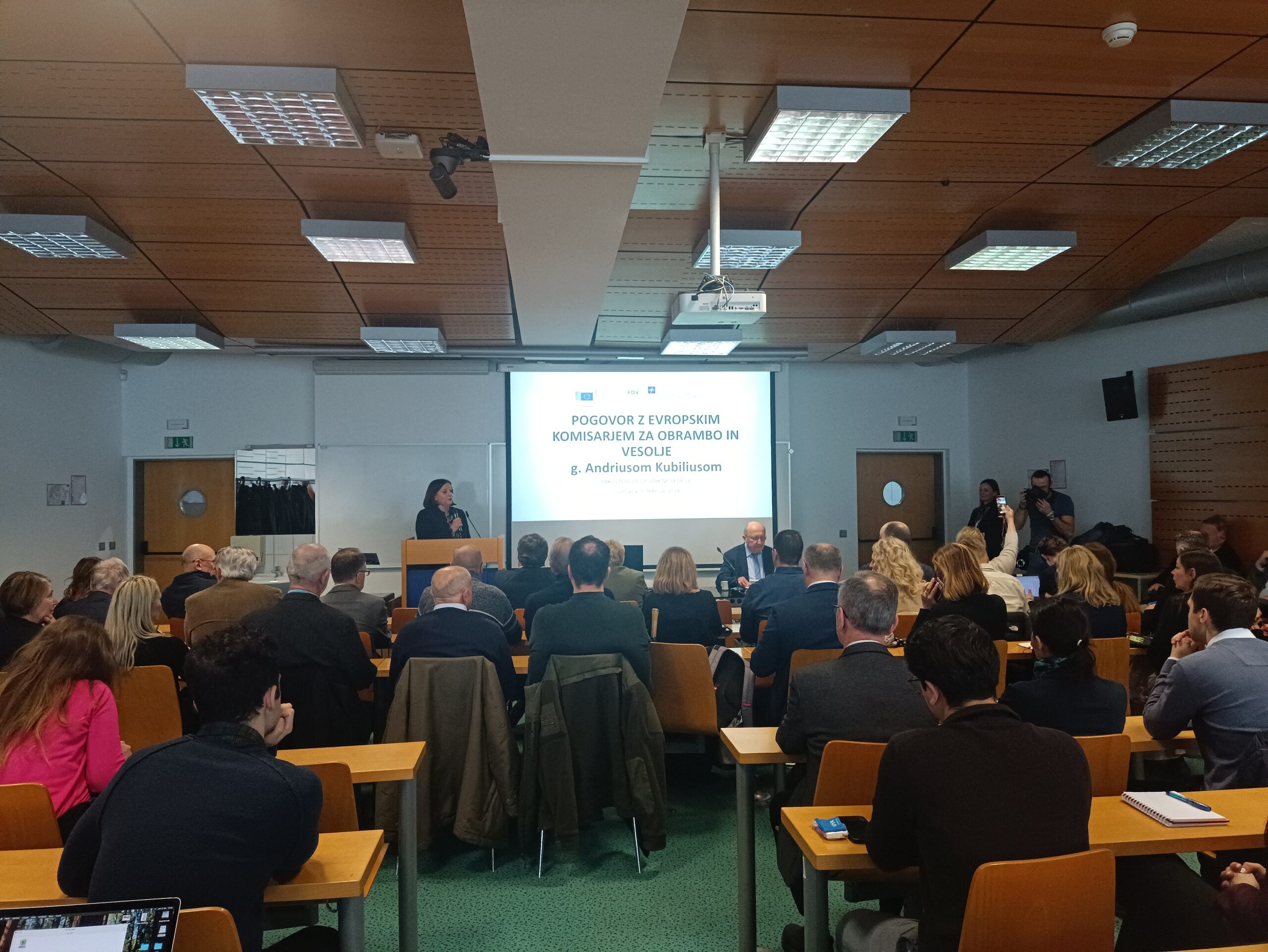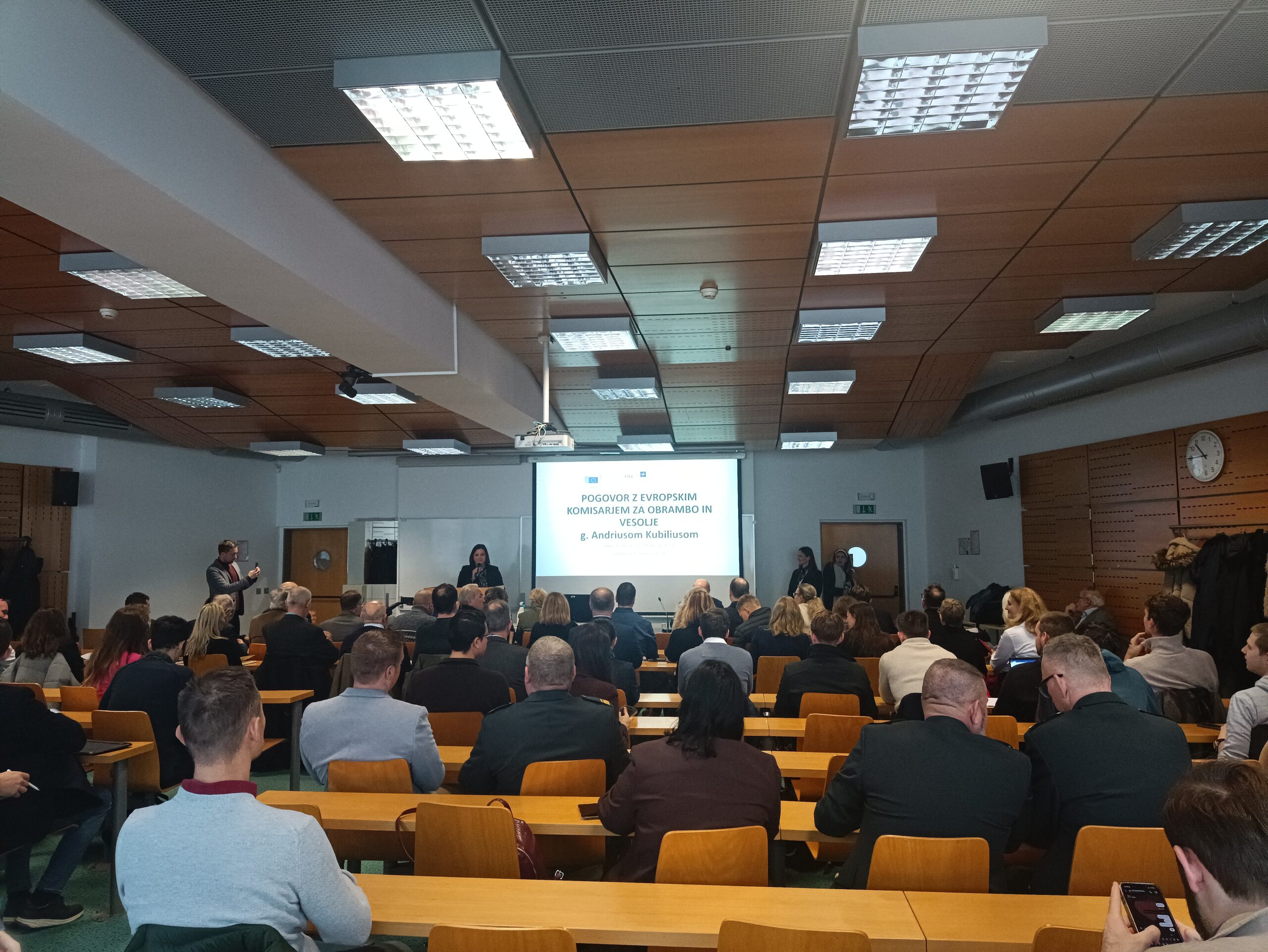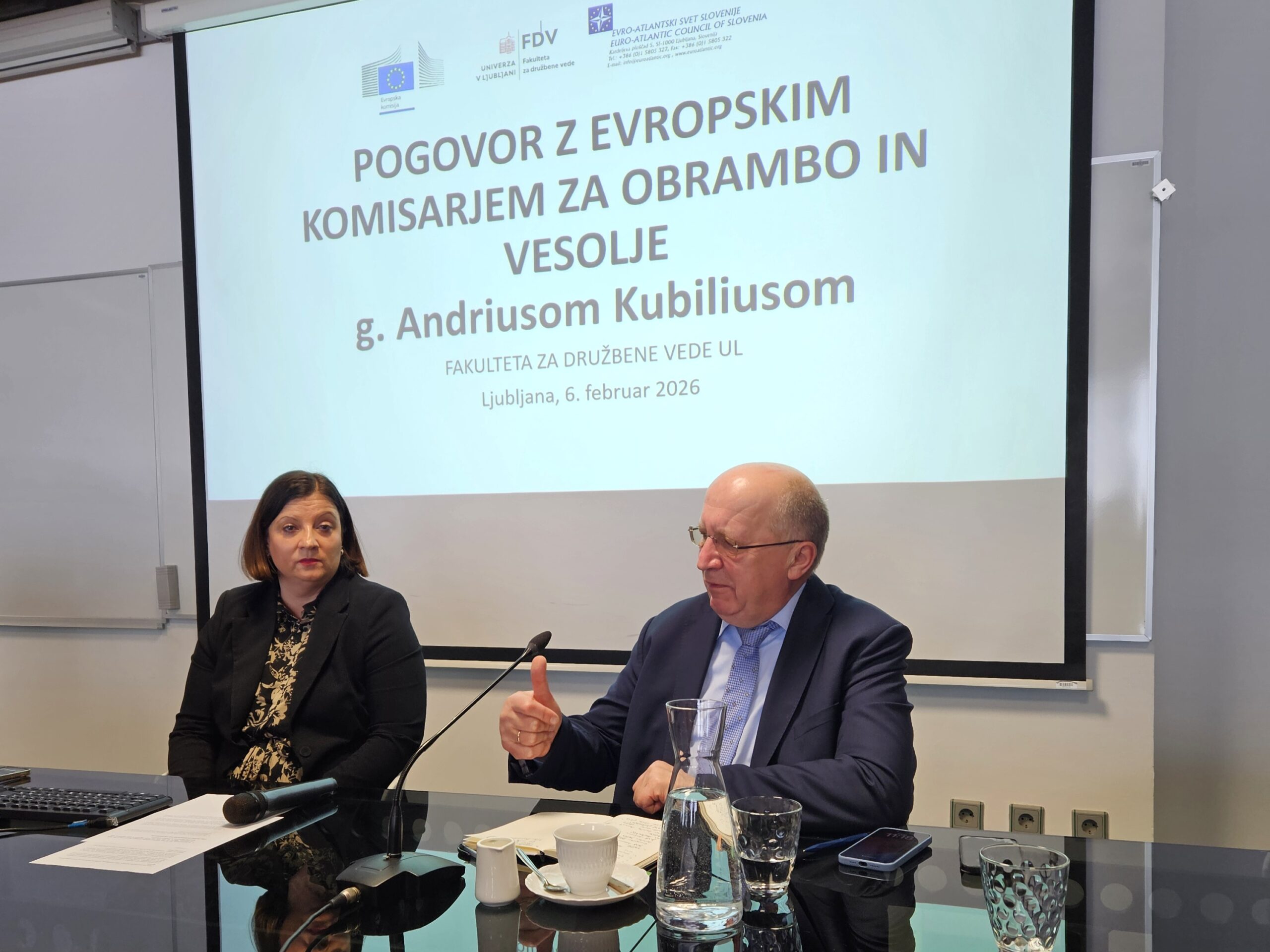
On Friday, 6 February 2026, the Faculty of Social Sciences of the University of Ljubljana hosted a public discussion with the European Commissioner for Defence and Space, Mr Andrius Kubilius. The event was organised by the Euro-Atlantic Council of Slovenia, the Chair of Defence Studies at the Faculty of Social Sciences, and the Representation of the European Commission in Slovenia. The discussion was moderated by Assoc. Prof. Dr Jelena Juvan.
The discussion focused on current geopolitical challenges and the role of the European Union in the fields of defence, security, and space technologies. The event was attended by approximately 90 participants, including students, young professionals, diplomats, and representatives of both the expert community and the wider public.
Against the backdrop of heightened security tensions along Europe’s borders, evolving transatlantic relations, and increasingly intense global technological competition, Commissioner Kubilius outlined the key priorities of the European Commission in strengthening the EU’s strategic autonomy, resilience, and defence capabilities. He stressed the importance of a comprehensive approach that integrates defence policy, industrial capacity, and technological development.
In his remarks, the Commissioner emphasised that technological progress, space, and geopolitics will undergo profound transformations in the coming decades, requiring Europe to demonstrate greater strategic independence and decisiveness. According to him, the European Union must emerge from the current crises more consolidated, better organised, and better prepared to address future security and geopolitical challenges.
Key Messages of the Discussion
-
- The European Union will inevitably continue to consolidate in response to recurring crises, leading to stronger organisation and expanded competencies in the field of security and defence.
- The transatlantic context is changing: as the United States increasingly shifts its strategic focus towards the Indo-Pacific, Europe is assuming greater responsibility for its own security.
- The development of European defence capabilities must be future-oriented. Artificial intelligence, unmanned systems, as well as cyber and quantum technologies, will play a decisive role in shaping contemporary and future warfare.
- Space is becoming a critical infrastructure of the modern strategic and security environment. As communication and navigation systems are indispensable, the EU must strive for greater technological autonomy and reduced dependence on external actors. The Galileo system represents a significant European strategic advantage.
- Effective and credible defence requires stronger organisational and operational integration of capabilities, both among EU Member States and in cooperation with other European partners. In this regard, Ukraine’s defence experiences are of particular value.
- Public opinion increasingly supports the strengthening of the European defence dimension, which national leaders and EU institutions must recognise and reflect through clear, transparent, and proactive communication with citizens.
The Geopolitical Environment: From Russia to the Indo-Pacific
Europe is confronted with an aggressive Russia and the real possibility that it could directly threaten European states in the coming years. At the same time, the United States’ strategic attention is shifting towards the Indo-Pacific region, where China’s military and political power continues to grow. This security environment means that Europe can no longer assume that the American security umbrella will remain permanently guaranteed, as U.S. capabilities are limited and globally deployed. Taking greater responsibility for its own defence is therefore becoming a strategic necessity, rather than merely a political ambition.
Defence Capabilities and Development Priorities
In 2025, NATO member states adopted new capability targets. This development has significant implications for the European Union as well, given that 23 NATO members are also EU Member States, which requires close coordination between national and European defence efforts within the broader European security and defence framework.
Meeting these targets necessitates increased defence spending and the channelling of investments into future-oriented capabilities, particularly in the following areas:
-
- unmanned systems,
- digital and information warfare,
- artificial intelligence,
- quantum technologies.
According to Commissioner Kubilius, this implies a gradual but sustained increase in defence expenditure, with a strong focus on the development of advanced and disruptive technologies that will shape the future character of warfare. These technologies should be understood as the strategic core of future defence, rather than merely an add-on to existing capabilities.
He also placed particular emphasis on strengthening Europe’s strategic autonomy in the field of space-based communication and navigation systems, which form the backbone of modern military operations as well as broader societal security and resilience. In this context, the Galileo system was highlighted as an example of successful European technological independence. Modern technologies are thus a central pillar of contemporary defence architecture, rather than being solely a supporting element.
The Transatlantic Balance and European Capabilities
Europe must prepare for the gradual replacement of capabilities that are currently provided to a large extent by the United States. This does not concern personnel alone, but above all key enabling capabilities, such as logistics, strategic communications, intelligence, surveillance and reconnaissance (ISR), strategic airlift, air and missile defence, and space support.
Particular emphasis was placed on the need for Europe to independently develop and sustain core capabilities for rapid crisis response, which have so far been heavily dependent on U.S. support. In the Commissioner’s view, this represents a key prerequisite for greater European operational autonomy and for strengthening Europe’s credibility as a security actor.
Organisation and Governance: Gradual Deepening of Integration
The European legal framework stipulates that defence remains largely within the competence of Member States, while a significant share of defence planning, standardisation, and operational coordination is carried out within NATO. According to the speaker, this division of responsibilities has led to several structural challenges, including:
-
- fragmentation of defence procurement and production,
- the absence of a single European defence market,
- loss of competitiveness and jobs in the European defence industry,
- outflow of European financial resources to procurement outside the European Union.
Nevertheless, in his assessment, Europe is moving—albeit gradually, yet in a substantively deep manner—towards greater cooperation and joint management of defence capabilities. He described this process as a form of practical integration, developing through intergovernmental agreements and joint projects, without formal amendments to the EU’s founding treaties. He compared this evolution to the development of the Schengen Area, where practical integration gradually went beyond initial institutional constraints.
Public Opinion and Communication with Citizens
Commissioner Kubilius emphasised that the success of the proposed changes largely depends on public support. Eurobarometer surveys indicate that security is becoming one of the central concerns of European citizens, while support for strengthening the European defence dimension is increasing across many Member States.
In this context, political leadership plays a crucial role. Governments and EU institutions must inform citizens in a clear, accessible, and transparent manner, while actively engaging them in discussions on security and defence issues. Only in this way can the democratic legitimacy of bigger institutional and defence-related changes be ensured.
Proposed Institutional and Operational Steps
The discussion also highlighted several concrete proposals for the future development of European security and defence, including:
-
- the establishment of a European Security Council as a platform bringing together major European states under a rotating presidency, aimed at strategic coordination (the idea is still at an early stage, but is perceived as having high added value);
- creation of European rapid reaction forces as a response to existing gaps in crisis response capabilities;
- development of common European defence systems and the strengthening of the EU defence industry in order to reduce fragmentation and enhance competitiveness;
- systematic integration of Ukrainian experience and capabilities into European standards, doctrines, and training systems.
Space, Greenland, and the Arctic
Space was emphasised as a critical defence domain, particularly in the fields of communication and navigation. In the context of Greenland and the Arctic, the Commissioner stressed the need for more constructive dialogue with partners and for strengthening Europe’s presence in this strategically important region, which the United States places within the framework of its Western Hemisphere.
Looking Ahead: Technology, Democratic Resilience, and Knowledge
Although the long-term development of technology—including space capabilities—is difficult to predict with precision, the Commissioner noted that technology and geopolitics will become increasingly intertwined. Europe’s democratic resilience will therefore depend ever more on its ability to identify strategic trends promptly, set clear policy directions, and act with confidence and credibility in international debates.
Conclusion
In his address, the Commissioner delivered a clear and direct message to the youth on the importance of fundamental intellectual skills and an active understanding of global developments. He highlighted reading, writing, and public speaking as essential tools for developing critical thinking and influencing society:
“You must learn how to read, write, and speak—maintain curiosity and an understanding of what is happening around you. Writing helps structure thinking, while speaking enables you to influence others.”
According to him, the ability to think analytically, communicate clearly, and understand the broader political and security environment will be essential for future generations operating in an increasingly complex international system.
Today, Europe faces decisions that will shape its long-term position in the international system—from the level and structure of defence spending to innovation, institutional reform, and the preservation of public legitimacy. Responding to the new security reality, therefore, requires a carefully balanced combination of strategic autonomy, a strong transatlantic partnership, and a robust European industrial base.