

Sudan, Somalia & Ethiopia
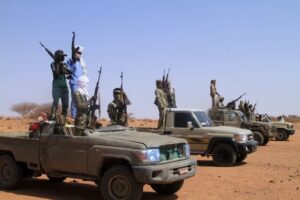
August saw a somewhat expected escalation in the Sudan conflict, although some limited normalcy was restored in the capital, Khartoum. Meanwhile, the return of Somali piracy has been more unexpected. The US-Iran war continues to impact the security an logistical issues across the wider region, while Etiopia is facing increased domestic instability, while at the same time running into problems with Egypt regarding the building of additional Ethiopian dams on the Nile.
1. Sudan
Sudan’s conflict intensified across the provinces of Darfur, Kordofan and the Blue Nile, while growing foreign involvement and disruptions linked to the US–Iran war further complicated both military and humanitarian supply chains. On 2 August, a Sudanese Armed Forces (SAF) drone strike hit a court in Garra al-Zawaya, North Darfur, killing at least 35 civilians and wounding several others.2
The Rapid Support Forces (RSF) and allied Sudan People’s Liberation Movement-North (SPLM-N al-Hilu) made their most significant gains in Blue Nile State. They captured Geissan on 11 August and Kurmuk on 13 August, using drones and artillery to overcome SAF positions.1,4 The fighting displaced about 7,800 people, including some, who fled into Ethiopia.3 Control of the two Ethiopian-border towns opened new routes towards Damazin and the SAF-controlled Nile Valley, while also connecting RSF positions with alleged supply routes through western Ethiopia. Concerns about Ethiopian involvement increased after reports that RSF forces may have operated from Benishangul-Gumuz, while an Ethiopian military build-up was detected near the border later in August. Sudan’s army also claimed that hostile drones had been launched from Ethiopian territory. The RSF captured two further army bases southeast of Damazin on 28 August, increasing pressure on SAF positions in the state.1,4
At the same time, the RSF attempted to reverse SAF’s gains around El Obeid in North Kordofan. Drone strikes and attacks around the city intensified in mid-August, including a major 13 August assault on Jabrat al-Sheikh, involving more than 250 RSF combat vehicles, which the SAF repelled.4 Continued fighting drove large-scale displacement with more than 200,000 people newly displaced across Kordofan since late 2025, while El Obeid received thousands of additional civilians during August. Damage from RSF drone attacks to electricity and water infrastructure caused prolonged outages and disrupted hospitals, telecommunications and water supplies. Threats to transport routes also pushed up food prices and complicated humanitarian deliveries.3,7
The conflict is increasingly shaped by drone warfare and disrupted international supply chains. Drones now account for roughly half of violent incidents in Sudan, compared with only 4% at the beginning of the war.7 The US–Iran war, which began in February, has disrupted routes and supply networks through the Red Sea and Strait of Hormuz. This has delayed humanitarian supplies entering Sudan3 and reportedly disrupted the RSF’s access to drone-related supplies, contributing to fewer but more selective strikes.7 The Iran conflict therefore affects Sudan indirectly by constraining both humanitarian logistics and military resupply, while adding pressure to already insecure Red Sea trade routes. 3,7
The RSF also showed signs of internal strain. Its Kordofan governor resigned on 12 August, criticising the RSF-led political coalition, while hundreds of fighters subsequently defected to the SAF.1,4 The army reported about 318 defections on 20 August5, followed by another roughly 200 RSF fighters on 31 August, including the RSF intelligence chief in North Kordofan.8 These defections do not indicate an imminent RSF collapse but suggest that SAF battlefield pressure and disruption of RSF supply lines may be weakening cohesion.5
SAF chief Gen. Abdel Fattah al-Burhan simultaneously pursued military pressure and a political track. On 15 August, he offered guarantees to participants in a national dialogue while insisting that fighting would continue until the RSF withdrew from cities and disarmed.5 Civil and political groups rejected the initiative during 22–23 August consultations in Addis Ababa, arguing that it could legitimize military rule. Sudan also strengthened relations with Saudi Arabia, establishing a High Council for Strategic Cooperation on 17 August.1
Regional spillover became increasingly visible late in the month. Chad accused the SAF of striking a military convoy inside Chadian territory on 20 August, while Sudan continued accusing Chad of facilitating UAE military supplies to the RSF, with both Chad and the UAE denying the allegations. The United States warned that cross-border escalation threatened regional stability and pushed for a wider arms embargo, including restrictions on attack drones.6
Despite continued fighting elsewhere, conditions improved sufficiently in Khartoum for the government to lift its two-year curfew and state of emergency on 28 August, after more than two million displaced residents had returned since the SAF regained the capital. However, damaged infrastructure, power shortages and fears of RSF sleeper cells underline that stabilisation in Khartoum remains fragile.6
2. Somalia
Al-Shabaab made its first territorial gain of the year on 2 August, seizing the town of Teedaan in the Hiraan region. The Federal Government responded with airstrikes across Hiraan, Middle Shabelle and Lower Shabelle between 11 and 21 August.9
In Galkayo on 5 August, Puntland forces seized a camp held by the Mogadishu-aligned Puntland Security Force, with up to 18 people reportedly killed and more than 100 arrested. Puntland accused the Federal Government of deploying troops and weapons to undermine its authority. Other forces operating outside Puntland’s command were subsequently reintegrated, further weakening Mogadishu’s position in the region.9
In Baidoa on 17 August, forces loyal to the ousted leader of region South West, Abdiaziz Hassan Mohamed Laftagareen, launched their largest attack since his removal in March and temporarily occupied parts of the city. Federal troops later pushed them out. Around 30 attackers were reportedly killed.10 Further reporting on 18 August put the civilian toll at four dead and 98 wounded and said South West authorities estimated around 50 attackers killed. Al-Shabaab simultaneously attacked two military positions on Baidoa’s outskirts, raising allegations of coordination with Laftagareen-aligned forces. The fighting showed how disputes between Mogadishu and federal member states can create openings for extremist groups.11
Pirates seized the MV Lutuf off Puntland on 17 August and the MT Sibu 1 off Yemen on 20 August, reportedly steering the latter towards Puntland. The resurgence of piracy is linked to the continuing US-Iran war and insecurity around Hormuz and the Bab al-Mandab Strait, which diverted naval attention away from Somalia while bringing more commercial traffic closer to its coast. 12
The Lutuf reportedly carried equipment intended for Turkish operations in Somalia. Puntland accused Turkey of carrying out drone strikes against pirate-linked groups, while Mogadishu said on 29 August that Somali and Turkish forces had freed the vessel and killed 14 pirates. Puntland disputed this, claiming a ransom had been paid. 12
3. Ethiopia
Tensions in Tigray escalated sharply in August. Fighting erupted on 1 August in Shererina, near the Sudanese border, between federal forces and TPLF-aligned units including Army 70, reportedly using heavy artillery and mechanised units and displacing hundreds into Sudan. Federal drone strikes followed throughout the month, including attacks on Tigrayan forces on 10 August and on Mekelle on 20 August, where 13 people were reportedly injured. On 15 August, Fano militias and Tigrayan forces reportedly carried out their first joint attack against federal positions on the Tigray–Amhara border, pointing to a possible emerging anti-government alignment. AU envoy Olusegun Obasanjo met TPLF leaders on 24 August, but no tangible progress toward talks with Addis Ababa was reported. Meanwhile, insurgencies continued in Amhara and Oromia, while reports also suggested possible Ethiopian involvement in Sudan’s war, including an Ethiopian military build-up near the border and alleged RSF operations from Ethiopian territory.13
The risk of renewed war in Tigray became more pronounced after the 1 August clashes at Shererina and subsequent drone strikes. Federal and Tigrayan forces had already been massing along the regional border, while both sides accused each other of preparing for conflict. The TPLF entered the confrontation in a weaker position than during the 2020–2022 war and appeared increasingly reliant on possible alliances with Eritrea and Fano forces. Analysts warned that a renewed conflict could be more regionalised than the previous war, potentially drawing in Eritrea, Sudan and other neighbouring actors, while US diplomatic engagement remained limited.14
A drone strike hit a residential area of Mekelle on 20 August, following earlier strikes in Tigray and clashes earlier in the month. The attack marked a further escalation after the Pretoria peace agreement had largely contained the conflict since 2022. Tigrayan authorities blamed the federal government, while Addis Ababa did not publicly confirm responsibility.15
Further reporting on the 20 August Mekelle strikes said 13 people were wounded, apparently civilians, and residential buildings were damaged. Tigrayan authorities accused the federal government of carrying out the attacks, while federal authorities neither confirmed nor denied responsibility. The incident came amid reports that TPLF forces were forming alliances with local armed groups, including Fano, reinforcing concerns that a broader coalition against Prime Minister Abiy Ahmed’s government could be emerging.16
Regional tensions also intensified over the Nile dispute. On 20 August, Egyptian Foreign Minister Badr Abdelatty warned that Egypt would not accept additional Ethiopian dams on the Nile and said Cairo had a legitimate right to defend its water security. The statement followed earlier Egyptian warnings on 4 and 16 August over reports that Ethiopia planned further projects alongside the Grand Ethiopian Renaissance Dam (GERD). The dispute remains unresolved after negotiations between Ethiopia, Egypt and Sudan stalled again in 2024, adding another interstate pressure point around Ethiopia.17
* Views and opinions of the authors of this paper do not necessarily correspond to the views of the Euro-Atlantic Council of Slovenia.
Sources
[1] International Crisis Group. “Global Overview, August 2026”. (August 2026). International Crisis Group. https://www.crisisgroup.org/crisiswatch/august-trends-and-september-alerts-2026#somalia
[2] AFP. “Sudan army drone attack on Darfur kills 35, rights group says”. Al Jazeera. (2 August 2026) https://www.aljazeera.com/news/2026/8/2/sudan-army-drone-attack-on-darfur-kills-35-rights-group-says
[3] IOM. “Sudan: 200,000 Newly Displaced as Fighting and Floods Intensify, Closure of Red Sea and Strait of Hormuz Threatens Critical Aid”. IOM. (19 August 2026) https://www.iom.int/news/sudan-200000-newly-displaced-fighting-and-floods-intensify-closure-red-sea-and-strait-hormuz-threatens-critical-aid
[4] DeAngelo, M., Karr, L. & Wiebler, A. “RSF Counters Recent SAF Gains in Sudan: Africa File, August 20, 2026”. Critical Threats. (20 August 2026) https://www.criticalthreats.org/analysis/sudan-rsf-splm-issp-lakirawa-nigeria-africa-file-august-20-2026
[5] Al Jazeera. “Is Sudan’s battlefield shaping the terms of its next political phase?”. Al Jazeera. (26 August 2026) https://www.aljazeera.com/news/2026/8/26/is-sudans-battlefield-shaping-the-terms-of-its-next-political-phase
[6] Plett Usher, B. “Two-year curfew lifted in Sudan’s capital”. BBC. (28 August 2026) https://www.bbc.com/news/articles/c2076gxr0llo
[7] Savage, R. “People fleeing Sudan civil war face ‘dire and deteriorating’ conditions in refuge city”. The Guardian. (30 August 2026) https://www.theguardian.com/world/2026/aug/30/humanitarian-crisis-worsening-refuge-civilians-sudan-el-obeid
[8] Sudan Tribune. “About 200 fighters defect from Sudan’s RSF to army, state media says”. Sudan Tribune. (31 August 2026) https://sudantribune.com/article/318103
[9] Al Jazeera & APF. “Puntland forces seize government-held camp in Somalia’s Galkayo”. Al Jazeera. (5 August 2026) https://www.aljazeera.com/news/2026/8/5/puntland-forces-seize-government-held-camp-in-somalias-galkayo
[10] Reuters. “Somali troops push militiamen out of Baidoa after fierce fighting”. Reuters. (17 August 2026) https://www.reuters.com/world/somalia-federal-troops-armed-opposition-clash-baidoa-city-2026-08-17/
[11] Faruk, O. “Fighting in southwestern Somalia kills dozens of people, including 4 civilians”. AP News. (18 August 2026). https://apnews.com/article/somalia-baidoa-militia-clash-b2b2d9024f24fa457b412a7bc475118c
[12] Plett Usher, B. “Somali piracy surges as the impact of the US-Iran war ripples outwards”. BBC. (31 August 2026). https://www.bbc.com/news/articles/cr4vx4pneydo
[13] International Crisis Group. “Global Overview, August 2026”. (August 2026). International Crisis Group. https://www.crisisgroup.org/crisiswatch/august-trends-and-september-alerts-2026#somalia
[14] France24. “Is a new conflict brewing in northern Ethiopia?” France24. (2 August 2026) https://www.france24.com/en/live-news/20260814-is-a-new-conflict-brewing-in-northern-ethiopia
[15] The Africa Report. “Ethiopia’s Tigray rebels say drone hits Mekelle residential area”. The Africa Report. (20 August 2026) https://www.theafricareport.com/428186/ethiopias-tigray-rebels-say-drone-hits-mekelle-residential-area/
[16] Borkena. “Drone Strikes Leave 13 Wounded in Mekelle, Ethiopia”. Borkena. (20 August 2026) https://borkena.com/drone-strikes-leave-13-wounded-in-mekelle-ethiopia/
[17] Elkabany, H. & Chouiref, T. “Egypt says it has right to defend water security over new Ethiopian dams on Nile River”. AA. (20 August 2026) https://www.aa.com.tr/en/middle-east/egypt-says-it-has-right-to-defend-water-security-over-new-ethiopian-dams-on-nile-river/4032262