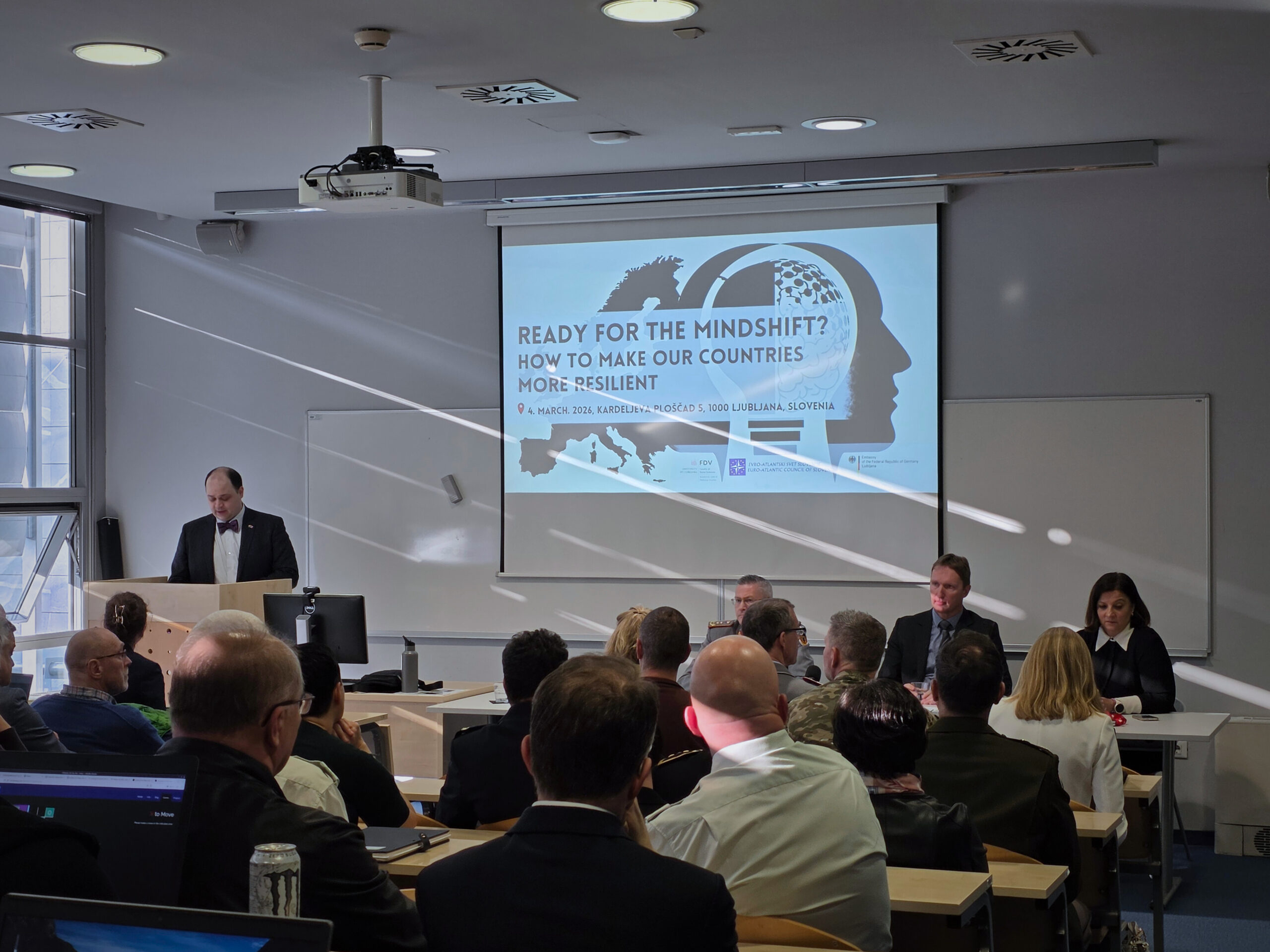
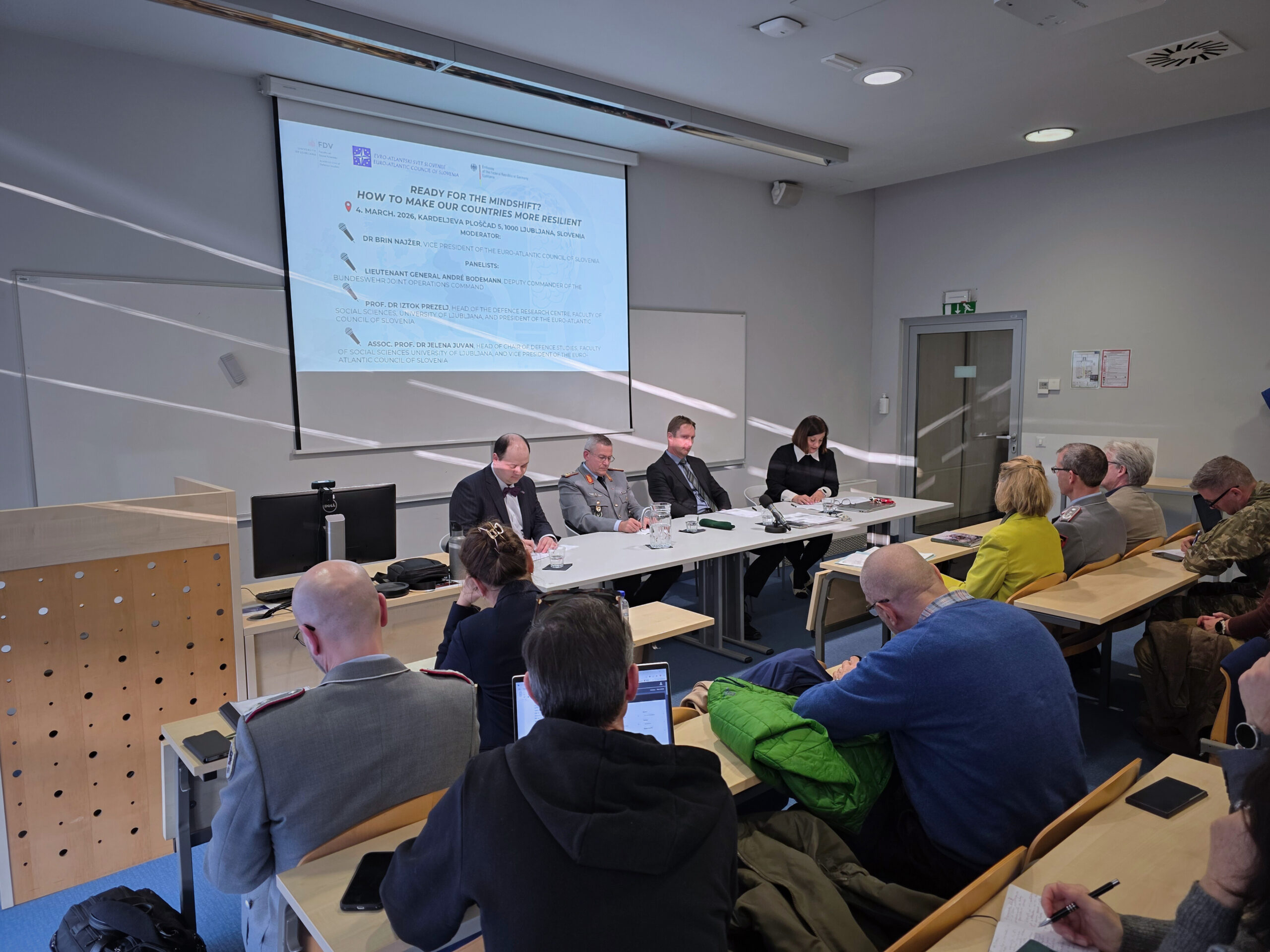
On 4 March 2026, the Faculty of Social Sciences at the University of Ljubljana (FDV UL) hosted an international panel discussion titled “Ready for the Mindshift? How to Make Our Countries More Resilient.” The event was organised by the Euro-Atlantic Council of Slovenia, the Chair of Defence Studies, and the Embassy of the Federal Republic of Germany.
The panel featured:
-
- Lieutenant General André Bodemann, Deputy Commander of the Bundeswehr Joint Operational Command and Commander for Territorial Tasks in Berlin,
- Prof. Dr Iztok Prezelj, Head of the Defence Research Centre at the Faculty of Social Sciences, University of Ljubljana, and President of the Euro-Atlantic Council of Slovenia,
- Assoc. Prof. Dr Jelena Juvan, Head of the Chair of Defence Studies at the Faculty of Social Sciences, University of Ljubljana, and Vice-President of the Euro-Atlantic Council of Slovenia,
- Brin Najžer, PhD, Vice-President of the Euro-Atlantic Council of Slovenia (Moderator).
Opening Remarks: Students as Drivers of the Future
The discussion began by highlighting the importance of involving young people in security debates. It was emphasised that students represent the generation that will directly shape future responses to global security challenges.
The long-standing cooperation between the Faculty of Social Sciences and the Embassy of the Federal Republic of Germany provides an important foundation for fostering the strategic maturity of future decision-makers.
The German Perspective: An Operational Plan for Strengthening Security
During the discussion, Germany’s new operational defence plan was presented. It is based on two key pillars: military readiness in the event of a large-scale conflict and comprehensive civil defence.
Given Germany’s geostrategic position as a logistical hub for the movement of allied forces towards NATO’s Eastern Flank, the main priorities include:
-
- establishing territorial forces to protect critical infrastructure,
- strengthening logistical, IT, and medical capabilities,
- actively integrating civilian industry and the population into the defence system.
The Changing Nature of Threats and Hybrid Warfare
Speakers also pointed to serious intelligence assessments suggesting that Russia could regain the military capability for a direct confrontation with NATO member states by 2029.
According to the speakers, hybrid warfare is already underway and continues to intensify both in scope and diversity. The most common methods include:
-
- sabotage and espionage,
- disinformation campaigns targeting the psychological stability of societies,
- attacks on critical infrastructure (energy, water resources, food supply, and transport).
Such operations are often designed in a way that makes direct attribution difficult. Nevertheless, their objective is clear: the destabilisation of Western societies and the testing of their resilience.
Slovenia as a “Security Bubble” in Europe
The discussion also highlighted a paradox within the Slovenian society. Despite the largest war on European soil since 1945, Eurobarometer data suggests that many Slovenians still feel relatively safe and often perceive conflicts as distant.
Speakers therefore stressed the need for a shift in mindset, specifically:
-
- a transition from the “peace dividend” mentality to a “peace preparedness” mentality,
- the development of strategic maturity within society, recognising that security is not self-evident but the result of conscious political and societal choices.
Euro-Atlantic institutions remain central to the security of European states. However, the war in Ukraine clearly demonstrates that alliances are only as strong as the active contributions of their members. Today, security is no longer solely the responsibility of the armed forces or defence ministries; it is becoming a whole-of-society project, requiring:
-
- strengthening societal resilience,
- developing defence logistics and personnel capacities,
- maintaining a balance between deterrence and resilience,
- fostering greater strategic maturity across society.
Small states such as Slovenia lack what is often referred to as strategic depth, making them particularly vulnerable to potential disruptions in the international order. The vulnerability of Slovenia’s only commercial port illustrates how quickly a local crisis could escalate into a broader regional challenge.
How Can Societal Resilience Be Strengthened?
The final part of the discussion focused on how societies can prepare for new security realities without creating unnecessary alarm.
Among the key measures highlighted by the speakers were:
-
- Systematic education – strengthening political and security literacy at all levels of the education system.
- Transparent communication – encouraging open dialogue about complex security issues and addressing radical narratives that undermine institutional legitimacy.
- A comprehensive approach to defence – recognising that security is a responsibility shared by the entire society, not only uniformed services but also individuals working in firefighting, healthcare, civil protection, and crisis management.
Concluding Thoughts
Peace, democracy, and fundamental values cannot be taken for granted. The security environment in Europe has changed permanently, and a return to the “old normal” is not currently in sight.
The central message of the discussion was clear: ensuring security is not solely the responsibility of military structures, but of society as a whole. Only through cooperation with allies and the consistent strengthening of our own resilience and capacities for security, defence, and protection can we build a safe and stable future for the next generations.