
Eastern Europe
February saw the continuation of peace negotiations between Russia and Ukraine, although without any significant progress. SpaceX disabled access to its Starlink network to Russian forces while Russian authorities began clamping down on the usage of the Telegram application. The Group of Five EU states announced a new cooperation programme with Ukraine on the use and defence against unmanned aerial systems. Lithuania published a new national security strategy focused on an existential threat from Russia. Hungary and Slovakia increased tensions with Ukraine over its blockage of Russian oil shipments through the Druzhba pipeline.
Russia–Ukraine Conflict
The United States has continued its efforts to reach a peace deal in Ukraine with a series of talks and meetings. The first meeting took place on 4 February 4 in Abu Dhabi, marking the beginning of a new phase of efforts that the United States initiated in January. US Secretary of State Marco Rubio noted that, while progress was made on some topics, there was still no progress on the more difficult issues, especially those on territorial compromises… Kremlin spokesman, Dmitry Peskov, said Moscow would not comment on the progress of the talks, arguing that the door to a peaceful solution was open but that they would not suspend military operations until Ukraine met their demands[1].
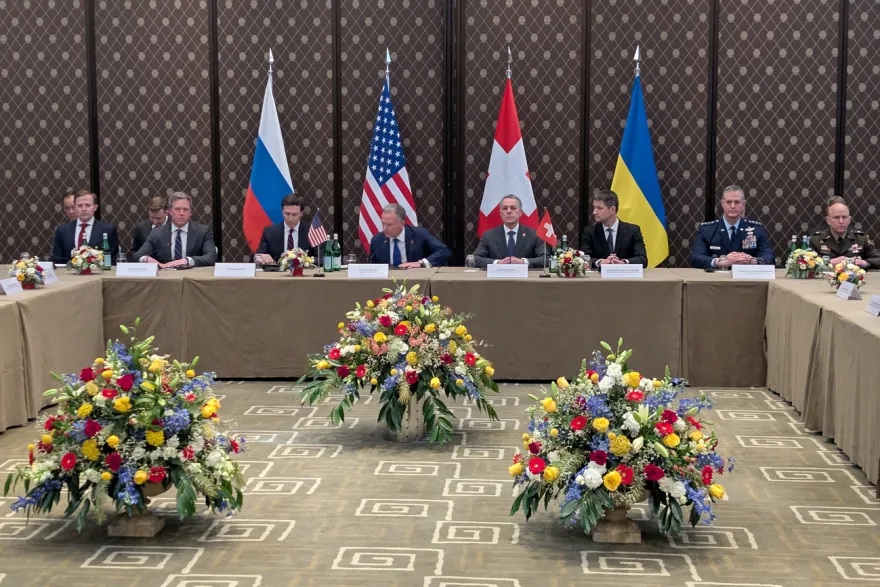
The next meeting, on 17 February in Geneva, also ended without much progress. Both sides described the meeting as very tough. The meeting failed to reach any significant agreement, and after the meeting, all sides reported that new negotiations would soon begin. The main obstacle remains the issue of territorial division, specifically of the four Ukrainian regions (Donetsk, Lugansk, Kherson, and Zaporizhzhia) which Russia unilaterally annexed in 2022 but controls only parts of their territory. [2]
On 26 February in Geneva, US representatives also held separate talks with Ukrainian officials and the Russian envoy. They discussed the current developments in the war. The goal of the talks between Ukraine and the US was to prepare for the next meeting with Russia, which is scheduled for March. Neither side commented on the meeting between the Russian envoy and US officials. [3]
In early February, the American company SpaceX announced that it had turned off the terminals for accessing its Starlink satellites, which the Russian military was using for communications. At the same time, SpaceX reached an agreement to use the system in Ukraine, which also relies on Starlink for both civilian and military communications. The shutdown of access is a major blow to Russian forces, which have also used Starlink for such important tasks as coordination between units and control of drones.[4] The Russian government announced on 10 February that it would slow down and eventually completely shut down the most popular social media app in Russia, Telegram, which was one of the main communication channels for Russian soldiers in Ukraine. This sparked outrage among military personnel who used Telegram to communicate with their families.[5]
Eastern Europe
The E5 (European Group of Five consisting of the five countries in the EU with the highest defence spending, France, Germany, Italy, Poland, and the United Kingdom) announced a new development program that uses Ukrainian expertise in the field of the use and production of small, low-cost unmanned systems and systems for defence against unmanned aerial vehicles. Poland already been cooperating with Ukraine in the field of drone technology in 2025, through joint military exercises and production projects.[6] The main goal is to strengthen the response of European countries in their efforts to defend against small Russian drone incursions and develop their own strike capabilities by deploying small, low-cost unmanned aerial vehicles.[7]
Latvia, together with Denmark and Finland, has signed an 800 million euro deal with four different Ukrainian manufacturers of unmanned systems and ground robotics. The agreements are based on the “Build with Ukraine” initiative, which was launched by Ukrainian president Volodymyr Zelensky in 2025, with the purpose of strengthening joint defence development and production and also increasing Ukrainian defence exports. The framework has partnered the Danish company Copenhagen Global A/S, and the Finnish companies INSTA and New Paakkola Oy, with Ukrainian companies Culver Aerospace, TENCORE, and Ramtechnology, to produce long (up to 2500km) and medium (up to 400km) range unmanned aerial systems and unmanned ground systems for the Ukrainian military. Additionally, the Latvian company SIA Baltic Forces has signed an agreement for cooperation with Ukrainian company Terminal Autonomy Ukraine to assist in the development and construction of missiles, unmanned systems, and air defence systems. The agreement aims to improve allied cooperation and expand industrial cooperation between the countries. The agreements were signed on 24 February, the fourth anniversary of the Russian invasion.[8]
Lithuania approved an updated national security strategy on 25 February that is focused on existential threats to the country and the Euro-Atlantic community. This is an update of the existing national security strategy adopted in 2021. The new main points of the strategy are the strengthening of its own and allied military capabilities and the recognition of Russia as the main threat to its security, along with Belarus.[9]
The European Union was set to sign a €90 billion aid package for Ukraine, but the process was stalled by a Hungarian veto linked to a dispute over the Druzhba pipeline, which supplies Russian oil to Hungary and Slovakia. The main reason for the dispute is the disruption of Russian oil supplies through the pipeline due to damage suffered by the pipeline in the aftermath of a Russian drone attack.[10][11] Slovakia did not use its veto but expressed support for the Hungarian decision. Slovakia has also threatened to cut off electricity supplies to Ukraine if Russian oil supplies via the Druzhba pipeline to Slovakia do not resume.[12]
Hungary has announced the deployment of military and police forces around key energy facilities after intelligence services indicated that Ukraine was preparing sabotage operations. Ukraine has denied the accusations of deliberately withholding oil and sabotage attempts. It cited a damaged pipeline as the reason for the supply interruption, which is too dangerous to repair in the current circumstances due to Russian activity and would seriously endanger the safety of workers.[13]
Moldova has announced that it will reject any plans to re-integrate the separatist region of Transnistria unless the plan includes a strategic commitment to membership in the European Union and explicitly supports and recognises the territorial integrity of the Republic of Moldova. Moldova hopes that integration of the separatist region would bring greater internal stability, which is one of the most significant obstacles to the EU integration process. Transnistria is supported by Russia, which allows it to directly influence Moldovan internal politics and project its military power over southeastern Europe.[14]
* Views and opinions of the authors of this paper do not necessarily correspond to the views of the Euro-Atlantic Council of Slovenia.
Sources
[1] Hrabchuk, K. (4 February 2026). Russia and Ukraine envoys meet in Abu Dhabi for 2 days of US-brokered talks. APNEWS. https://apnews.com/article/russia-ukraine-war-us-talks-abu-dhabi-e9307c98b7ec337a3364ed9de28e6eca
[2] Gozzi, L. (18 February 2026). ‘Difficult’ Russia-Ukraine peace talks end without breakthrough. BBC NEWS. https://www.bbc.com/news/articles/c0k1xj0d708o
[3] FRANCE 24 (26 February 2026). Next round of Ukraine-Russia peace talks set for early March, Zelensky says. FRANCE 24. https://www.france24.com/en/europe/20260226-live-russia-ukraine-missiles-drones-us-ukraine-talks
[4] Sauer, P. (9 February 2026). Russian military scrambles to find Starlink alternative after access blocked. The Guardian. https://www.theguardian.com/world/2026/feb/09/russia-scrambles-starlink-access-deactivated-elon-musk-space-x
[5] Kolomychenko, M. (23 February 2026). How Will the Loss of Starlink and Telegram Impact Russia’s Military?. Carnegie politika. https://carnegieendowment.org/russia-eurasia/politika/2026/02/russia-starlink-telegram-shutdown
[6] Mcneil, S., Ciobanu, C. (21 February 2026). 5 European nations pledge millions to use Ukrainian know-how to make cheap drone defenses. APNEWS. https://apnews.com/article/e5-poland-drone-defense-military-nato-b00f5c80c312a6b97dcad40a8692db86
[7] Ministry of National Defence Republic of Poland (20 February 2026). Strengthening allied relations and the will to act within the E5 Group. Gov.pl. https://www.gov.pl/web/national-defence/strengthening-allied-relations-and-the-will-to-act-within-the-e5-group
[8] Odessa-journal (26 February 2026). 4 Ukrainian nanufacturers signs €800M defense tech deals with Denmark, Finland, Latvia. Odessa-journal. https://odessa-journal.com/4-ukrainian-nanufacturers-signs-800m-defense-tech-deals-with-denmark-finland-latvia
[9] Mezha (26 February 2026). Lithuania Approves Updated National Security Strategy Highlighting Regional Threats. Mezha. https://mezha.net/eng/bukvy/lithuania-approves-updated-national-security-strategy-highlighting-regional-threats/
[10] Schuman, N., Paternoster T. (27 February 2026). Fact check: Did the EU bypass Hungary’s veto on Ukraine’s €90 billion loan?. Euronews. https://www.euronews.com/my-europe/2026/02/27/fact-check-did-the-eu-bypass-hungarys-veto-on-ukraines-90-billion-loan
[11] Nikolik, N. (20 February 2026) Orbán threatens Ukraine with power cuts over Russian oil blockade. Mia.MK. https://mia.mk/en/story/orb%C3%A1n-threatens-ukraine-with-power-cuts-over-russian-oil-blockade
[12] Al Jazeera Staff, AP & Reuters (21 February 2026). Slovakia threatens to cut electricity to Ukraine over Russian oil spat. Al Jazeera. https://www.aljazeera.com/news/2026/2/21/slovakia-threatens-to-cut-electricity-to-ukraine-over-russian-oil-spat
[13] The Associated Press (25 February 2026). Hungary’s Orban orders extra security, alleges Ukraine attacks plot. Al Jazeera. https://www.aljazeera.com/news/2026/2/25/hungarys-orban-orders-extra-security-alleges-ukraine-attacks-plot
[14] Oleksandr, S. (15 February 2026). Moldova Rejects Any Transnistria Reunification Plan Lacking Sovereignty and EU Path. 112.ua. https://112.ua/en/moldova-vidkidae-plani-reintegracii-pridnistrova-bez-dvoh-klucovih-principiv-140314