
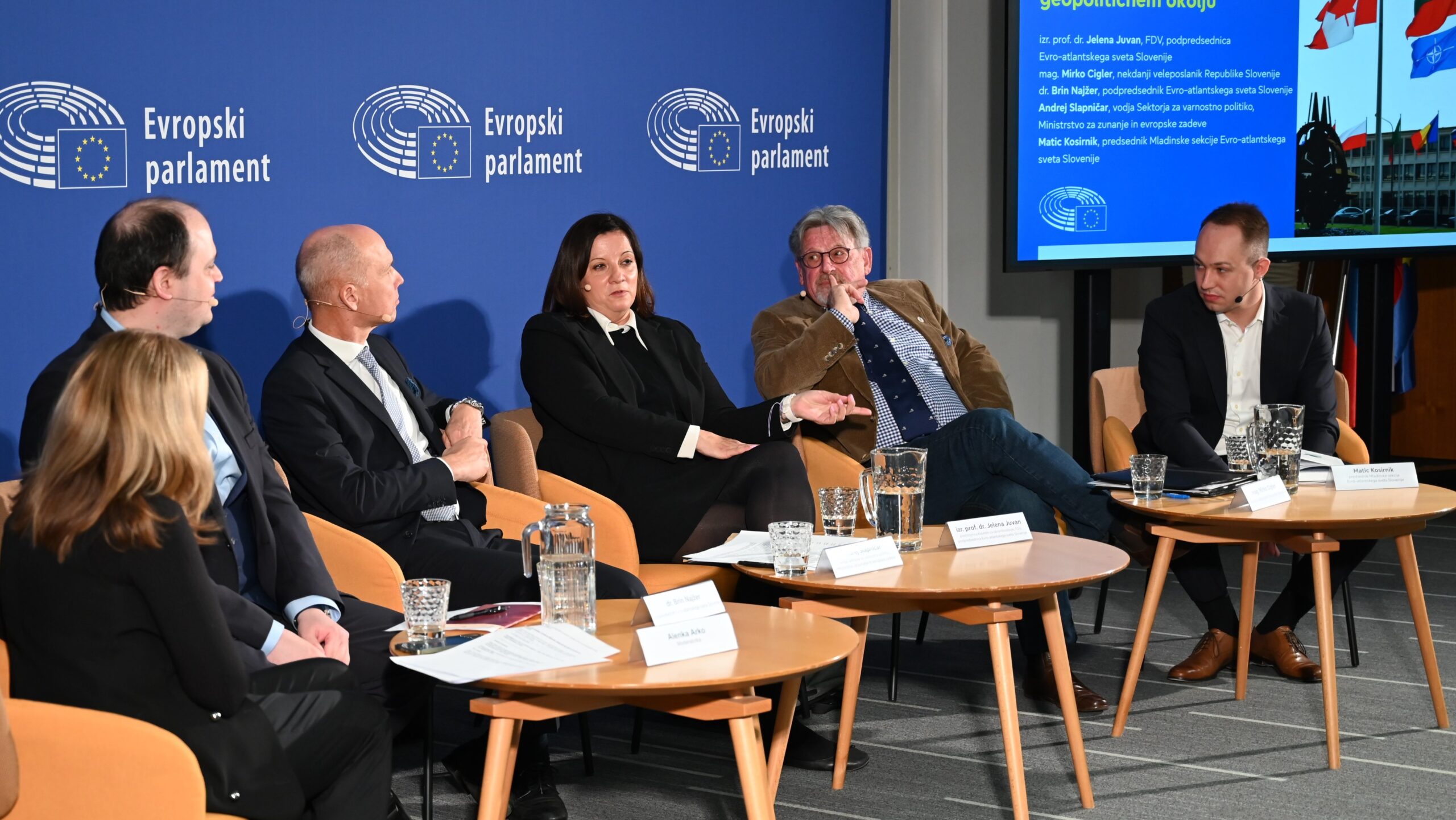
On 24 April 2026, a public discussion titled European Security in a New Geopolitical Environment took place at the House of the European Union in Ljubljana as part of the Studio Europa series, organised by the European Parliament Office in Slovenia. The discussion addressed the evolving trajectory of European security and defence policy, with particular attention to the European Union’s role in ensuring stability both within Europe and in its broader neighbourhood.
The panel brought together Associate Professor Dr Jelena Juvan, Head of the Chair of Defence Studies at the Faculty of Social Sciences, University of Ljubljana and Vice President of the Euro-Atlantic Council of Slovenia; Mirko Cigler, former Ambassador of the Republic of Slovenia; Brin Najžer, PhD, Vice President of the Euro-Atlantic Council of Slovenia; Andrej Slapničar, Head of the Security Policy Department at the Ministry of Foreign and European Affairs; and Matic Kosirnik, President of YATA Slovenia. The discussion was moderated by Alenka Arko.
The debate was framed within the context of a profoundly transformed European security environment. Russia’s war of aggression against Ukraine has reintroduced high-intensity, conventional military warfare as a central concern of European security policy. In this context, increased defence spending across the European Union was identified both as a direct response to the war and as a corrective measure addressing decades of underinvestment following the end of the Cold War. However, it was emphasised that current efforts are constrained by a relatively low starting point, which continues to affect both the speed and effectiveness of capability development.
The speakers underlined that the core challenges of European defence are not primarily financial, but political and structural. While defence budgets are rising, persistent obstacles include limited political cohesion, institutional fragmentation, and difficulties in translating financial inputs into tangible military capabilities. The discussion also highlighted the EU’s continued dependence on external actors in critical areas such as advanced technologies and strategic raw materials, which limits its ability to achieve full strategic autonomy and underscores the importance of stable, reliable partnerships.
A recurring theme was the discrepancy between perceived and actual security conditions. In parts of Europe, including Slovenia, a sense of stability persists despite the deteriorating security environment. This perception gap contributes to limited societal and political readiness to implement necessary reforms, including those related to force structure and military service models. Participants stressed the need to adapt these models to contemporary demographic and societal realities, while also rethinking the role of the individual within modern armed forces.
The discussion further addressed the future organisation of European security. Existing crisis management mechanisms were deemed insufficiently adapted to current challenges, prompting calls for reform. At the same time, it was noted that any emerging European defence framework will likely remain predominantly defensive in nature, with corresponding implications for capability development and investment priorities.
The relationship between the European Union and NATO was identified as a central pillar of European security. The development of European defence capabilities was consistently framed as complementary to the Alliance. At the same time, broader shifts in transatlantic relations—particularly indications of a reduced long-term U.S. role as Europe’s primary security provider—underscore the need for greater European responsibility in defence. Strengthening European capabilities was thus seen as essential for maintaining the credibility and effectiveness of NATO, rather than as an alternative to it.
Speakers also examined the changing character of warfare, with the war in Ukraine serving as a key reference point. The widespread use of unmanned systems was highlighted as a major factor reshaping battlefield dynamics, organisational structures, and operational practices. Nevertheless, it was emphasised that while technology significantly alters the character of war, its fundamental nature remains unchanged and continues to depend on specific strategic and operational contexts.
At the institutional level, the discussion raised concerns regarding the effectiveness of decision-making within the European Union. The requirement for unanimity was recognised as an important safeguard for smaller member states, but also as a constraint on timely and decisive action in crisis situations. This has contributed to growing debate on the potential extension of qualified majority voting in selected areas, alongside the need to preserve national sovereignty in core security matters.
The societal dimension of security was also a key point of discussion. Younger generations in many European countries have grown up in conditions of relative stability, contributing to a perception of security as a given. In contrast, societies with more immediate historical experience of security threats—particularly in Eastern Europe—demonstrate higher threat awareness and stronger support for measures to strengthen defence.
The discussion concluded with the observation that, although the European Union possesses a formal legal basis for mutual defence, its practical effectiveness ultimately depends on political will, sustained investment, technological development, and institutional coherence. Without these elements, ambitions related to European strategic autonomy will remain difficult to realise.
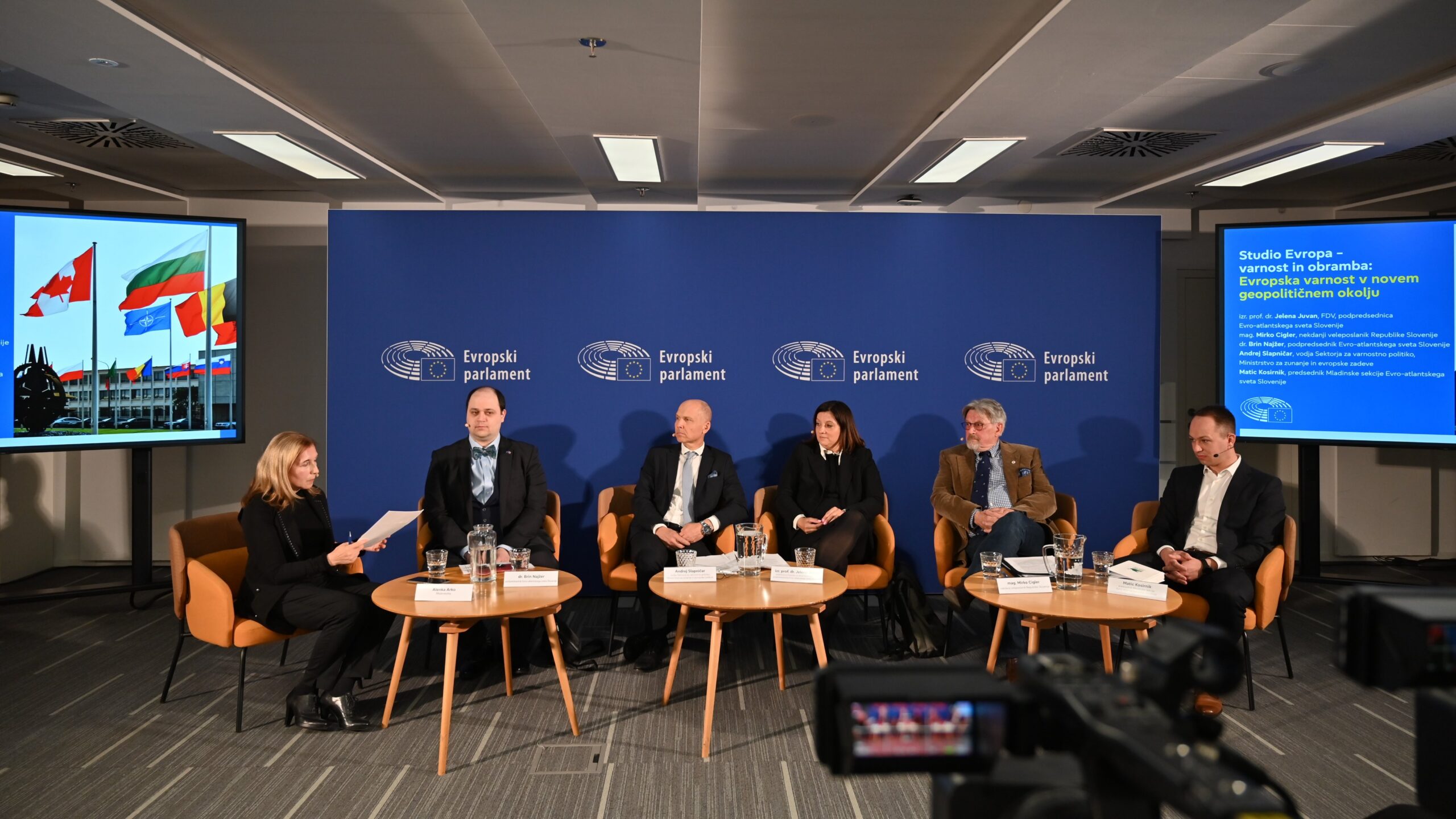
Photo: ljubljana.europarl.europa.eu