
The Western Balkans
The month of August was significantly marked by elections in Serbia, Bosnia and Herzegovina, and Kosovo. In Serbia, by pre-election speculation; in Bosnia and Herzegovina, by preparations for the campaign; and in Kosovo, by the post-election constitution of institutions. At the same time, several developments are unfolding in Kosovo that highlight the failure of the normalisation process between Kosovo and Serbia, while also testing Kosovo’s statehood. In August, the gradual withdrawal of international forces from the bridge in Mitrovica was announced, while in the municipality of Zubin Potok, also in the north, buildings that are mostly owned by Serbs are being demolished. Alongside the consolidation of Kosovo’s statehood, mass graves containing victims of the 1998–1999 war are emerging. The challenge, therefore, is not only to normalise the present, but also to resolve the past. Aleksandar Vučić hosted Volodymyr Zelenskyy and, prior to that, visited Bosnia and Herzegovina, where he met with Milroad Dodik.
1. Elections – Serbia, Bosnia and Herzegovina, Kosovo
In Serbia, the question of holding snap parliamentary elections has been a recurring issue in the public sphere for months. For a long time, the question was whether there would be elections at all, with the President of Serbia, Aleksanda Vučić, initially saying they might be held “before Vidovdan” (which falls in June), but certainly “by the end of the year.” In August, Vučić announced that parliamentary elections would be held in the second half of October, although at the time of writing, they had not yet been formally called.[1] These elections represent the culmination of almost two years of protests led by students, even though elections were not among the initial demands with which students and other citizens took to the streets. Over the course of those two years, however, a change of government emerged as the primary objective. Consequently, these elections are expected to be a turning point – to remove the Serbian Progressive Party (SNS) from sixteen years of power – while everything else can be dealt with afterwards. The significance of these elections therefore lies in the prospect of fundamental social and political change, although there is considerable room for debate as to whether such a change can actually take place. President Vučić represents the public face of the government, led by the SNS and its coalition partners, and has, through his political activities, built a personality cult on the one hand and generated resistance on the other. The President, who is also the public face of the SNS (although he is not the party’s president), spent August visiting communities across Serbia, speaking with residents and even addressing their individual problems.[2] Vučić presents these visits as an expression of concern for all Serbian citizens, while others view them as a classic (unofficial) election campaigning.
The student movement is preparing its own electoral list with which it intends to contest the elections. Meanwhile, other political parties in Serbia are deciding whether to support the student list, whether to run independently, which other parties to join in coalition with, whether they would be prepared to cooperate with any party after the elections, or whether they already have clearly defined partners. The individuals who will appear on the student list were not known during August, and this approach by the students was frequently the subject of public debate. Some believe it was a deliberate and well-considered decision, as it would give their candidates time to avoid being subjected to a media onslaught. The students argue that the parties in power have not clearly presented their candidates.[3] Like the President, the students have also been travelling around Serbia during this period, visiting citizens and working to establish direct contact with them.
On 4 October, Bosnia and Herzegovina will hold regular general elections, in which members of the state Presidency, the President of the Republika Srpska entity, and representatives of legislative bodies at the cantonal, entity and state levels will be elected. These elections do not carry the significance of a turning point like those in neighbouring Serbia. Nevertheless, like any elections, they bring a degree of uncertainty and raise the question of what will change and what will remain the same. Will the parties of the Troika achieve an electoral result that will enable them to remain in power at the state level and at the entity level in the Federation of Bosnia and Herzegovina, and in which cantons will they form governments? In the previous general election, held in 2022, the Troika parties formed governments at the entity and state levels without the most significant and oldest Bosniak party – the Party of Democratic Action (SDA), through cooperation with the Croatian Democratic Union (HDZ) and the Alliance of Independent Social Democrats (SNSD) at the state level.
A change is expected in the Republika Srpska entity, where the SNSD, led by Milorad Dodik, has held power for many years, both in the entity government and in the position of entity president. There, public attention has focused on the behaviour of the opposition, specifically on whether it will contest the elections jointly or in several separate blocs. It is certain that all Serb opposition parties will support a single candidate for entity president – Branko Blanuša of the Serb Democratic Party (SDS) – while they will run on several separate lists for the entity assembly.[4] For the Serb seat in the state Presidency, the opposition will likewise put forward two candidates. Nebojša Vukanović of the List for Justice and Order has joined Marinko Božović, an SDS member and candidate for the Presidency, and will himself run for the position. Vukanović claims that the other opposition parties in Republika Srpska are under the direct control of the SNSD, or of the authorities in Belgrade, and that Marinko Božović’s candidacy is in fact the result of an instruction from Serbia aimed at keeping the opposition in the entity divided. Nebojša Vukanović is otherwise highly critical of all opposition politicians in Republika Srpska, accusing them of blind obedience to Belgrade, of helping to keep Dodik’s SNSD in power, and of accumulating personal wealth as a result.[5] The fact that Blanuša will not face a rival from any of the other Serb opposition parties should be viewed in light of the fact that the position of entity president is an individual office and has been held by the SNSD for 20 years. The primary objective, therefore, is to take this position away from the SNSD, as it is also the public face of the entity, making opposition unity an easier decision in this particular case. The formation of the entity government, however, is an issue on which parties are more inclined to pursue their own interests and, not infrequently, to overcome the sometimes verbally aggressive rivalry between them. The opposition parties in Republika Srpska have not signed an agreement committing them to joint action after the elections, although such an agreement was proposed.[6] The election campaign officially begins on 4 September. These will be the first elections in Bosnia and Herzegovina in which ballot scanners will be used at all polling stations, and voters will be identified biometrically.
In Kosovo, snap parliamentary elections were held on 7 June. At the time of writing, the Assembly had not yet been constituted, nor had a government been formed. The central issue in August was whom the parties would nominate for President of the country and whether they would be able to agree on a single candidate.[7] The reason Kosovo’s citizens went to the polls again in a snap election was precisely that, following the snap elections held in December, the parties had been unable to elect a President. In August, Albin Kurti, leader of the Self-Determination Movement, and Lumir Avdixhiku, leader of the Democratic League of Kosovo, met several times in an effort to agree on a candidate who would be supported by MPs from both parties in the Assembly of Kosovo. They eventually succeeded at the very end of the month, when they announced that their joint candidate would be Bekim Sejdiu, a former Kosovan diplomat and Constitutional Court judge.[8] Before the agreement was reached, the parties had been accusing one another of various attempts ant manipulation. The Self-Determination Movement was accused of seeking full control of government by having its own President, while the other major parties – most of which are predominantly Albanian in terms of their ethnic composition – were accused of wanting to trigger another election. However, the relative winner of the last two electoral cycles in Kosovo has been Kurti’s Self-Determination Movement, meaning that another election in the near future does not appear to be in the logical interest of the other parties.
2. Kosovo: The bridge dividing Mitrovica, demolitions at Gazivode and mass graves
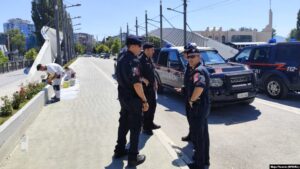
Mitrovica, a city in northern Kosovo, is divided into a southern and a northern part, with a bridge spanning the Ibar River between the two banks that has been guarded by members of international forces and the Kosovo Police since the end of the war in 2000. It is a typical symbol of the division, as the population of North Mitrovica is predominantly Serb, while South Mitrovica is predominantly Albanian. The bridge has been the site of several direct inter-ethnic clashes between Serbs and Albanians, including clashes that resulted in fatalities. Both Albanian and Serb refugees also crossed the bridge. For years, the bridge was closed to pedestrian and motor traffic, but it is now regularly crossed by pedestrians. However, the temporary arrangement that remains in place is the deployment of the international NATO force, KFOR, which guards the bridge. In August, KFOR announced that it would gradually reduce the presence of its troops, as the security situation was assessed to have improved. In that case, responsibility for security would gradually be transferred to the Kosovo Police.[9] Serbs from northern Kosovo and from Serbia believe that the security situation is not favourable to them and oppose the withdrawal of KFOR.[10] They do not trust the Kosovo Police or other institutions, which Kosovo Serbs left in November 2022 following instructions from the Serb List and with support from Belgrade.[11] The concern is not merely about the possibility of renewed clashes. The issue is also the consolidation of Kosovo’s statehood, which would undoubtedly be furthered by the transfer of responsibilities to the Kosovo Police.
At the same time, residential and hospitality facilities, most of which are owned by Serbs, around Lake Gazivode (Zubin Potok municipality) in northern Kosovo are due to be removed. The Kosovo public company “Ibar-Lepenac” claims that the holiday homes, houses and hotels were built on its land. Some of the structures were demolished during the previous period, while 18 August was the deadline by which the owners were expected to vacate the remaining ones. Further demolitions are scheduled to begin in early September. In addition to the fact that some owners claim that their properties were legally constructed, the fact that appeal and evidentiary proceedings were still ongoing during this period is also problematic. From this perspective, the demolitions and the decision requiring the owners to vacate the properties were also criticised by the European Union, which called for these activities to be suspended until the legal issues had been resolved.[12] However, this did not happen. In the context of relations between Serbia and Kosovo, and between Serbs and Albanians, this is interpreted as pressure on Kosovo Serbs. It is also a test for the authorities in Serbia, which are under pressure to meet expectations that the local population should be protected, particularly in light of statements such as “We will not give up Gazivode.”[13]
In the same municipality, the excavation of human remains from a mass grave continued throughout August. The remains are yet to be analysed and the identities of the victims established. The assumption is that they are civilian victims of the 1998–1999 war in Kosovo.[14] Finding people who are still registered as missing from that war, and cooperation between the Kosovo and Serbian authorities in dealing with such cases, are significant components of the normalisation of relations between the two sides. In 2023, Pristina and Belgrade also signed a Declaration on Missing Persons, committing themselves to cooperation.[15] Nevertheless, the discovery of the mass grave and the excavation of the remains provided grounds for further disputes. During the excavation period, one person was arrested in Serbia on suspicion of spying on the institutions of the Republic of Serbia for the benefit of the Albanian intelligence service. However, according to media reports, this was in fact a person who had provided the Kosovo authorities with information about the mass grave in Zubin Potok municipality. Kosovo therefore accused Serbia of having arrested the person precisely because they had disclosed information about the grave.[16] In addition, in August, Serbia arrested two Kosovo citizens on suspicion of having committed war crimes against civilians in Kosovo. The Kosovo authorities are calling on the Republic of Serbia to open archives containing information on missing persons, while the Serbian authorities are calling on Kosovo to begin investigating certain locations believed to contain mass graves of Serb victims.[17]
3. Aleksandar Vučić: host to Volodymyr Zelenskyy and guest of Milorad Dodik
At the beginning of August, Ukrainian President Volodymyr Zelenskyy visited Belgrade at the invitation of Serbian President Aleksandar Vučić.[18] There have been numerous analyses of the foreign-policy significance of the visit, but they are largely predictable and highly logical. Serbia’s well-known policy of balancing, the need for dialogue … in short, a form of diplomacy that does not represent any fundamental or drastic change in Serbia’s foreign policy. Some media commentators immediately described it as routine and of little significance, and for now, with some time having passed, that appears to be the case. The visit was also presented as confirmation of Serbia’s independence and as proof that its balancing policy works. Serbian diplomat Zoran Milivojević highlighted Zelenskyy’s support for Serbia’s territorial integrity, which includes Kosovo, thereby sending a message of consistency to the European Union, given that the EU supports Ukraine’s territorial integrity.[19] Zoran Vuletić believes that the visit should have been marked by solidarity with Ukraine and that it was not given the significance Ukraine currently deserves as a country under aggression. He compared this with a hypothetical visit by Putin to Serbia, wondering what kind of reception would be arranged for him in such a case.[20]
Before receiving Zelenskyy, Vučić visited Bosnia and Herzegovina, but not its state institutions. He travelled to smaller communities with predominantly Serb populations in both of the country’s entities. Rhetorically, the visit was marked by an emphasis on the need for Serb unity, regardless of where Serbs live. Following the approach he uses in Serbia, Vučić also spoke with residents in communities across Bosnia and Herzegovina – in some places as the President of Serbia, and in others simply as Aleksandar Vučić. He recalled his childhood and upbringing in a Bosnian village from which his father originated, presenting his image as an “ordinary man”.[21] This is a familiar feature of President Vučić’s public appearances and represents a continuation of his informal campaigning, which is now even more important given the upcoming elections in Serbia. Serbs in Bosnia and Herzegovina also mostly hold citizenship of the Republic of Serbia, making them part of the electorate in that country. The fact that this visit was aimed primarily at consolidating support among Bosnian Serbs, rather than constituting a visit to the country of Bosnia and Herzegovina, is also demonstrated by the fact that he did not meet with non-Serb politicians at other senior levels of the government. He met with Milorad Dodik, the SNSD party leader, as well as with several politicians from the ruling parties in Republika Srpska. Nevertheless, he did not meet with the Serb opposition parties, which, regardless of their relationship with the SNSD and Dodik, regard Serbia as their homeland and the authorities there as an indispensable partner and protector.
* Views and opinions of the authors of this paper do not necessarily correspond to the views of the Euro-Atlantic Council of Slovenia.
Sources
[1] Danas (20.8.2026). Vučić: Izbori će biti 18. ili 25. oktobra. https://www.danas.rs/vesti/politika/vucic-izbori-ce-biti-18-oktobra/
[2] Radio Slobodna Evropa. (19.8.2026). Vučićeva turneja po Srbiji: Predsednički posao ili stranačka kampanja. https://www.slobodnaevropa.org/a/srbija-vucic-predsednik-kampanja/33833709.html
[3] N1. (2.9.2026). Studenti : Lista spremna mesecima, tehnički i taktički razlozi zašto se sa objavljivanjem čeka. https://www.youtube.com/watch?v=WSiewe-zXSE
[4] BHRT. (22.7.2026). Opozicija u RS podržava Blanušu, ali na izbore za Predsjedništvo BiH ipak ide u dvije kolone. https://www.bhrt.ba/opozicija-u-rs-podr%C5%BEava-blanu%C5%A1u-ali-na-izbore-za-predsjedni%C5%A1tvo-bih-ipak-ide-u-dvije-kolone
[5] N1 BiH. (21.8.2026). Vukanović: Beograd sve kreira, cilj je da poslije izbora naprave vlast sa Dodikom. https://www.youtube.com/watch?v=c6kmxHIPRNE&t=1159s
[6] N1 BiH (24.8.2026). Igor Crnadak: Cvijanović sigurno gubi ako opozicija bude imala jednog kandidata. https://www.youtube.com/watch?v=64rwfSPH2dc&t=753s
[7] Radio Slobodna Evropa. (13.8.2026). Državni lideri Kosova s osporenim legitimitetom. https://www.slobodnaevropa.org/a/kosovo-lideri-vrsioci-duznosti-legitimitet/33829542.html
[8] Radio Slobodna Evropa. (31.8.2026). Vladajuća i vodeća opoziciona partija dogovorili kandidata za predsednika Kosova. https://www.slobodnaevropa.org/a/kosovo-sejdiu-kandidat-predsednik/33844068.html
[9] Radio Slobodna Evropa. (10.8.2026). KFOR počeo ‘postepenu tranziciju’ stalnog prisustva na mostu preko Ibra u Mitrovici. https://www.slobodnaevropa.org/a/kosovo-most-ibar-mitrovica-kfor/33825936.html
[10] Radio Slobodna Evropa. (12.8.2026). KFOR se sastao sa Srpskom listom nakon protivljenja ove stranke smanjenju prisustva na mostu preko Ibra. https://www.slobodnaevropa.org/a/kosovo-kfor-srpska-lista-most-ibar-mitrovica/33827500.html
[11] BBC. (5.11.2022) Srbija i Kosovo: Srbi se povukli iz svih institucija, policajci poskidali uniforme, EU poziva na razum https://www.bbc.com/serbian/lat/srbija-63527308
[12] Radio Slobodna Evropa. (4.9.2026). Kosovo nastavilo rušenje objekata na jezeru Gazivode
https://www.slobodnaevropa.org/a/gazivode-jezero-rusenje-kosovo-/33846908.html
[13] Kancelarija za Kosovo i Metohiju Vlada Republike Srbije. (4.4.2016). Vučić: Gazivode ne damo. https://www.kim.gov.rs/lat/v1319.php
[14] Radio Slobodna Evropa. (3.8.2026). Od hapšenja do iskopavanja: Šta se zna o masovnoj grobnici u Zubinom Potoku?. https://www.slobodnaevropa.org/a/kosovo-zubin-potok-grobnice-hapsenja/33820780.html
[15] DW. (2.5.2023). Srbija i Kosovo usvojili Deklaraciju o nestalim osobama. https://www.dw.com/sr/srbija-i-kosovo-usvojili-deklaraciju-o-nestalim-osobama/a-65496484
[16] Radio Slobodna Evropa. (31.7.2026). U Kraljevu hapšenje zbog ‘špijunaže’, u Prištini kažu zbog davanja informacija o masovnoj grobnici. https://www.slobodnaevropa.org/a/srbija-hapsenje-spijunaza-masovna-grobnica-kosovo/33819300.html
[17] Radio Slobodna Evropa. (3.8.2026). Na Kosovu iskopavanje grobnice, šta bi pokazalo otvaranje arhiva u Srbiji. https://www.slobodnaevropa.org/a/grobnice-kosovo-arhiv-srbija-zubin-potok-/33821012.html
[18] Radio Slobodna Evropa. (8.8.2026). Predsjednik Ukrajine u posjeti Beogradu. https://www.slobodnaevropa.org/a/zelenski-beograd-vucic/33824764.html
[19] Newsmax Balkans. (10.8.2026). Zelenski u Srbiji: Šta je poseta donela Beogradu i kuda ide srpska diplomatija? https://www.youtube.com/watch?v=R29B14Q6Zio&t=1089s
[20] Newsmax Balkans. (12.8.2026). Srbija pred novim izazovima: Izbori, EU uslovi, situacija na KiM. https://www.youtube.com/watch?v=Zg2WryTdHyk&t=2352s
[21] FTV. (3.8.2026). Vučić nastavio posjetu BiH: Na rasporedu rodno mjesto njegovog oca, selo Čipuljić kod Bugojna. https://www.youtube.com/watch?v=IJQKEvCQAUY