

The Middle East: Iran
September’s developments in the Middle East could be described by the title of the 1929 novel All Quiet on the Western Front. The region was marked by unsuccessful attempts to reach an agreement between Iran and the United States of America, alongside continued and escalating hostilities. Houthi attacks and advances, as well as attacks on oil infrastructure, further increased uncertainty in the global oil market amid concerns over shipping and oil supplies, while civilians fled their homes because of the fighting.
1. United States and Iran: Negotiations to End the War
Mohsen Rezaei, head of Iran’s Supreme National Security Council, conveyed Iran’s conditions for ending the war to the United States through Qatari mediators. These include an end to the war on all fronts, the release of frozen assets, and an end to the naval blockade. This time, the conditions did not include a demand for financial compensation for wartime damage, although Iran had demanded it in the past. Tehran also maintains that it is prepared to continue the war if no agreement is reached between the United States and Iran. Rezaei said that a potential Iranian response could target American bases and companies in the Middle East. He also stated that Iran’s military operations plan to focus on American naval capabilities in the Persian Gulf, the Gulf of Oman, and the Arabian Sea. According to Rezaei, Tehran continues to adhere to the religious prohibition on nuclear weapons. He maintained that this doctrine remains unchanged but added that he does not know what will happen in the future. ¹
Speaking at the United Nations General Assembly on 22 September, US President Donald Trump threatened Iran with destruction if it failed to reach an agreement to end the war. He also insisted that Iran must not possess nuclear weapons. Despite these threats, he expressed confidence that an agreement would be reached. ²
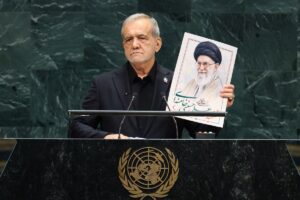
The following day, the Iranian president described the American attacks as cowardly during his address to the United Nations General Assembly. He displayed photographs of the late Supreme Leader Ali Khamenei and more than 150 schoolchildren killed in the first days of the conflict. ³ Despite the talks, on 26 September Trump rejected Iran’s proposal to reopen the Strait of Hormuz and end the hostilities. According to him, Iran wants to reopen the strait because restrictions on shipping are causing it to lose revenue. Trump also claimed that the United States was winning the war. ⁴
2. Houthi Advances in Yemen and Attacks on Saudi Arabia
In September, the Houthis seized Yemen’s entire Red Sea coast, including the port city of Mocha and the strategically important island of Mayun. Houthi forces now have considerable influence over shipping through the vital Bab al-Mandab Strait. According to the International Organization for Migration (IOM), more than 2,000 people fled Yemen for Djibouti, which lies on the African side of the strait, within 24 hours. These people are being provided with food and water in the town of Obock, but the IOM warns that they need additional assistance.
The Bab al-Mandab Strait is highly significant, as approximately 12 percent of global trade, 8 percent of liquefied natural gas shipments, and 11 percent of seaborne oil shipments pass through it. Houthi political bureau member Hazem al-Assad said that ships would be allowed to pass unhindered, but international shipping companies have responded cautiously to recent developments. Despite his assurances, several ships linked to Saudi Arabia were attacked in recent weeks. Some shipping companies had already rerouted their vessels around the Cape of Good Hope, making the journey longer. ⁵
In addition to Mayun, the Houthis also took control of the islands of Zuqar and Hanish. By capturing these strategically important islands, they further strengthened their control over Yemen’s Red Sea coast. According to the German news agency dpa, they could now intensify attacks on shipping as tensions with Saudi Arabia, the main supporter of Yemeni government forces, rise once again. Al Masirah television, which is affiliated with the Houthis, reported that the Saudi military had carried out two attacks on the Houthi-controlled airport in Mocha. ⁶
2.1 Houthi Attacks on Saudi Arabia
After taking control of the previously mentioned ports and islands along the Red Sea coast, the Houthis also intensified their attacks against Saudi Arabia. They claim to have used drones and missiles to attack the capital, Riyadh, and facilities belonging to the oil company Aramco along the Red Sea. Saudi authorities stated that they had intercepted a missile launched towards the capital but did not confirm all the attacks reported by the Houthis. Smoke was observed near fuel storage tanks close to Riyadh’s King Khalid Airport, and flights were temporarily disrupted. The Houthis claim that the attacks are retaliation for Saudi intervention in Yemen, where Saudi Arabia supports government forces. ¹⁰
The Houthis also reportedly targeted the holy Islamic city of Mecca. According to the Saudi-led coalition, air defences intercepted a drone south of Mecca before it entered the restricted airspace above the city. Coalition spokesperson al-Maliki condemned the incident as an attempt to intimidate worshippers. The Houthis denied attacking Mecca and asserted that they do not target holy sites. For the first time since 2017, Saudi Arabia issued a warning in Mecca about a possible Houthi attack. ⁸
In addition to the Houthi attacks, Saudi Arabia was also hit in September by an attack involving drones launched from Iraq, prompting it to shut down a key oil pipeline. Iraq stated that it had dismissed a military commander in the province from which the drones had been launched and opened an investigation. Saudi Arabia had previously accused Iranian-backed militias in Iraq of attacking its oil facilities. The pipeline is approximately 1,200 kilometres long and helped Saudi Arabia bypass the Strait of Hormuz. Riyadh stated that it had shut down the pipeline as a precaution, while satellite images showed scorched ground and smoke near the site of the attack. The pipeline is significant because, according to Reuters, it carries approximately 4 to 5 percent of the global oil supply. ⁷
* Views and opinions of the authors of this paper do not necessarily correspond to the views of the Euro-Atlantic Council of Slovenia.
Sources
1. B. V. “Iran sporoča, da je prek Katarja ZDA prenesel pogoje za končanje vojne.” MMC RTV SLO. (19. 9. 2026). https://www.rtvslo.si/svet/vojna-v-iranu/iran-sporoca-da-je-prek-katarja-zda-prenesel-pogoje-za-koncanje-vojne/794288
2. B. V. in G. V. “Trump v ZN-u zagrozil Iranu z uničenjem in hkrati napovedal možnost dogovora o koncu vojne.” MMC RTV SLO. (22. 9. 2026). https://www.rtvslo.si/svet/s-in-j-amerika/trump-v-zn-u-zagrozil-iranu-z-unicenjem-in-hkrati-napovedal-moznost-dogovora-o-koncu-vojne/794445
3. The Associated Press. “Iran’s President Delivers Defiant UN Speech, and Other Mideast Developments.” Associated Press. (23. 9. 2026). https://apnews.com/article/iran-us-israel-yemen-un-houthis-hormuz-september-23-2026-f92f4e2fcb039365c082f081b73d6915
4. Hunnicutt T., Hafezi P. in AlaaElDin M. “Trump Rejects Iranian Proposal to Open Hormuz and End Fighting.” Reuters, objavljeno na Internazionale. (26. 9. 2026). https://www.internazionale.it/ultime-notizie-reuters/2026/09/26/iran-awaits-us-move-after-wsj-report-says-trump-rejects-peace-plan
5. Mansour M. “Red Sea Nations Watch as Houthis Seize Bab al-Mandeb Strait.” Al Jazeera. (13. 9. 2026). https://www.aljazeera.com/economy/2026/9/13/red-sea-nations-watch-as-houthis-seize-bab-al-mandeb-strait
6. STA in N. V. “Hutijevci prevzeli nadzor nad celotno jemensko obalo ob Rdečem morju.” 24ur.com. (11. 9. 2026). https://www.24ur.com/novice/tujina/hutijevci-prevzeli-nadzor-nad-celotno-jemensko-obalo-ob-rdecem-morju.html
7. BBC News. “Saudi Arabia shuts key oil pipeline after drone attack launched from Iraq.” BBC News. (12. 9. 2026). https://www.bbc.com/news/articles/c62m933465eo
8. Al Jazeera Staff in Reuters. “Saudi-led coalition intercepts Houthi drone headed for Mecca.” Al Jazeera. (16. 9. 2026). https://www.aljazeera.com/news/2026/9/16/saudi-led-coalition-intercepts-drone-headed-for-mecca
9. BBC News. “Houthis say they targeted Saudi capital with ballistic missiles.” BBC News. (19. 9. 2026). https://www.bbc.com/news/articles/cwly5d9v7r43o