
The Western Balkans
In Serbia, Ratko Mladić, a former commander of the Army of Republika Srpska, who was convicted of war crimes by the International Criminal Tribunal for the former Yugoslavia, was buried using state resources and with military honours. The funeral was attended by Serbian politicians from the Bosnian-Herzegovinian entity of Republika Srpska, including candidates for key executive positions in the October general elections. The pre-election campaign in both Serbia and Bosnia and Herzegovina unfolded against the backdrop of expressions of nationalism and the cultivation of the legacy of the war. So far, no sanctions have followed, either against individuals or against the state.
In Montenegro, the initiative to remove the Speaker of Parliament from office failed. Members of the Kosovo Liberation Army were convicted of war crimes by the International Criminal Cours in the Hague. The response from the population and politicians has been protests and attempts to discredit the court. In Serbia, early parliamentary elections have officially been called. The students have submitted a list of 250 candidates for the National Assembly.
1. Former Yugoslavia: elections, nationalism, legacies of war (and) crimes, pragmatism
The start of September was marked across the Balkans by the outrage over the state funeral of Ratko Mladić, who died in prison in the Hague on 27 August while serving a life sentence for genocide and crimes against humanity. The Serbian government sent an aircraft to collect his body, and he was buried in Belgrade on 7 September with military honours, and Serbia’s ministers attended both the funeral and the memorial ceremony.[1][2] The funeral temporarily overcame the rivalry between the authorities and the opposition in the Bosnian-Herzegovinian entity of Republika Srpska, with representatives of both sides appearing at the Belgrade cemetery, including candidates for President of Republika Srpska, candidates for the Serb member in the Presidency of Bosnia and Herzegovina, and the current mayor of Banja Luka, Draško Stanivuković, who is aiming for the position of Prime Minister of Republika Srpska.[3] The funeral coincided with the official pre-election campaign in Bosnia and Herzegovina and with what was, at the time, an unofficial but increasingly certain pre-election campaign in Serbia. Two days after the funeral, Aleksandar Vučić called snap parliamentary elections for 25 October.[4] Aleksandar Vučić did not personally attend the funeral, but he approved and supported it, both through his words and through the state’s resources. On the day of the funeral, he received the President of Uzbekistan, although his meeting with President Mirziyoyev took place the following day.[5] Nevertheless, the visit served as an official and credible excuse. In this way, he satisfied the public while sparing himself the damage to his reputation in the eyes of international observers.
The Albanian population and politicians in Kosovo reject the verdict against four leading figures of the Kosovo Liberation Army (KLA). Hashim Thaçi, Jakup Krasniqi, Kadri Veseli and Rexhep Selimi were sentenced at first instance by the Kosovo Specialist Chambers in The Hague to a total of 81 years in prison for war crimes involving the unlawful detention, cruel treatment, torture and killing of individual civilians whom they accused of espionage, treason, collaboration with the Serbian authorities and similar acts.[6] The decision sparked a number of street protests while Kosovo Albanian politicians, including Prime Minister Albin Kurti, have sought to discredit the court and the verdict, characterising it as unjust.[7][8][9] The Assembly of Kosovo adopted a Declaration stating that the findings of the verdict are unacceptable and calling for the protection of the dignity of the KLA.[10] The Democratic Party of Kosovo submitted a proposal to amend the law governing the court, which would, for example, limit the maximum sentence the court could impose to 15 years.[11] The messages coming from the streets are the same as those expressed among the Serbian population in the case of Mladić: that these men are heroes, not criminals, and that the court based its judgment on speculation rather than facts.
Unlike Mladić’s case, the judgment against the Kosovo Four is not final, and the appeals process is yet to take place. However, regardless of these differences, the dismissive attitude towards legal proceedings and judicial institutions, together with the appropriation and nationalisation of prominent political and military figures, lies at the foundation of all ethno-nationalist politicians who consistently reduce the governance of states to wartime history and make ethno-religious identity the foundation of society.[12]
1.1 Pragmatic Responses and the Question of Sanctions
The reactions have largely been limited to verbal condemnation. Ursula von der Leyen and António Costa stated that they were shocked by the scenes in Belgrade, while the President of the European Commission postponed her visit to both Belgrade and Sarajevo as part of her tour of the Western Balkans.[13] However, the reason for the postponement was the pre-election campaign in both countries, which coincided in timing with the planned visit.[14] Marta Kos did cancel her visit to Serbia explicitly because of the funeral. Nevertheless, this does not constitute a sanction, since neither the Serbian government nor individuals face any direct consequences as a result. When Andrija Mandić (Nova srpska demokratija), President of the Parliament of Montenegro, expressed his condolences to Mladić’s family, the President of Montenegro, Jakov Milatović, said that Mladić was unequivocally a war criminal, that this was not a political position, and that there was no room for relativisation.[15] Members of the Parliament of Montenegro submitted an initiative to remove Mandić from office. Despite receiving the support of 39 members of parliament, the initiative did not pass.[16] The support was withheld by a majority of MPs from the Europe Now Movement, the ruling party in Montenegro, as well as by the opposition pro-Serb Democratic People’s Party of Milan Knežević. The MPs did not attend the session, thereby preventing the quorum required to debate Mandić’s removal. The removal of the Speaker of Parliament would jeopardise Montenegro’s goal of closing all negotiating chapters by the end of the year. With this in mind, Mandić’s removal was unlikely from the outset.
Likewise, an official suspension of Serbia’s accession process is unlikely, although it was reportedly proposed by some member states.[17] The process is already effectively on hold, as Serbia has not opened a single negotiating chapter since December 2021, but this reflects the actions and policies of the Serbian authorities. An official suspension of the process by the European Union would not encourage the current government to reconsider its conduct; instead, it could strengthen Euroscepticism among both citizens and politicians. This could then be turned into a persuasive argument that the European Union does not want Serbia and that turning to other partners is the only sensible approach for the country. However, this apparent leniency towards Serbia can also be explained by a number of other, more pressing issues currently occupying the European Union’s member states. Good-neighbourly relations and regional cooperation are among the key achievements of European initiatives and of the accession process itself. The region is now far from that. Speaking from the podium of the United Nations General Assembly, Vučić said that Croatia was proud of its Nazi past.[18] Following the funeral, Bosnia and Herzegovina’s Minister of Foreign Affairs, Elmedin Konaković, decided to withdraw diplomatic personnel from the embassy in Belgrade.[19] However, the issue subsequently disappeared from the media, so it is not known whether or how the decision was implemented.
1.2 Snap Parliamentary Elections in Serbia and the Prospects for Change
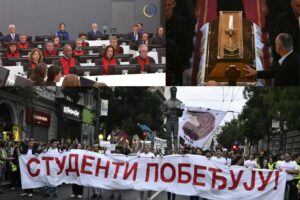
Nationalism appears to be alive and well in the Balkan countries and continues to shape relations among them. A change of government through elections, in any of these countries, is not sufficient to change this state of affairs. Serbia is preparing for elections that could prove to be a turning point, but it is uncertain in what direction the situation will turn. These elections have an experimental character. The students have presented their own electoral list, comprising 250 candidates for the National Assembly, on 14 September.[20] The people on the list are not prominent political figures in Serbia. This is interpreted both as an advantage and as a weakness. Ideologically, they are undefined, while the common point that brings them together is the removal of the Serbian Progressive Party (SNS) from power, or, more precisely, the restoration of the Constitution and the proper purpose of the offices of prime minister and president, the government, as well as the fight against corruption and crime. Consequently, the parties that have backed this list, at the cost of giving up their own parliamentary seats, in order to create a referendum-like atmosphere, come from both the left and the right of the political spectrum and include both parliamentary and non-parliamentary parties. This approach has been used in other countries, always with the aim of changing a long-standing government. What makes the situation in Serbia distinctive is that the list was assembled by students and contains no powerful, influential or well-known individuals. Nevertheless, not all opposition parties have backed this list. The coalition of parliamentary parties European Serbia is running separately, as is the Authentic Right party.[21]Dragan Đilas, president of the Party of Freedom and Justice (SSP), explained that the decision for this coalition to run separately is intended to bring voters to the polls, since a high turnout is crucial. He argued that if the European Serbia Coalition or Authentic Right were to withdraw from the electoral race, their regular voters would stay at home.[22] In total, including the current governing and opposition parties, nine electoral lists have been submitted to the Republic Electoral Commission.
Governments can change relatively quickly; the values of a society cannot. Even if there is a change of government, some of the new governing parties will likely include those that promote nationalist ideas, which almost always go hand in hand with the preservation of the criminal legacy of the wars of the 1990s.
* Views and opinions of the authors of this paper do not necessarily correspond to the views of the Euro-Atlantic Council of Slovenia.
Sources
[1] Radio Slobodna Evropa. (7.9.2026). Uz državne počasti u Beogradu sahranjen ratni zločinac Ratko Mladić. https://www.slobodnaevropa.org/a/ratko-mladic-sahrana-autobusi-banja-luka/33848062.html
[2] Radio Slobodna Evropa. (8.9.2026). Od državnog i crkvenog vrha do ‘Noćnih vukova’: Ko je bio na sahrani Ratka Mladića? https://www.slobodnaevropa.org/a/ratko-mladic-sahrana-beograd/33849473.html
[3] RTVBN.com (7.9.2026). Srbi se opraštaju od generala Ratka Mladića: More ljudi na Topčiderskom groblju, narod i dalje pristiže (VIDEO). https://www.rtvbn.com/4096283/srbi-se-oprastaju-od-generala-ratka-mladica-more-ljudi-na-topciderskom-groblju-narod-i-dalje-pristize-video
[4] Danas. (9.9.2026). Vučić raspisao izbore za 25. oktobar. https://www.danas.rs/vesti/politika/vucic-izbori-25-oktobar-raspisivanje/
[5] Danas. (7.9.2026). Vučić dočekao predsednika Uzbekistana Šavkata Mirzijojeva. https://www.danas.rs/vesti/politika/savkat-mirzijojev-vucic-docek/
[6] Radio Slobodna Evropa. (16.9.2026). Tači i Krasnići osuđeni na po 25 godina zatvora za ratne zločine, Veselji na 18, Seljimi na 13. https://www.slobodnaevropa.org/a/hag-sud-presuda-kosovo-thaci-selimi-veseli-krasniqi-ratni-zlocini-ovk/33857229.html
[7] Radio Slobodna Evropa. (17.9.2026). Deo kompleksa EULEX-a zapaljen tokom protesta zbog osude bivših lidera Oslobodilačke vojske Kosova. https://www.slobodnaevropa.org/a/kosovo-eulex-ovk-presuda/33858023.html
[8] Radio Slobodna Evropa. (21.9.2026). Kurti se sastao s američkim kongresnikom Lawlerom i kritizirao presudu Specijaliziranih vijeća u Haagu. https://www.slobodnaevropa.org/a/kosovo-kurti-kongresmen-lawler-sud-hag-presuda-thaci/33860201.html
[9] Radio Slobodna Evropa. (22.9.2026). Kurti tokom sastanka sa Kallas: Kosovo će biti posvećeno ispravljanju odluke Specijalnog suda. https://www.slobodnaevropa.org/a/kurti-kalas-kosovo-specijalni-sud-sastanak-/33861343.html
[10] Radio Slobodna Evropa. (28.9.2026). Skupština Kosova usvojila deklaraciju povodom presude Specijalnog suda. https://www.slobodnaevropa.org/a/kosovo-skupstina-deklaracija-presuda-ovk/33865742.html
[11] Radio Slobodna Evropa. (21.9.2026). Demokratska partija Kosova predložila zakon za ograničavanje mandata Specijalnog suda. https://www.slobodnaevropa.org/a/demokratska-partija-kosova-pdk-skupstina-sud-haag/33860305.html
[12] Ujedinjene nacije | Međunarodni rezidualni mehanizam za krivične sudove. Mladić (IT-09-92). https://www.icty.org/bcs/case/mladic
[13] Al Jazeera. (8.9.2026). EU condemns Serbia’s ministers for attending funeral of war criminal Mladic. https://www.aljazeera.com/news/2026/9/8/eu-condemns-serbias-ministers-for-attending-funeral-of-war-criminal-mladic
[14] Radio Slobodna Evropa. (18.9.2026). Balkanska turneja Urusle von der Leyen bez Srbije i BiH. https://www.slobodnaevropa.org/a/eu-von-der-leyen-balkan-turneja/33858842.html
[15] Radio Slobodna Evropa. (28.8.2026). Predsednik Crne Gore nakon smrti Ratka Mladića pozvao da se ne relativizuju ratni zločini. https://www.slobodnaevropa.org/a/predsednik-crne-gore-osuda-velicanja-zlocinca/33842425.html
[16] RTCG. (24.9.2026). Bez kvoruma za sjednicu o inicijativi za smjenu Mandića; Živković: Prekidamo saradnju sa Vladom i većinom. https://rtcg.me/vijesti/politika/885832/bez-kvoruma-za-sjednicu-o-inicijativi-za-smjenu-mandica-zivkovic-prekidamo-saradnju-sa-vladom-i-vecinom.html
[17] Velike priče. (21.9.2026). Georeport: Zli duhovi nad Balkanom. https://www.youtube.com/watch?v=OAhkuTVhpew&t=572s
[18] United Nations. (24.9.2026). 🇷🇸 Serbia – President Addresses United Nations General Assembly 81st Session | #UNGA. https://www.youtube.com/watch?v=qLTigVu8VJI
[19] Buka. (7.9.2026). KONAKOVIĆ POVLAČI OSOBLJE AMBASADE BiH IZ BEOGRADA: „Da mogu, odmah bih prekinuo diplomatske odnose sa Srbijom“. https://6yka.com/bih/konakovic-povlaci-osoblje-ambasade-bih-iz-beograda-da-mogu-odmah-bih-prekinuo-diplomatske-odnose-sa-srbijom/
[20] BBC News na srpskom. (14.9.2026). Studenti predali izbornu listu RIK-u: Srdanović prvi, slede Stanić, Bodiroga, Šoškić. https://www.bbc.com/serbian/articles/ce8en6egnn4o/lat
[21] N1. (3.10.2026). Spisak proglašenih izbornih lista. https://n1info.rs/vesti/spisak-proglasenih-izbornih-lista/
[22] Stranka slobode i pravde. (20.9.2026). Dragan Đilas – Probudi se. https://www.youtube.com/watch?v=VlF7N0U_ZZ4