

The Middle East
Developments in the Middle East in August were marked by renewed clashes between the United States and Iran, unsuccessful negotiations between Israel and Lebanon as well as new regional security agreements. The United States expanded its sanctions against Iran and, at the end of the month, struck Iranian rocket-launching systems in the Strait of Hormuz following a month-long pause. Iran responded by launching missiles at US bases in Jordan. Iran and Oman agreed on a temporary shipping corridor, but Tehran continued to make the full reopening of the strait conditional on the lifting of the blockade and sanctions, the release of frozen Iranian assets, and the payment of war reparations. Negotiations between Lebanon and Israel also ended without progress, while attacks on southern Lebanon continued. Pakistan, Saudi Arabia and Turkey concluded a mutual defence agreement providing for collective defence, military exercises and cooperation in the development of defence technologies. In Syria, the Syrian Democratic Forces disbanded after losing most of the territory under their control and were integrated into the state army.
1. US–Iran Conflict
The United States further intensified its economic pressure on Iran in August. The Treasury Department added nearly 60 Iran-linked individuals, companies and vessels to its sanctions list, including several entities based in China.¹ On the same day, the Office of Foreign Assets Control expanded the sanctions framework to cover aviation, shipping, technology, the gold market and digital assets. This also exposed foreign companies doing business with Iran in these sectors to potential sanctions.²
At the end of August, US forces struck Iranian rocket-launching systems in the Strait of Hormuz following a month-long pause. Iranian media reported explosions near Larak Island. According to US Central Command, members of Iran’s Islamic Revolutionary Guard Corps were preparing to launch rockets carrying sea mines into the strait. The Guard confirmed the attack and stated that several of its members and other Iranian citizens had been killed or wounded. Iran later announced that it had launched ballistic missiles at US bases in Jordan, while the Jordanian military stated that it had intercepted eight missiles.³
1.1 Negotiations on the Strait of Hormuz
On 9 August, Iran presented six conditions for the full reopening of the Strait of Hormuz. Mohammad Bagher Zolghadr, Secretary of Iran’s Supreme National Security Council, demanded an end to US threats and insults to Iran’s national and religious values, a permanent end to attacks against Iran and its allies in Lebanon, Palestine, Yemen and Iraq, the lifting of the US naval blockade, and the withdrawal of US naval and air forces from the area surrounding Iran. The remaining demands included compensation for damage caused during two wars, the lifting of sanctions, and the unconditional release of frozen Iranian assets. Iran’s Islamic Revolutionary Guard Corps emphasised that reopening the strait depended on whether the United States accepted these conditions and that the issue was separate from negotiations between Iran and Oman.⁴
Following a meeting between their foreign ministers on 25 August, Iran and Oman presented a framework for the phased management of shipping through the strait. In a joint statement, they proposed establishing a temporary shipping corridor and cooperating in mine-clearance operations. According to Iranian Deputy Foreign Minister Kazem Gharibabadi, ships entering the Persian Gulf would sail through Iranian waters, while the outbound route would pass partly through Iranian and partly through Omani territorial waters. Technical negotiations on a permanent corridor and the future management of the strait were expected to continue for another 30 to 60 days.⁵ The proposed arrangement would exclude military vessels from passage.⁶ The agreement therefore did not remove the broader political conditions previously imposed by Iran.
2. Negotiations between Israel and Lebanon
Lebanon and Israel began the seventh round of direct negotiations under US mediation in Rome on 4 August. The three-day talks focused on establishing new pilot zones in southern Lebanon, from which Israeli forces would gradually withdraw and the Lebanese army would assume responsibility for security. A framework agreement concluded on 26 June linked the phased Israeli withdrawal to the disarmament of Hezbollah and other non-state armed groups. The Lebanese delegation proposed Bint Jbeil or Khiam as a possible area for the next phase. Hezbollah did not participate in the negotiations. Its Secretary-General, Naim Qassem, rejected direct talks with Israel, stating that they would bring Lebanon only shame, humiliation and further concessions.7
The negotiations ended on 6 August without progress on expanding the pilot zones. The central disagreement concerned the sequence of Israel’s withdrawal and Hezbollah’s disarmament: Lebanon demanded a complete Israeli withdrawal, while Israel and the United States insisted on the removal of Hezbollah’s military infrastructure. Israel intensified its attacks on southern Lebanon on 5 August. According to the United Nations Interim Force in Lebanon, more than 113 projectiles were fired, the highest number recorded since late June. The next round of negotiations was scheduled for early September.8
3. Defence Agreement between Pakistan, Saudi Arabia and Turkey
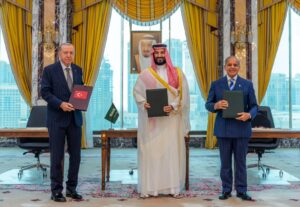
The leaders of Pakistan, Saudi Arabia and Turkey signed a mutual defence agreement in Mecca on 7 August, under which an attack on any one of the three countries would be treated as an attack on all of them. The agreement was concluded amid heightened regional uncertainty caused by the war with Iran, while Saudi Arabia was seeking additional defence partnerships following attacks on its infrastructure. The signatories emphasised that the agreement was not directed against any third country and did not replace their existing alliances. The Saudi government also rejected interpretations that it represented the formation of a military or religious bloc or an agreement to extend Pakistan’s nuclear deterrent.9
On 13 August, the Turkish Ministry of Defence presented the first details concerning the agreement’s implementation. Coordination was expected to take place at the level of foreign and defence ministers and military leaderships. Cooperation would include joint land, naval and air exercises, air defence, unmanned systems, and the joint development and production of defence technologies. Autonomous systems, electronic warfare and artificial intelligence were identified as priority areas.10
4. Developments in Syria
On 18 August, Israel carried out eight air strikes targeting the runway and storage facilities at the Abu al-Duhur airbase in north-western Syria. No casualties were reported. It was reportedly the first Israeli attack on Syrian government facilities since March.11 The Israeli Prime Minister’s Office justified the strike by claiming that Damascus intended to allow Turkey to deploy troops at the airbase. Turkish authorities rejected the Israeli claim, while Turkey’s Foreign Ministry condemned the attack as a violation of Syrian sovereignty. US Special Envoy for Syria Tom Barrack described the strikes as an unnecessary escalation that did not contribute to regional stability.12
Syrian Democratic Forces (SDF) commander Mazloum Abdi announced the organisation’s dissolution in Damascus on 25 August and stated that the integration of its members into the Syrian army had been completed. The SDF, which had been the United States’ principal local partner in the fight against the Islamic State since 2015, controlled approximately one-quarter of Syrian territory at the height of its influence. Following the new Syrian authorities’ January offensive, the SDF lost most of the territory under its control and reached an agreement with Damascus on integrating its military and civilian structures into state institutions.13 The dissolution ended the organisation’s independent military operations, although not all details of the integration had been resolved. During the transitional period, former SDF units retained parts of their command structure within the newly established brigades, while their long-term status remained subject to negotiations. On 28 August, the Syrian authorities also announced Abdi’s appointment as a presidential adviser. His responsibilities were not specified in detail. The appointment therefore secured the former SDF leadership a place within the presidential administration, although not necessarily significant influence over decision-making.14
* Views and opinions of the authors of this paper do not necessarily correspond to the views of the Euro-Atlantic Council of Slovenia.
Sources
[1] U.S. Department of the Treasury. (24. august 2026). “Treasury Launches Unprecedented Campaign Against Iranian Regime on Economic D-Day”. U.S. Department of the Treasury. https://home.treasury.gov/news/press-releases/sb0613
[2] Office of Foreign Assets Control. (24. august 2026). “Determination Pursuant to Section 1(a)(i) of Executive Order 13902: Aviation, Digital Asset, Gold, Shipping, and Technology Sectors of the Iranian Economy”. U.S. Department of the Treasury. https://ofac.treasury.gov/media/936781/download?inline=
[3] Toropin, K., Anna, C. in Finley, B. (30. august 2026). “US strikes Iranian rocket launchers on the Strait of Hormuz in first military action in weeks”. Associated Press. https://apnews.com/article/6b098da673ac3161a266ee459d5eff44
[4] Al Jazeera Staff, Reuters in Associated Press. (9. august 2026). “Iran issues new demands as Pezeshkian seeks deal”. Al Jazeera. https://www.aljazeera.com/news/2026/8/9/iran-issues-new-demands-as-pezeshkian-seeks-deal
[5] Associated Press. (25. august 2026). “Iran and Oman hold talks on managing the Strait of Hormuz and other news from around the Middle East”. Associated Press. https://apnews.com/article/middle-east-iran-israel-hormuz-pakistan-august-25-2026-1a4fa2e3812c458a25a561b38dc89f09
[6] Associated Press. (26. august 2026). “Iran warns of military ship ban in Hormuz under potential deal with Oman, and other Middle East news”. Associated Press. https://apnews.com/article/middle-east-iran-israel-west-bank-august-26-2026-cb19bc3f0b467db591edbef52d0db273
[7] Shankar, P. (4. august 2026). “Seventh round of Israel-Lebanon talks begins – what’s on the agenda?” Al Jazeera. https://www.aljazeera.com/news/2026/8/4/seventh-round-of-israel-lebanon-talks-begins-whats-on-the-agenda
[8] Hülsemann, L. (6. august 2026). “Israel-Lebanon talks end without progress in expanding pilot zones”. NOW Lebanon. https://nowlebanon.com/israel-lebanon-talks-end-without-progress-in-expanding-pilot-zones/
[9] Fraser, S. in Ahmed, M. (7. august 2026). “Saudi Arabia, Turkey and Pakistan have signed a key defense agreement”. Associated Press. https://apnews.com/article/saudi-arabia-turkey-pakistan-defense-agreement-58048d4a100befd4d2c18e0cbae58b7c
[10] The National. (13. august 2026). “Turkey, Saudi Arabia and Pakistan to establish political and military mechanisms under defence pact”. The National. https://www.thenationalnews.com/news/gulf/2026/08/13/turkey-saudi-arabia-and-pakistan-to-establish-political-and-military-mechanisms-under-defence-pact/
[11] Al Jazeera Staff, AP in Reuters. (18. august 2026). “Israel attacks airbase in Syria’s Idlib as US, Turkiye slam ‘escalation’”. Al Jazeera. https://www.aljazeera.com/news/2026/8/18/eight-air-strikes-hit-airbase-in-syrias-idlib
[12] Kassabali, S. (18. august 2026). “Israel strikes an air base in northwest Syria to prevent Turkish troops from deploying”. Associated Press. https://apnews.com/article/syria-israel-turkey-airstrikes-idlib-3a0e758c87ded0f26ed71b4a92db6816
[13] Alsayed, G. in Sewell, A. (25. august 2026). “Kurdish-led Syrian Democratic Forces group says it has dissolved after merging with the Syrian army”. Associated Press. https://apnews.com/article/syrian-democratic-forces-dissolution-mazloum-abdi-1b7d210c96d2c608007b0411db25f453
[14] Utucu, S. B. in Hasan, A. (28. august 2026). “Syria’s al-Sharaa appoints SDF commander as adviser after Kurdish force dissolves”. Euronews. https://www.euronews.com/2026/08/28/syrias-al-sharaa-appoints-sdf-commander-as-adviser-after-kurdish-force-dissolves